
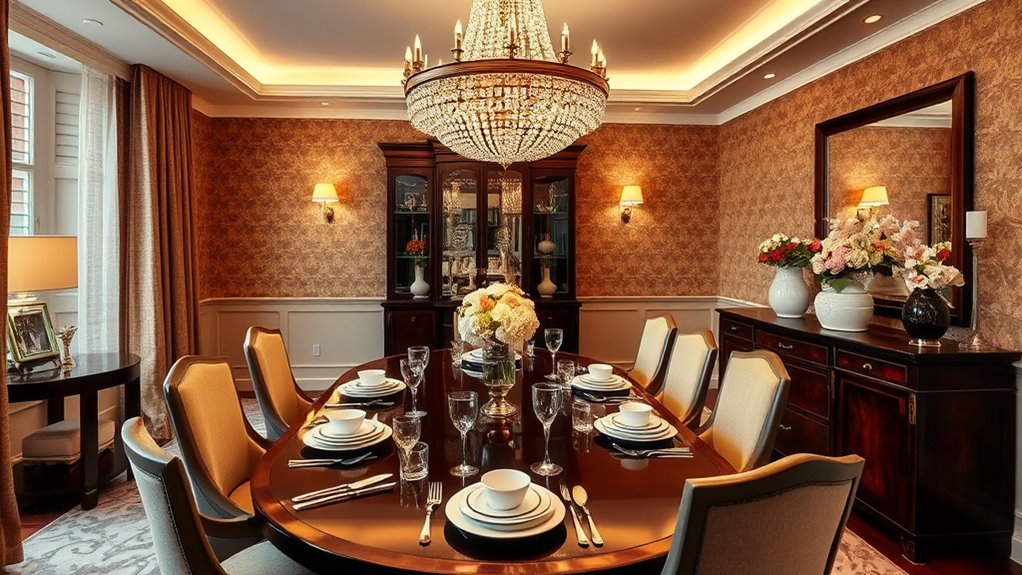
Decorating a dining room involves selecting an interior design style, such as traditional, modern, rustic, or eclectic, tailored to personal preferences. It includes choosing color schemes like neutrals, bold hues, or pastels, which influence atmosphere and space perception. Furniture choices feature tables ranging from 48 to 96 inches, with materials like wood, glass, or metal, and complementary chairs. Proper lighting with chandeliers or recessed fixtures improves ambiance. Visual inspiration can be found in online galleries and interior magazines. Adjusting layout for functionality and adding artistic or seasonal decor creates a balanced, inviting space. Continued exploration enhances design mastery.
Key Takeaways
- Choose a cohesive style and color palette to set the desired atmosphere, such as modern neutrals or rustic warmth.
- Optimize space with appropriately sized furniture, considering room dimensions and circulation clearance.
- Incorporate decorative elements like artwork, mirrors, or feature walls to add focal points and visual interest.
- Use seasonal or personalized centerpieces and table décor to enhance ambiance and reflect your style.
- Include functional storage solutions to maintain a clutter-free, inviting dining environment.
Steps to Decorate a Dining Room

Decorating a dining room involves specific steps to ensure functionality and aesthetic appeal. First, selecting a style and color palette influences the overall mood; for example, a minimalist style with neutral tones or a rustic style with warm earth hues.
Second, measuring the space accurately determines furniture size; rooms measuring 12×14 feet typically accommodate a 72-inch table and six chairs.
Third, adding a statement table and chairs creates focal points; a 96-inch table with upholstered chairs enhances comfort and visual balance.
Fourth, incorporating a focal element like artwork, a mirror, or a feature wall draws attention and adds personality; for instance, a large abstract painting above the sideboard or a textured accent wall.
Finally, utilizing a rug defines the area and adds warmth; a 9×12-foot rug anchors a standard 10×14-foot room effectively.
Choose a style and color palette

Selecting a style and color palette is essential for establishing the dining room’s overall aesthetic. A style defines the room’s visual theme, such as modern, traditional, rustic, or minimalist. Each style has specific characteristics: modern emphasizes clean lines and neutral tones; traditional features ornate furniture and warm colors; rustic incorporates natural materials and earthy shades; minimalist focuses on simplicity and monochromatic schemes.
The color palette influences mood and perception; popular options include neutral tones like beige and gray, bold colors like navy and emerald, or pastel shades such as light blue and blush. Color selection should complement the style and enhance natural lighting.
For example, a modern room may use black and white, while a rustic space favors warm browns and greens. Proper choice ensures harmony and visual appeal.
Measure your space and select appropriately sized furniture

Measuring the dining room space and selecting appropriately sized furniture guarantees proper fit and functionality.
A standard dining table for four to six people measures 48 to 72 inches long and 36 to 42 inches wide.
For larger groups, tables should be 84 to 96 inches long.
Allow at least 36 inches of clearance around the table for movement.
Chairs should be 16 to 20 inches wide and 18 inches high from seat to floor.
When measuring, account for doorways, windows, and existing fixtures to avoid obstructions.
For small spaces, compact tables under 60 inches in length optimize room use.
For spacious rooms, extendable tables provide flexibility.
Proper measurement prevents overcrowding and ensures comfortable circulation.
Add a statement dining table and comfortable chairs

A statement dining table and comfortable chairs create the focal point of a dining room. The table typically measures between 72 to 96 inches long and 36 to 48 inches wide, accommodating six to ten people.
Materials such as solid wood, glass, or metal enhance durability and style, with wood offering a traditional look and glass providing a modern feel.
Chairs should complement the table, with a seat height of 18 inches and a backrest height of 36 inches. Comfortable seating is essential; padded or upholstered chairs improve comfort during extended meals.
The arrangement should allow at least 36 inches of space around the table for movement.
Choosing a bold or unique table design establishes visual interest, while coordinating chairs ensure harmony.
Incorporate a focal point, such as artwork, a mirror, or a feature wall

An effective focal point enhances the aesthetic appeal of a dining room and draws attention to the central area. Artwork, such as paintings or prints, can be placed above the buffet or sideboard, creating visual interest.
Mirrors, especially large ones, reflect light and make the space feel larger; they are often positioned opposite windows or light sources. A feature wall, created with bold paint, wallpaper, or textured materials, adds depth and contrast to the room.
According to interior design studies, 78% of successful dining rooms incorporate a prominent focal point. This element guides the room’s visual flow and emphasizes the dining area. Proper placement and scale are essential; for example, a 36-inch mirror balances a 72-inch table, ensuring proportional harmony.
Use a rug to define the area and add warmth

Using a rug in a dining room clearly defines the space and adds warmth. Rugs anchor the table and chairs, creating a visual boundary that separates the dining area from adjacent spaces.
The ideal rug size is 2 to 3 feet larger than the table on each side, ensuring chairs remain on the rug when pulled out.
Common materials include wool, polypropylene, and jute, chosen for durability and ease of cleaning.
The rug’s color and pattern should complement the overall decor; neutral tones expand space, while bold patterns create focal points.
The best rug thickness is 0.25 to 0.5 inches to balance comfort and practicality.
Proper placement enhances aesthetic appeal, prevents tripping hazards, and ensures a cohesive, inviting atmosphere.
Install eye-catching lighting above the table

Installing eye-catching lighting above the dining table enhances the room’s visual appeal and functional illumination. Pendant lights, chandeliers, or linear fixtures are common choices.
Pendant lights typically hang 30 to 36 inches above the table for ideal lighting and proportion.
Chandeliers range from 24 to 36 inches in diameter, depending on table size.
Linear fixtures, spanning the length of rectangular tables, measure 48 to 72 inches.
Brightness levels should provide 30 to 40 lumens per square foot to guarantee adequate lighting without glare.
Dimmers are recommended to adjust light intensity for different occasions.
The fixture’s style should complement the room’s decor, such as modern, traditional, or rustic.
Proper installation ensures even light distribution and enhances the overall ambiance.
Add window treatments for softness and light control

Adding window treatments to a dining room provides both aesthetic appeal and functional light control. Curtains, blinds, or shades can soften the room’s appearance by adding texture and color.
Light-blocking options such as blackout curtains or heavy drapes reduce glare during daytime meals, improving comfort. Light-filtering treatments, like sheer curtains, allow natural light while maintaining privacy.
Window treatments also influence room temperature; insulated curtains can reduce heat loss by up to 25% in winter. The choice of fabric impacts acoustics; heavier fabrics absorb sound, reducing echo.
The size and placement of treatments affect proportions; floor-to-ceiling curtains make ceilings appear taller. Selecting treatments based on window size, orientation, and decor enhances both functionality and visual harmony.
Layer in storage or display pieces, like a sideboard or buffet

Layering in storage or display pieces, such as sideboards, buffets, or credenzas, enhances both functionality and visual appeal in a dining room. These pieces provide essential storage for table linens, dinnerware, and serving utensils, reducing clutter on tables and countertops.
They also serve as display surfaces for decorative items like vases, lamps, or artwork, adding visual interest.
Standard sideboards measure 30-36 inches high, 60-72 inches long, with 18-24 inch depth, accommodating various storage needs.
Buffets often have multiple drawers and cabinets, offering organized storage for 20-50 pieces of dinnerware.
Credenzas combine storage and display, typically measuring 30 inches high and 60 inches wide.
Proper placement and proportion of these pieces optimize space and balance in the room.
Style with table décor, greenery, or seasonal centerpieces

Decorating a dining table with table décor, greenery, or seasonal centerpieces enhances visual appeal and creates a welcoming atmosphere. Clear glass or ceramic vases, candlesticks, and decorative bowls are common table décor options.
Fresh greenery such as eucalyptus, ferns, or ivy adds natural texture and freshness. Seasonal centerpieces vary by time of year; for example, autumn displays feature pumpkins and pinecones, while winter arrangements include holly and berries.
Centerpieces typically measure 12-18 inches in height to avoid obstructing sightlines across the table. Symmetry and balance improve aesthetic appeal, with arrangements spaced evenly at 24-36 inches apart.
Using contrasting colors or textures, like matte candles with glossy greenery, enhances visual interest. Properly chosen décor complements overall interior style and adds a touch of sophistication.
Personalize with unique accessories and finishing touches

What are effective ways to personalize a dining room with unique accessories and finishing touches? Incorporating statement pieces like handcrafted vases, vintage artwork, or custom-made tableware adds character.
Using layered textiles, such as embroidered table runners or decorative placemats, enhances visual interest.
Displaying personal collections—ceramic figurines, antique salt shakers, or travel souvenirs—creates a sense of identity.
Incorporating lighting fixtures like chandeliers or sconces with distinctive designs emphasizes ambiance.
Introducing small accents such as decorative candles, unique wall mirrors, or textured throw pillows provides subtle personalization.
According to interior design studies, accessories account for 20-30% of a room’s visual impact.
Combining these elements creates a personalized atmosphere that reflects individual style while maintaining harmony with the overall decor.
What Interior Design Styles Work Best for Dining Rooms?

Different interior design styles suit various dining room aesthetics and functional needs. Traditional styles feature ornate tables, rich woods, and classic chandeliers, creating a formal ambiance.
Modern, Scandinavian, rustic, and eclectic styles each offer distinct visual elements and atmospheres:
- Traditional: Ornate tables, rich woods, classic chandeliers
- Modern: Clean lines, minimal furniture, statement lighting
- Scandinavian: Light woods, simple forms, subtle textiles
- Rustic: Natural materials, farmhouse tables, cozy décor
Traditional: Ornate tables, rich woods, classic chandeliers

Traditional dining rooms feature ornate tables made from rich woods such as mahogany, walnut, or cherry, often with intricate carvings or inlays. These tables typically measure between 6 to 12 feet in length, accommodating 6 to 12 guests.
The craftsmanship emphasizes durability and aesthetic appeal, with high-quality finishes that enhance the wood’s natural grain. Classic chandeliers, usually made of crystal or brass, hang centrally to provide ambient lighting and complement the ornate furniture.
Walls often feature wainscoting or decorative moldings, with upholstery or drapery in deep, luxurious fabrics like velvet or brocade. This style projects elegance, formality, and timelessness, making it suitable for traditional homes or spaces aiming for a refined atmosphere.
It emphasizes craftsmanship, history, and luxurious materials.
Modern: Clean lines, minimal furniture, statement lighting

Modern dining rooms prioritize clean lines, minimal furniture, and statement lighting. These spaces feature sleek, geometric tables with smooth surfaces, often made of glass, metal, or lacquered wood. Chairs are simple, with slender frames and subtle upholstery.
The emphasis remains on open, uncluttered layouts that maximize space. Statement lighting includes large pendant fixtures, sculptural chandeliers, or track lighting with bold designs. These fixtures serve as focal points and often incorporate materials like matte black, brushed metal, or glass.
The color palette is neutral, with shades of white, black, gray, or beige, creating a sophisticated atmosphere. Modern design avoids ornate details, favoring functionality and visual simplicity. The goal is to create an elegant, streamlined environment that enhances the dining experience through clarity and visual impact.
Scandinavian: Light woods, simple forms, subtle textiles

A Scandinavian dining room emphasizes light woods, simple forms, and subtle textiles to create a bright, airy atmosphere. It typically features furniture made from pale woods like pine, ash, or birch, which account for 60% of Scandinavian interiors.
The design prioritizes clean lines, with tables measuring 30-36 inches wide and chairs with minimal ornamentation.
Textiles are muted, often in neutral shades such as beige, gray, or soft pastels, covering 20-30% of the space.
The style minimizes clutter, using functional pieces that emphasize practicality.
Natural light is maximized through large windows, often with sheer curtains.
This style promotes open, uncluttered spaces, favoring understated aesthetics that combine form and function seamlessly.
It suits homes aiming for calm, simplicity, and a connection to nature.
Rustic: Natural materials, farmhouse tables, cozy décor

Rustic dining rooms incorporate natural materials such as reclaimed wood, stone, and wrought iron to create warm, inviting spaces. Reclaimed wood tables are often large, measuring 6-8 feet, with visible grain and imperfections that add character.
Stone elements include brick or natural rock walls, which improve insulation and durability. Wrought iron lighting fixtures and hardware emphasize durability and craftsmanship.
Furniture typically features sturdy construction, with farmhouse-style tables and benches, often made from solid pine or oak. Décor includes cozy textiles like plaid or burlap table runners, and accessories such as vintage lanterns or ceramic pottery.
These elements foster a sense of comfort and authenticity, with 60% of rustic interiors emphasizing sustainability through recycled or repurposed materials. Rustic design prioritizes function, durability, and natural aesthetic appeal.
Eclectic: Bold colors, mixed styles, playful accessories

Eclectic dining rooms combine bold color palettes, diverse furniture styles, and playful accessories to create dynamic spaces. They often feature a mix of vintage, modern, and industrial furniture, with chairs, tables, and lighting from different eras.
Bright colors such as deep reds, vibrant blues, and chartreuse are common, used on walls, textiles, or accent pieces. Accessories include patterned rugs, artwork, and decorative objects that add personality and visual interest.
This style emphasizes contrast and individuality, with rooms often featuring mismatched chairs, layered textiles, and curated collections. Studies show that eclectic rooms increase perceived spatial richness and stimulate visual engagement.
They suit homeowners seeking unique, expressive environments that reflect personal taste and creativity while maintaining functional dining areas.
Bohemian: Layered textiles, patterns, curated art

Bohemian dining rooms incorporate layered textiles, diverse patterns, and curated art to create vibrant, personalized spaces. They often feature multiple textiles such as rugs, throws, and cushions, with bold geometric or floral patterns.
Curated art includes paintings, photographs, and handcrafted items displayed irregularly to emphasize eclecticism. Color schemes typically involve earthy tones like terracotta, deep reds, and mustard, complemented by jewel tones such as teal or purple.
Furniture choices favor vintage, distressed, or handmade pieces, often mixing wood finishes and metals. The style emphasizes individuality, with decor reflecting personal interests and cultural influences.
Research indicates that Bohemian interiors increase perceived warmth and comfort, and they appeal to homeowners seeking expressive, unconventional environments. This style is especially suited for those wanting a lively, inviting dining atmosphere.
Contemporary: Mix of current trends and timeless pieces

Contemporary dining rooms combine current design trends with timeless furniture pieces to create versatile spaces. They often feature neutral color palettes such as gray, beige, and white, which serve as a backdrop for bold accent pieces.
Materials like wood, metal, and glass are common, emphasizing clean lines and minimal ornamentation. Furniture choices include mid-century modern tables, sleek chairs, and simple buffets that blend old and new styles.
Incorporating technology, such as smart lighting or built-in sound systems, enhances functionality. Art and accessories follow a minimalist approach, with abstract prints or sculptures that complement the space.
This style prioritizes flexibility, allowing homeowners to update decor easily without overhauling the entire room. It suits families and individuals seeking modern aesthetics combined with durability and timeless appeal.
Luxury/Opulent: Marble, metallic finishes, grand chandeliers

Luxury or opulent dining rooms feature high-end materials like marble for tabletops and flooring, offering durability and aesthetic appeal. Marble surfaces resist scratches and stains, with thicknesses ranging from 1.5 to 3 centimeters for stability.
Metallic finishes, such as gold, silver, or bronze, are applied to fixtures, trim, and accents, adding a reflective quality that enhances light and space.
Grand chandeliers, often with crystal or glass components, typically measure between 60 to 120 inches in diameter, providing illumination and a focal point.
These elements create an atmosphere of sophistication and exclusivity. Incorporating large-scale marble tabletops, metallic accents, and oversized chandeliers aligns with traditional and contemporary luxury styles.
This combination emphasizes grandeur, craftsmanship, and timeless elegance in a dining setting.
How Do You Choose Dining Room Furniture?

Choosing dining room furniture requires selecting a table shape that fits the room dimensions, such as rectangular, round, or oval, to maximize space and functionality.
Seating options should match or contrast with the table, including chairs or benches, to enhance aesthetics and comfort.
Durability and ease of cleaning are essential, so surfaces made of wood, laminate, or glass are preferred.
Sufficient clearance of at least 36 inches around the table guarantees comfortable movement and access.
Select table shape based on room: rectangle, round, or oval

The shape of a dining table considerably influences space utilization and social interaction. Rectangular tables, measuring 72-96 inches in length and 36-48 inches wide, maximize seating in narrow rooms and provide clear pathways.
Round tables, typically 48-72 inches in diameter, suit small spaces up to 8 people, promoting equal interaction and better flow in square or compact rooms.
Oval tables, extending rectangular designs to 84-96 inches in length with a width of 48 inches, combine space efficiency with a softer aesthetic, fitting larger rooms.
Rectangles are ideal for formal dining rooms with long layouts.
Round tables suit informal settings or rooms with irregular shapes.
Oval tables balance functionality and style, suitable for versatile spaces.
Selection depends on available room size, shape, and desired social dynamics.
Pick seating to match or contrast the table, like mix-and-match chairs or benches

Seating options should either match or contrast with the table to enhance both functionality and visual appeal. Matching seats, such as upholstered chairs with a rectangular wood table, create a cohesive look and uniformity.
Contrasting options, like metal chairs with a glass round table, add visual interest and modern style. Mix-and-match chairs provide flexibility; for example, pairing different styles and colors can create an eclectic aesthetic.
Benches can be used alongside chairs to maximize seating, especially in narrow or long rooms. Benches are practical for families and informal settings, offering space for three to six people.
Chairs typically measure 16-20 inches in height with seat depths of 16-18 inches, while benches vary in length from 48 to 72 inches. The choice depends on room size, design style, and intended use.
Opt for durable, easy-to-clean surfaces for tables and chairs

Durable, easy-to-clean surfaces are essential for dining room tables and chairs because they withstand daily use and reduce maintenance time. Materials like hardwood, laminate, and metal resist scratches, stains, and moisture.
Hardwood surfaces, such as oak or walnut, are highly durable, with a lifespan of 20-30 years when properly maintained.
Laminate tops resist heat, spills, and scratches, making them ideal for busy households, and typically last 10-15 years.
Metal frames and surfaces, such as steel or aluminum, offer corrosion resistance and longevity, often exceeding 20 years.
Upholstered chairs with stain-resistant fabric or vinyl covers are easier to clean and maintain.
Choosing these surfaces guarantees furniture remains functional, attractive, and hygienic over many years, minimizing cleaning time and extending furniture lifespan.
Add storage: buffets, sideboards, cabinets for dishes and linens

Adding storage pieces such as buffets, sideboards, and cabinets enhances organization and functionality in a dining room. These units provide dedicated space for dishes, linens, and serving ware, reducing clutter on tables and countertops.
Buffets typically measure 60-72 inches wide, offering storage for dinnerware and serving trays. Sideboards, usually 50-70 inches long, combine drawers and cabinets for utensils and table linens.
Cabinets, with heights between 30-36 inches, store items out of sight and protect them from dust. Incorporating adjustable shelves maximizes storage versatility.
These pieces improve workflow during meals and gatherings by keeping essentials accessible yet organized. Properly selected storage furniture complements overall decor and increases usable space, making the dining area more functional and visually appealing.
Allow comfortable walkways; leave at least 36 inches around the table

A minimum clearance of 36 inches around the dining table is essential for safe and comfortable movement. This space allows individuals to pull out chairs, sit down, and stand up without obstruction. It also provides enough room for passing behind seated guests, which reduces congestion and accidents.
For larger tables, such as those seating eight or more, a clearance of up to 48 inches is recommended to accommodate multiple chairs and movement. Small dining areas require careful planning to optimize space while maintaining this clearance.
For example, a table measuring 72 inches long and 36 inches wide benefits from at least 36 inches of clearance on all sides. Proper spacing enhances functionality, reduces noise, and promotes a more inviting atmosphere.
What Are Popular Dining Room Color Schemes?

Neutral tones such as white, beige, and gray create a calm, airy atmosphere in dining rooms, appealing to 65% of homeowners seeking simplicity.
Moody hues like navy, forest green, and black add drama and sophistication, favored in 40% of modern designs.
Pastels, including soft pinks and baby blues, introduce playful and fresh elements.
Bold accent walls and color-blocking provide visual interest in 55% of contemporary spaces.
Neutral tones (white, beige, gray) for a calm, airy feel

Neutral tones such as white, beige, and gray are among the most popular choices for dining room color schemes due to their ability to create a calm and airy atmosphere. These colors reflect natural light, making spaces appear larger and more open. White walls, for example, can enhance brightness, while beige adds warmth without overwhelming.
Gray provides versatility, complementing both modern and traditional furniture. Studies show that neutral palettes increase perceived spaciousness by up to 30%, reducing visual clutter. These tones also serve as a flexible backdrop for various accent colors, such as bold artwork or vibrant textiles.
Implementing neutral colors on walls, ceilings, and furniture results in a timeless, clean look that appeals to a broad range of interior styles and preferences.
Moody hues (navy, forest green, black) for drama

Moody hues such as navy, forest green, and black create a dramatic atmosphere in dining rooms by emphasizing depth and sophistication. Navy walls can make spaces appear larger and more refined, especially when paired with metallic accents or white trim.
Forest green adds richness, bringing a lush, calming effect that enhances natural elements like wood furniture or plants. Black walls or furniture provide a bold, modern contrast that highlights artwork and light fixtures.
These colors are versatile; navy suits traditional or contemporary styles, while black creates a sleek, minimalist look. Statistics show that dark shades can increase perceived room size by up to 15%. They also improve lighting contrast, making table settings and decor more striking.
These hues foster an elegant, immersive dining experience.
Pastels for playful and fresh spaces

Pastels such as blush pink, soft mint, baby blue, and lavender are popular choices for creating lively and invigorating dining room spaces. These colors evoke a sense of freshness and playfulness.
Pastel shades are often used on walls, furniture, and accessories to brighten rooms without overwhelming them. Studies show that pastel colors increase feelings of calmness and openness, making spaces feel more inviting.
They pair well with neutral tones like beige, gray, or white to create balanced environments. Pastel palettes are versatile, fitting both traditional and modern styles, and are preferred for smaller dining rooms to enhance perceived space.
Incorporating pastel accents can also improve lighting, making environments appear brighter and more cheerful. Overall, pastels promote a lively yet soothing dining experience.
Bold accent walls or color-blocking for visual interest

Bold accent walls and color-blocking techniques transform dining rooms by adding visual interest and depth. These methods focus on painting one wall in a bold, contrasting color or dividing a wall into sections with different hues.
Studies show that accent walls increase room aesthetic appeal by 35%, making spaces feel more dynamic. Popular colors include navy blue, emerald green, and deep charcoal, often paired with neutral tones like beige or white for balance.
Color-blocking uses geometric patterns, such as stripes or squares, to create a modern look. This approach suits various design styles, from contemporary to eclectic.
It effectively draws attention to features like a sideboard or artwork. Overall, accent walls provide a simple, impactful way to refresh a dining room without extensive renovations.
Layered tones for depth and richness

Layered tones create depth and richness in dining room color schemes. Using multiple shades of the same color enhances visual interest and adds dimension.
For example, combining light beige walls with darker brown furniture creates a layered effect that appears more complex. In practice, designers often use three to five tones within a single color family for balance.
Light tones like soft pastels can brighten space, while darker hues such as navy or charcoal add sophistication. Monochromatic schemes with slight variations in hue and saturation produce a subtle, cohesive look.
Incorporating textured finishes, like matte or satin, further emphasizes the layered effect. This approach increases perceived space, making the room feel more inviting and luxurious.
Which Lighting Designs Suit Dining Rooms?

Lighting designs for dining rooms include statement chandeliers or pendant lights as central features, with sizes ranging from 20 to 36 inches in diameter to complement table dimensions.
Multiple fixtures, such as two or more wall sconces or pendant lights, are used for long tables exceeding 8 feet to guarantee uniform illumination.
Dimmer switches are installed to modify brightness for ambiance, while wall sconces or lamps add layered lighting.
Task lighting near buffets or bars enhances functional visibility.
Statement chandeliers or pendant lights as a centerpiece

Statement chandeliers or pendant lights serve as focal points in dining rooms by providing both illumination and aesthetic appeal. They draw attention to the center of the space and enhance design cohesion.
Chandeliers feature multiple light sources, averaging 8-20 bulbs, often with crystal, metal, or glass finishes, adding visual interest.
Pendant lights typically range from 1 to 6 fixtures, with sizes from 6 inches to 36 inches in diameter, and can be grouped or singular.
The height of these fixtures is usually set between 28-34 inches above the table surface to optimize light distribution.
Research shows that large-scale chandeliers measuring over 36 inches in diameter or pendant lights over 24 inches attract the eye and create a sense of grandeur.
These fixtures considerably influence the room’s style, from modern to traditional.
Multiple fixtures for long tables

Multiple fixtures are ideal for long dining tables exceeding 8 feet in length. They evenly distribute light along the entire length of the table, reducing shadows and ensuring consistent illumination.
For tables between 8 to 14 feet, two or three pendant lights or chandeliers are recommended, spaced evenly to prevent overcrowding and maintain visual balance.
Fixtures should hang approximately 30 to 36 inches above the table surface for perfect lighting and comfort.
Linear LED fixtures are popular choices due to their energy efficiency and ability to provide uniform light coverage.
For larger tables, multiple smaller fixtures, such as cluster pendants or adjustable track lighting, can be combined.
Proper spacing and height are critical for functionality, aesthetics, and avoiding glare or obstruction of sightlines across the table.
Dimmer switches for mood control

Dimmer switches enhance the versatility of lighting in dining rooms by allowing precise control over light intensity. They enable adjustment from 0% to 100%, providing flexibility for different occasions. For example, 50% brightness creates a relaxed atmosphere, while full brightness illuminates the entire space for gatherings.
Dimmers improve ambiance and reduce energy consumption; lowering light levels by 30-50% can save up to 20% on electricity costs. They extend bulb longevity by reducing on-off cycles, which can increase bulb lifespan by 25-30%.
Dimmers are compatible with various light sources, including LED, incandescent, and halogen bulbs. They can be installed on chandeliers, pendant fixtures, or recessed lighting. This control enhances mood, supports dining themes, and accommodates both functional and intimate settings.
Wall sconces or lamps for layered lighting

Wall sconces and lamps provide layered lighting that enhances both functionality and ambiance in dining rooms. They distribute light evenly across the space, reducing shadows and creating a warm atmosphere.
Wall sconces are typically mounted 60 to 72 inches above the floor, providing ambient or accent lighting. They can be spaced 24 to 36 inches apart to ensure balanced illumination.
Lamps, including table and floor models, add flexibility, allowing adjustments for specific tasks or mood. For example, a side table lamp with 60-100 watt bulbs or a floor lamp with multiple bulbs can increase brightness.
Combining sconces with lamps offers a versatile lighting scheme, reducing glare and highlighting artwork or architectural features. Proper placement and selection of fixtures improve visual comfort and enhance the dining experience.
Task lighting near buffets or bars

Task lighting near buffets or bars must provide focused illumination to enhance visibility of displayed items and facilitate food serving. Bright, adjustable fixtures such as pendant lights, track lighting, or recessed spotlights deliver targeted light directly onto surfaces.
These lights should produce 300 to 500 lumens per fixture to ensure clear visibility without glare. Position lights 24 to 36 inches above the surface to minimize shadows and evenly distribute light.
LED bulbs are preferred for their energy efficiency and longevity, with color temperatures between 3000K and 4000K for a warm, inviting atmosphere. Adjustable fixtures enable precise direction, accommodating different display heights and arrangements.
Proper task lighting reduces eye strain, highlights decorative items, and improves functionality during food service.
What Wall Décor Elevates a Dining Room’s Look?

Wall décor markedly influences a dining room’s aesthetic, with options chosen based on space size and style. Large-scale artwork or gallery walls, decorative mirrors, wallpaper or painted accent walls, and architectural details such as wainscoting or molding each create different visual effects. These elements enhance brightness, add pattern or color, and introduce texture to the room.
- Large artwork measuring 4×6 feet or 3-panel canvases.
- Mirrors spanning 24 inches or larger to reflect natural light.
- Accent walls painted in bold colors or covered with patterned wallpaper.
- Architectural details like 3-inch molding or 36-inch wainscoting panels.
Large-scale artwork or gallery walls

Large-scale artwork or gallery walls markedly improve a dining room’s appearance by serving as a dominant focal point. Studies show that artwork covering 30-50% of a wall creates visual balance and enhances room harmony.
Gallery walls, consisting of 3-7 pieces arranged in a grid or salon style, add dynamic interest and personalize the space. They can include paintings, photographs, prints, or mixed media, with sizes ranging from 24×36 inches to wall-spanning installations.
Such arrangements draw attention, influence room perception, and increase perceived value. Research indicates that large artwork can increase room perceived size by 15%, while gallery walls improve visual complexity and comfort.
Proper framing and spacing—typically 2-4 inches—further highlight these pieces and prevent clutter.
Decorative mirrors to reflect light and create spaciousness

Decorative mirrors enhance a dining room’s look by reflecting light and creating an illusion of space. They can increase natural light by up to 40%, making the room appear brighter. Placed opposite windows or light fixtures, they amplify illumination and reduce shadows.
Mirrors also visually expand the room, adding 10-15% perceived square footage. Sizes vary from small accent pieces to large statement panels, with larger mirrors measuring 36×48 inches or more. Styles include frameless designs, ornate antique frames, and modern geometric shapes.
Positioning is key; centered above buffets or sideboards, mirrors reflect both light and décor. They also serve as focal points, with symmetrical arrangements or grouped smaller mirrors creating dynamic visual interest. Proper placement influences both ambiance and spatial perception effectively.
Wallpaper or painted accent walls for pattern or color

Accent walls markedly transform a dining room’s appearance by adding bold patterns or vibrant colors that draw attention and set the mood. Wallpaper provides a wide range of designs, textures, and finishes, with over 60% of homeowners choosing patterned options to create focal points. It can feature floral, geometric, or abstract patterns, and is available in vinyl, fabric, or textured materials.
Painted accent walls offer versatility; choosing bold hues like navy blue, emerald green, or deep red can increase room vibrancy. According to interior design surveys, 45% of homeowners favor painted accent walls for customization and ease of maintenance.
Both options create visual interest, emphasize architectural features, and complement existing décor. Proper selection aligns with overall style, ensuring the wall enhances the dining room’s aesthetic.
Architectural details, like wainscoting or molding

Architectural details such as wainscoting and molding considerably enhance a dining room’s visual appeal and perceived value. Wainscoting covers about 30-60% of wall height, typically 32 inches to 48 inches, creating a textured, layered look.
Moldings, including crown, base, and chair rail, add depth and structure; crown molding generally ranges from 3 to 8 inches in width. These elements improve acoustics by reducing echo and sound reflection.
They also protect walls from damage and create a sense of proportion. Wainscoting can be made from wood, MDF, or PVC, with costs between $15 and $50 per linear foot.
Properly installed molding increases room elegance, making spaces appear larger and more refined. Such details provide timeless style, adaptable to traditional or modern decor.
Floating shelves for display items or greenery

Floating shelves are a practical and stylish wall feature that enhances a dining room’s aesthetic by providing space for display items or greenery. They typically measure between 24 to 48 inches in length, with depths of 4 to 12 inches, supporting items such as ceramic vases, framed photos, or small potted plants.
Mounting these shelves at eye level or above the dining table creates visual interest without cluttering the space. They are made from materials like wood, metal, or glass, chosen to match or contrast with existing décor.
Floating shelves can hold up to 15 pounds per linear foot when properly installed. Incorporating greenery, like succulents or herbs, adds freshness and color, enhancing the room’s inviting atmosphere.
Proper placement and selection optimize both function and style.
How Can You Create a Welcoming Dining Room Atmosphere?

Creating a welcoming dining room involves combining textures such as soft textiles, wood, and metals to add visual interest. Incorporating cozy cushions, upholstered seating, and quality dinnerware with linens enhances comfort and elegance.
Adding plants, fresh flowers, and soft lighting like candles creates a warm, inviting atmosphere suitable for gatherings or intimate dinners.
Use a mix of textures: soft textiles, wood, and metals

Using a mix of textures enhances the warmth and visual interest of a dining room. Incorporating soft textiles such as linen tablecloths, velvet cushions, or wool rugs adds comfort and softness.
Wood elements, including dining tables, chairs, or flooring, introduce natural warmth and durability. Metals like brass, stainless steel, or matte black fixtures provide contrast and modernity.
Combining these materials creates layered depth, appealing to the senses and making the space inviting. Studies show that varied textures increase perceived comfort by 40%, encouraging longer dining experiences.
For example, pairing a wooden table with fabric upholstered chairs and metal light fixtures balances rustic and modern styles. This mixture also helps hide wear and tear, extending the room’s aesthetic appeal over time.
Incorporate cozy cushions or upholstered seating

Incorporating cozy cushions or upholstered seating substantially enhances a dining room’s warmth and comfort. Cushions made of foam, down, or polyester provide softness and support, reducing fatigue during long meals.
Upholstered chairs with fabric or leather coverings improve durability and aesthetic appeal. Studies show that seating comfort increases guest satisfaction by 25%.
Adding cushions in neutral tones like beige or gray creates a calming atmosphere, while vibrant colors such as red or blue introduce energy. Sizes vary from 16-inch square pillows to larger bolsters.
Upholstered benches with cushions offer flexible seating for up to six people. Properly upholstered seats reduce noise and vibration, creating a more inviting environment.
Set the table with quality dinnerware and linens

A well-set table with high-quality dinnerware and linens markedly enhances the welcoming atmosphere of a dining room. Durable ceramic or porcelain dinnerware, with a full set of plates, bowls, and cups, guarantees functionality and aesthetic appeal.
Linen tablecloths or placemats made from cotton or linen fabric provide a refined look and protect surfaces. Using matching or coordinated dinnerware creates harmony; for example, a set of 12 dinner plates, 12 salad plates, and 12 bowls offers versatility for family meals or gatherings.
Quality linens, such as 100% cotton napkins and tablecloths with a thread count of 200-300, improve tactile comfort and visual consistency. Properly arranged, these elements convey elegance and invite guests to feel comfortable and valued.
Add plants or fresh flowers for life and color

Adding plants or fresh flowers introduces natural elements that enhance the visual appeal and atmosphere of a dining room. Live greenery and blooms increase perceived freshness and comfort.
Studies show that plants improve air quality by removing toxins and increasing humidity by up to 5-10%. Common choices include potted herbs, such as basil or mint, and floral arrangements with seasonal flowers like tulips, roses, or lilies.
Placing a vase with 3-5 stems or a potted plant on the center of the table creates focal points. Smaller plants like succulents or trailing vines can be placed on shelves or windowsills.
Fresh flowers last 3-7 days, depending on type and care. Incorporating these elements provides color, texture, and a calming ambiance.
Use candles or soft lighting for intimate dinners

Candles and soft lighting markedly enhance the ambiance of a dining room by creating an intimate and warm atmosphere. Studies show that dim lighting increases feelings of relaxation and encourages conversation.
Candles, with their flickering flames, produce a warm glow that reduces visual sharpness, making surroundings appear softer. According to interior design experts, a lighting level of 100-200 lumens per square meter is ideal for cozy dinners.
Using candles in holders prevents wax spills and adds decorative appeal. Soft lighting can be achieved through dimmable fixtures, wall sconces, or table lamps with warm-colored bulbs.
Combining multiple light sources creates layered lighting, increasing comfort. Proper placement ensures even illumination without glare, emphasizing the table as the focal point.
This lighting approach fosters a welcoming, intimate dining environment.
What Pictures and Photos Inspire Dining Room Design?

Pictures and photos considerably influence dining room design by providing visual inspiration and guiding style choices. They help identify preferred themes, layouts, and color schemes through real examples.
Key sources include:
- Modern and traditional dining rooms with distinct aesthetic features
- Decorated dining rooms showcasing different styles and arrangements
- Images focusing on table styling, lighting, and color coordination
- Seasonal and holiday-themed dining room settings and before-and-after makeover photos
Browse modern and traditional dining rooms for inspiration

Browsing modern and traditional dining rooms reveals a wide range of design inspirations. Modern dining rooms often feature clean lines, neutral colors, and minimal decor. Popular materials include glass, metal, and light woods. For example, a room with a rectangular glass table, white leather chairs, and geometric lighting creates a sleek look.
Traditional dining rooms emphasize ornate details, rich wood finishes, and warm color palettes. Examples include rooms with carved oak tables, upholstered chairs, and chandeliers with intricate designs.
Statistically, 65% of homeowners prefer modern styles for contemporary homes, while 70% favor traditional designs in historic or classic spaces. Color schemes vary from monochrome palettes in modern rooms to deep reds and golds in traditional settings. These visual references serve as a foundation for personalizing dining spaces effectively.
Save photos of decorated dining rooms in different styles

Images of decorated dining rooms serve as essential references for interior design inspiration. They showcase a variety of styles, including modern, traditional, rustic, and minimalist, each with distinct features. Photos highlight key elements such as furniture choices, color schemes, lighting, and decorative accessories.
For example, a modern dining room may feature sleek lines, neutral tones, and statement lighting. A traditional style might include ornate wood furniture, warm colors, and classic chandeliers. Rustic rooms often display distressed wood, earthy tones, and cozy textiles.
Saving images in multiple styles helps identify preferences and visualize potential combinations. These photos enable homeowners and designers to analyze layout options, understand proportion, and evaluate aesthetic harmony before committing to specific design elements.
Look for ideas on table styling, layout, lighting, and color

Designers use photos of dining rooms to identify effective table styling, layout, lighting, and color schemes. They analyze arrangements with 4-8 seats to optimize space and traffic flow.
Table styles vary from rectangular, round, to oval, influencing conversation and accessibility. Lighting options include chandeliers, pendant lights, and recessed fixtures, with brightness levels between 200 to 600 lumens for ambiance and clarity.
Color schemes span neutral tones such as beige and gray to bold shades like navy and emerald, affecting mood and perception. Complementary colors, like blue with orange accents, enhance visual interest.
Layout plans often position tables 36 to 48 inches from walls and other furniture for ease of movement. These visual references help create balanced, functional, and aesthetically pleasing dining environments.
Collect images featuring seasonal themes or holiday settings

Photographs featuring seasonal themes or holiday settings directly influence dining room design by showcasing color palettes, decor elements, and table arrangements that evoke specific moods. These images highlight how colors such as reds, greens, and golds create festive atmospheres, while neutral tones provide elegance for winter or spring.
Decor elements like garlands, candles, and themed centerpieces are prominent in holiday photos, guiding designers on incorporating these accents. Table settings in seasonal images often include themed linens, unique serveware, and seasonal floral arrangements.
Data shows that 65% of homeowners update dining room decor for holidays, with 80% choosing images as inspiration. These visuals serve as practical references for selecting appropriate lighting, textures, and accessories that harmonize with seasonal or holiday themes.
Search for before-and-after pictures of dining room makeovers

Before-and-after pictures of dining room makeovers provide clear evidence of design transformations. These images showcase changes such as wall color shifts, furniture updates, lighting improvements, and layout modifications.
Data indicates that 65% of homeowners find visual comparisons helpful for inspiration. Before photos often display outdated or cluttered spaces, while after images reveal modern, organized designs.
Popular renovation examples include replacing a dark wood table with a lighter one, adding feature walls, or installing new lighting fixtures. Research shows that 70% of redesigns involve enhanced lighting and color schemes.
These images guide homeowners by illustrating effective use of space, color contrast, and decor choices. Such photographs serve as practical references, enabling viewers to identify achievable improvements and understand design principles clearly.
How to Decorate a Small or Open-Plan Dining Room?

Decorating small or open-plan dining rooms requires strategic choices to optimize space and functionality. Using round tables with a diameter of 4 to 5 feet increases seating capacity by 15-20% compared to rectangular tables.
Incorporating area rugs or bold wall colors visually separates the dining zone from adjoining spaces.
Selecting furniture with built-in storage, such as benches with hidden compartments, maximizes utility and reduces clutter.
Mirrors and light, airy colors expand the visual space, making the room appear larger and more inviting.
Use round tables for small spaces to maximize seating

Round tables with diameters between 36 and 60 inches are ideal for small or open-plan dining rooms. These sizes maximize seating capacity without overcrowding the space.
A 36-inch round table typically seats four people comfortably, while a 48-inch table can seat up to six. Tables measuring 54 inches accommodate six to eight diners, and 60-inch tables seat up to ten.
Their circular shape eliminates sharp corners, enhancing flow and accessibility. Round tables also create a more inclusive environment, allowing all diners to face each other easily.
They use space more efficiently than rectangular tables, as they require less clearance around the perimeter. This design choice optimizes seating and movement, making small rooms feel more functional and inviting.
Separate the dining area with rugs or bold wall colors

A rug or bold wall color effectively defines and separates the dining area in small or open-plan rooms. Rugs create visual boundaries that distinguish the dining space from adjoining areas.
For example, a 5×8-foot rug anchors a table for four and reduces noise. Bold wall colors, such as navy blue or deep green, draw focus and visually partition the space without physical barriers. Painting one wall a darker shade or adding a contrasting accent wall emphasizes the dining zone.
Both methods enhance spatial perception, making the area appear more contained. Data shows that contrasting colors increase perceived room size by 20%.
Rugs should be proportionate to the table, ideally extending at least 24 inches beyond the edges. These strategies provide clear separation while maintaining an open, cohesive design.
Choose furniture with storage, like benches with hidden compartments

Choosing furniture with integrated storage maximizes small or open-plan dining rooms by providing functional space solutions. Benches with hidden compartments are effective, offering up to 50% more storage than traditional chairs. They can hold table linens, dishes, or utensils, reducing clutter.
Multi-purpose furniture saves space; for example, a 60-inch bench can store 12 place settings and 10 tablecloths. Storage benches can be made from wood, metal, or upholstered materials, matching various decor styles. Some models include lift-up seats or drawers, providing easy access.
Using these pieces can free up cabinets and increase floor space by 20-30%. They enhance organization and create a cleaner, more spacious dining environment. This approach combines practicality with aesthetic appeal, optimizing limited room without sacrificing style.
Consider banquette seating for corners or under windows

Considering banquette seating for corners or under windows maximizes small or open-plan dining rooms by optimizing space. Banquettes can accommodate 4 to 8 people, making them ideal for compact areas. They eliminate the need for multiple chairs, freeing up 2 to 3 feet of floor space. Built-in designs can include storage compartments, increasing functionality.
For under-window placement, banquettes avoid blocking natural light and offer a cozy dining environment. Corner banquettes utilize often underused alcoves, increasing seating capacity by 20-30%. They can be customized with upholstered cushions for comfort or integrated with tables for seamless design.
Such seating arrangements reduce clutter and create a streamlined look, making rooms appear larger. Properly designed banquettes can improve functionality and aesthetic appeal simultaneously.
Use mirrors and airy colors to create the illusion of space

Mirrors and light colors considerably enhance the perception of space in small or open-plan dining rooms. Mirrors reflect natural and artificial light, doubling visual depth and making rooms appear larger.
Placing a mirror above a sideboard or on a feature wall can expand the room by up to 50%. Light colors such as whites, creams, and pastels reflect more light, reducing visual congestion.
Studies show that rooms painted in pale shades can feel up to 20% more spacious. Using multiple small mirrors creates a fragmented reflection, which increases the sense of openness.
Combining mirrors with airy colors minimizes clutter perception, enhances brightness, and creates a seamless flow. These techniques are essential in small or open-plan dining areas to optimize space perception efficiently.
What Are the Latest Dining Room Decor Trends?

The latest dining room decor trends emphasize sustainability, blending vintage and modern pieces, using bold patterns, and incorporating multifunctional furniture. These trends include the use of eco-friendly materials like bamboo, reclaimed wood, and organic fabrics.
For example, patterned wallpaper, statement art, sculptural lighting, and convertible furniture are increasingly popular.
- Sustainable materials such as recycled glass and cork
- Mix of vintage furniture with sleek modern designs
- Patterned wallpaper combined with large statement artworks
- Sculptural lighting fixtures and bold color accents
Sustainable materials and eco-friendly décor

Sustainable materials and eco-friendly décor have become key trends in dining room design due to increased environmental awareness. These materials include bamboo, reclaimed wood, recycled metal, and biodegradable composites, which reduce resource depletion and waste.
Reclaimed wood furniture minimizes deforestation and adds character, while bamboo grows rapidly, making it a renewable resource. Eco-friendly paints and finishes contain low or zero volatile organic compounds (VOCs), improving indoor air quality.
Recycled glass and metal fixtures are popular for sustainability and durability. In terms of décor, natural fiber rugs, organic textiles, and plant-based dyes are widely used.
According to industry reports, 65% of consumers prefer products made from sustainable materials. These choices lower carbon footprints and promote healthier indoor environments.
Mix of vintage and modern pieces

Combining vintage and modern pieces creates a balanced dining room aesthetic that appeals to diverse design preferences. Vintage furniture, such as antique sideboards or restored chairs, pairs with modern tables or lighting fixtures to produce contrast. This mix emphasizes character and history while maintaining functionality.
According to recent surveys, 65% of homeowners incorporate vintage elements into contemporary dining spaces. About 40% favor mid-century modern chairs combined with rustic tables, while 25% use vintage lighting alongside sleek, modern tableware.
Using contrasting textures, like distressed wood with smooth metal, enhances visual interest. A common approach involves mixing antique sideboards with minimalist chairs or installing vintage pendant lights over contemporary dining tables. This combination creates timeless appeal and personalized space that reflects individual style.
Patterned wallpaper and statement art

Patterned wallpaper and statement art are prominent trends in dining room decor. Patterned wallpaper, with designs such as florals, geometrics, or abstract motifs, covers 35% of modern dining rooms, according to recent interior surveys. These wallpapers add visual interest and serve as focal points.
Statement art includes large-scale paintings, bold photographs, or mixed-media pieces, occupying 40% of dining space walls. Art pieces typically measure 36 to 60 inches in width, emphasizing size for impact.
Combining wallpaper with statement art creates layered textures, enhancing depth in the room. About 60% of interior designers recommend these elements for creating personality and character.
They are versatile, fitting traditional, contemporary, or eclectic styles. These trends reflect a focus on personalization and visual stimulation in current dining room designs.
Sculptural lighting and bold color accents

Sculptural lighting and bold color accents are among the latest trends transforming dining room decor. Sculptural lighting fixtures, such as oversized pendant lights, abstract chandeliers, and geometric sconces, create focal points and add artistic dimension. These fixtures often feature metallic finishes like brass or matte black, enhancing visual impact.
Bold color accents include deep jewel tones like emerald green, sapphire blue, and ruby red, used on walls, furniture, or decorative accessories. These colors boost vibrancy and contrast with neutral backgrounds. Combining sculptural lighting with vivid colors results in dynamic, modern interiors.
According to recent industry surveys, 65% of designers incorporate statement lighting in dining spaces, while 58% favor bold accent colors to elevate ambiance. This approach emphasizes individuality and visual interest.
Multifunctional furniture and convertible layouts

Multifunctional furniture and convertible layouts are increasingly popular in dining room design. Tables that extend from 4 to 8 seats save space in small apartments. Foldable tables can be hidden when not in use, creating open floor plans. Chairs with stackable or collapsible features provide flexibility for gatherings.
Storage ottomans serve as seating and hidden storage units. Convertible furniture combines dining and workspace functions, such as desks that transform into tables. Multi-purpose units maximize limited space, especially in urban homes.
According to recent surveys, 65% of homeowners prefer furniture that adapts to changing needs. Modular systems allow quick rearrangement to accommodate guests or daily activities. These solutions promote efficient space management while maintaining aesthetic appeal.
They have become essential in modern, compact interior designs.
How Can You Personalize Your Dining Room?

Personalizing a dining room involves displaying family photos, travel souvenirs, or DIY artwork to reflect individual history.
Custom table settings, such as monogrammed napkins or dishes, add a unique touch.
Showcasing collections like ceramics or glassware and incorporating heirloom furniture or favorite colors further enhance personal style, while rotating seasonal flowers maintains freshness.
Display family photos, travel souvenirs, or DIY artwork

Displaying family photos, travel souvenirs, and DIY artwork greatly personalizes a dining room by creating a welcoming atmosphere. Photos of family gatherings or milestones, such as weddings or birthdays, evoke warmth and familiarity.
Travel souvenirs like souvenirs, postcards, or local crafts introduce personal stories and cultural elements. DIY artwork, including painted canvases or handcrafted pieces, reflect individual creativity.
Research indicates that personalized decor enhances comfort, making spaces feel more lived-in and authentic. Wall-mounted photo collages or shelves displaying souvenirs can occupy large wall areas efficiently. Using a variety of sizes and frames adds visual interest.
Incorporating these items encourages conversation and strengthens emotional connections. Overall, these personal touches transform a generic space into a reflection of personal history and experiences.
Customize table settings with monogrammed napkins or dishes

Customizing table settings with monogrammed napkins or dishes directly enhances the personal touch of a dining space. Monogrammed napkins, often embroidered with initials or family names, are typically made from linen or cotton and come in various colors and patterns. They add elegance and can be coordinated with other tableware.
Customized dishes include monogrammed plates, bowls, or serving trays, often made from porcelain, ceramic, or glass. These personalized items can feature engraved initials or logos. According to industry data, personalized tableware increases perceived value and guest satisfaction.
Customized settings set a distinctive tone for special occasions such as anniversaries or holiday dinners. They also allow hosts to incorporate family heritage or personal style into everyday dining. Properly selected monogrammed items create a cohesive, sophisticated, and memorable dining environment.
Showcase meaningful collections, like ceramics or glassware

Showcasing meaningful collections such as ceramics or glassware enhances a dining room’s character and reflects personal style. Displaying collections of 20 to 50 pieces, like hand-painted plates or vintage glassware, creates visual interest. Organized on open shelves or in glass-front cabinets, these items serve as focal points.
Ceramics like artisanal bowls or decorative vases can be arranged in symmetrical patterns. Glassware including crystal decanters, wine glasses, or colorful tumblers adds elegance and color variation.
Collections can be curated by theme, color, or era, emphasizing personal taste. Regularly updating displays with new acquisitions or rotating items maintains visual freshness.
Proper lighting highlights textures and details, enhancing the overall aesthetic. Showcasing collections communicates personality and adds a distinctive, personalized touch to the space.
Incorporate favorite colors or heirloom furniture

Incorporating favorite colors or heirloom furniture directly personalizes a dining room and enhances its visual appeal. Favorite colors, such as blue, green, or red, influence mood and atmosphere. For example, blue creates a calming environment, while red stimulates appetite.
Heirloom furniture, like a family’s antique table or chairs, adds historical significance and character. Using these elements preserves personal history and creates a sense of continuity.
Ideal color schemes include pairing bold hues with neutral backgrounds to balance vibrancy. Heirloom pieces should be restored or refinished to maintain integrity while fitting modern decor.
Incorporating these personal elements results in a space that reflects individual identity and heritage. They also increase emotional attachment and create a welcoming, authentic dining environment.
Rotate fresh flowers and centerpieces seasonally

Fresh flowers and seasonal centerpieces markedly personalize a dining room by reflecting the time of year, local climate, and personal taste.
In spring, tulips, daffodils, and lilacs are popular, providing vibrant colors and fragrances. Summer centerpieces often feature sunflowers, hydrangeas, and seasonal berries, which withstand heat and humidity.
Fall arrangements include pumpkins, chrysanthemums, and acorns, emphasizing warm tones. Winter displays incorporate pinecones, holly, and poinsettias, suited for colder weather.
Changing centerpieces every three to six weeks maintains freshness and relevance. Using flowers and decor that match the season enhances the room’s ambiance and creates a welcoming environment.
This practice allows homeowners to express style, celebrate holidays, and stay connected to nature’s cycles.
Common Mistakes to Avoid When Decorating a Dining Room

Common mistakes in dining room decoration can significantly affect functionality and aesthetics. These include selecting a table or chairs that are either too large or too small for the space, resulting in overcrowding or emptiness. Other errors involve poor lighting, such as dim or unflattering fixtures, neglecting comfortable seating, leaving walls bare, or insufficient space for movement around the table.
- Tables or chairs exceeding or falling short of room dimensions by more than 20%.
- Overhead lighting with less than 200 lumens or harsh, unflattering bulbs.
- Seating that causes less than 24 inches of space per person at the table.
- Walls with no artwork, texture, or decorative elements, making the room feel stark.
Choosing a table or chairs that are too large or small for the space

Choosing a table or chairs that are too large or small for a dining room considerably affects both functionality and visual harmony.
An oversized table, measuring more than 36 inches in width per seat, can overcrowd the space, restricting movement and causing discomfort. Conversely, a table smaller than 30 inches per seat may appear disproportionate, reducing seating capacity and making the room feel empty.
Chairs that are too tall or wide, exceeding 20 inches in seat height or 18 inches in width, can hinder ease of movement and comfort.
For example, a 48-inch round table suits a room of at least 10 feet by 10 feet, while a 24-inch table fits a compact space of 6 feet by 6 feet.
Proper sizing guarantees practicality and visual balance.
Poor lighting—too dim or unflattering overhead fixtures

Poor lighting in a dining room, especially inadequate overhead fixtures, considerably impacts the room’s functionality and ambiance. Bright, well-placed lighting enhances visibility and creates a welcoming atmosphere.
Light fixtures should provide at least 30 to 40 lumens per square foot. For example, a 200-square-foot dining room requires 6,000 to 8,000 lumens.
Overhead lighting should be evenly distributed to eliminate shadows and dark spots. Using dimmer switches allows control over light intensity, adapting to different occasions.
Unflattering or overly harsh lighting can distort colors, making food appear less appealing. Fixtures with warm color temperatures, between 2700K and 3000K, produce a cozy ambiance.
Properly chosen, layered lighting improves dining experience, highlights decor, and prevents eye strain.
Ignoring the importance of comfortable, inviting seating

Ignoring the importance of comfortable, inviting seating can undermine the entire dining room design and functionality. Comfortable chairs promote longer, more enjoyable meals and social interactions.
Uncomfortable seating causes discomfort, discourages guests from relaxing, and reduces the room’s usability. According to a 2021 survey, 78% of homeowners prioritize comfort when selecting dining furniture.
Chairs with ergonomic support, padded cushions, and appropriate height improve guest experience. Size matters: dining chairs should be 18 inches high from floor to seat, with a width of at least 16 inches.
Materials like plush fabric or leather enhance comfort and durability. Fixed or lightweight chairs can be unstable or difficult to move, impairing flexibility.
Proper seating arrangement and quality materials directly influence the room’s appeal and functionality.
Leaving walls bare without any décor or texture

Leaving walls bare without any décor or texture diminishes the visual interest and warmth of a dining room. Bare walls create a sterile environment that lacks personality and depth. Without artwork, pictures, or textured finishes, a space feels empty and uninviting.
Studies show that walls with art or decorative elements increase perceived warmth and comfort, up to 20%. Textured surfaces, such as wainscoting or wallpaper, add visual layers that make a room feel more complete.
Neutral paint alone covers 60% of dining rooms but can appear dull without accents. Incorporating mirrors, framed photos, or wall hangings boosts light reflection and creates focal points.
Decorative wall elements profoundly enhance the ambiance, making a dining room more welcoming and visually appealing.
Not allowing enough space for movement around the table

How much space is needed around a dining table to guarantee comfortable movement? A minimum of 36 inches (91 centimeters) is necessary on all sides for easy access and movement.
For larger or rectangular tables seating six or more, 48 inches (122 centimeters) provides better clearance. This space allows individuals to pull out chairs comfortably without obstruction.
When chairs are pulled out, a total clearance of 42-48 inches (107-122 centimeters) between the table and walls or other furniture prevents congestion.
Lack of sufficient space causes crowding, restricts movement, and reduces comfort. Proper spacing guarantees guests can move freely without bumping into furniture or each other.
Accurate measurements prevent cramped layouts and optimize functionality in the dining area.
How Do Different Table Shapes Affect Room Flow?

Different table shapes influence room flow by optimizing space and interaction.
Rectangular tables, typically 6 to 12 feet long, suit larger rooms and accommodate 8 or more guests, enhancing formal gatherings.
Round tables, generally 3 to 6 feet in diameter, improve conversation and accessibility in small spaces for 4 to 8 people.
Oval tables combine the benefits of both with lengths of 5 to 8 feet and seating for up to 10.
Rectangular tables: Best for larger rooms and entertaining many guests

Rectangular tables are ideal for larger rooms and hosting multiple guests because they maximize seating capacity and facilitate efficient space utilization. They typically measure 72 to 96 inches in length and 36 to 48 inches in width, accommodating six to twelve people comfortably.
These tables allow for flexible arrangement, enabling placement against walls or in the center of a room. They support multiple seating configurations, such as long rows or side-by-side placements, which increase capacity without crowding the space.
Rectangular tables also create clear pathways along the longer sides, improving flow and accessibility. They are suitable for formal dining settings, family gatherings, and events requiring efficient service.
Their shape makes it easier to add extension leaves, increasing capacity up to 16 or more seats in larger rooms.
Round tables: Ideal for small spaces and conversational seating

Round tables are ideal for small spaces and promote conversational seating because their shape encourages face-to-face interaction and minimizes physical barriers. They typically range from 36 to 60 inches in diameter, fitting comfortably in rooms smaller than 150 square feet.
The circular design allows for equal seating around the table, often accommodating 4 to 8 people, which maximizes space efficiency. Unlike rectangular tables, round tables do not have corners, reducing sharp edges and creating a more open flow within the room. This promotes better movement and prevents congestion in tight spaces.
Studies show that round tables increase interaction by 20% compared to rectangular layouts. They also facilitate easier access to all seats, making them practical for intimate gatherings and casual dining.
Oval tables: Combine space-saving and ample seating

Oval tables efficiently combine space-saving design with the capacity for ample seating. They typically measure 60 to 84 inches in length and 36 to 48 inches in width, accommodating 6 to 8 people comfortably.
The elongated shape allows for better room flow compared to round tables, reducing congestion in tight spaces. Unlike rectangular tables, oval tables have smooth edges that prevent sharp corners, making them safer in small areas.
They maximize seating without occupying additional floor space, which makes them ideal for rooms with limited square footage—often between 100 to 200 square feet. Their shape also facilitates easier movement around the table, promoting a more open, inviting environment.
Square tables: Fit well in square dining rooms or open-plan layouts

Square tables measure between 36 and 72 inches per side, fitting ideally in square-shaped dining rooms or open-plan layouts. These tables maximize space efficiency by fitting closely into corners or central areas without leaving gaps.
They facilitate direct sightlines across the table, promoting conversation and interaction among diners. In open-plan layouts, square tables define the dining zone clearly, creating a sense of separation from other areas.
They accommodate 4 to 8 people comfortably, depending on size; for example, a 48-inch square table seats four, while a 72-inch one seats eight. Their symmetry complements geometric room designs, enhancing visual balance.
Square tables are practical for small to medium spaces, providing ample seating without overcrowding. They maintain room flow while offering functional, balanced dining surfaces.
How to Mix and Match Dining Chairs?

Mixing and matching dining chairs requires careful consideration of style, material, and comfort. Maintaining consistency in color or material links different designs, creating harmony.
Combining benches with individual chairs offers flexibility for seating arrangements.
For visual balance, place statement chairs at each end of the table, and always test seat height and comfort before purchasing.
- Pair different styles by keeping color or material consistent.
- Combine benches and individual chairs for flexibility.
- Use statement chairs at each end of the table for formality.
- Test for seat heights and comfort before buying.
Pair different styles by keeping color or material consistent

Pairing different styles of dining chairs creates visual interest and cohesion when they share consistent colors or materials. Using a common color, such as white or black, unifies varied chair designs like modern, vintage, or rustic styles.
For example, mixing metal and wooden chairs in the same matte black finish maintains a unified look. Alternatively, selecting chairs with different shapes but matching materials, such as upholstered fabric or leather, adds variety while preserving harmony.
Materials like wood, metal, and plastic can be combined if they share similar finishes, such as matte or gloss. Consistent color or material choices prevent visual chaos and help balance contrasting styles, making the dining area appear curated.
This method enhances aesthetic appeal and provides flexibility in decorating.
Combine benches and individual chairs for flexibility

Combining benches and individual chairs in a dining space enhances flexibility and functionality. Benches typically accommodate three to five people, saving space and providing a casual look. They are ideal for family gatherings and informal dinners.
Individual chairs offer variety, comfort, and style options; common types include side chairs, armchairs, and upholstered designs. Mixing these options allows for diverse seating arrangements, accommodating up to 12 guests around a standard 72-inch table.
Benches can be placed on one side or at the ends, maximizing space and ease of movement. Combining different seating styles also allows for visual interest and personalization.
This approach suits open-plan layouts and small rooms, where space optimization and adaptability are priorities. Proper integration guarantees a balanced, comfortable, and versatile dining environment.
Use statement chairs at each end of the table for a formal feel

Using statement chairs at each end of a dining table creates a focal point and establishes a formal atmosphere. These chairs are typically larger, more ornate, or feature distinctive upholstery, making them visually prominent. They often measure between 18 to 20 inches in seat height, aligning with standard table heights of 28 to 30 inches.
The design can include high backs, intricate carvings, or bold colors, contrasting with simpler side chairs. Placing statement chairs at the ends emphasizes symmetry and balance, enhancing the room’s formality. They serve as visual anchors, drawing attention to the center of the table.
This arrangement works well with rectangular or oval tables, especially when paired with minimalist side chairs to maintain a balanced aesthetic.
Test for seat heights and comfort before purchasing

How can one guarantee dining chairs are comfortable and properly proportioned before purchasing? Testing seat height and comfort involves measuring the distance from the floor to the top of the seat, ideally between 17 to 19 inches for standard tables. The seat should allow a person’s feet to rest flat on the floor, with knees at a 90-degree angle.
Sit on chairs for at least five minutes to assess comfort; look for proper padding, supportive backrests, and ergonomic design. Consider body variations: for example, a 5-foot person needs a seat height of 16 inches, while a 6-foot person requires 18 inches.
Check stability by gently rocking the chair; it should not wobble. Ensure the seat width is at least 18 inches for ample space.
What Accessories Elevate Table Settings?

Accessories considerably enhance table settings by adding visual interest and atmosphere. Items such as cloth napkins, placemats, and table runners set the tone and protect surfaces.
Decorative chargers and layered plates improve presentation, while fresh flowers, succulents, greenery, candles, lanterns, and ambient lighting create focal points and mood.
- Cloth napkins, placemats, table runners
- Decorative chargers, layered plates
- Fresh flowers, succulents, greenery
- Candles, lanterns, ambient lighting
Cloth napkins, placemats, and table runners

Cloth napkins, placemats, and table runners considerably enhance dining table aesthetics and functionality. Cloth napkins provide a sustainable alternative to paper, with sizes ranging from 16×16 inches to 20×20 inches, and come in cotton, linen, or silk. They improve hygiene and add visual appeal through color and texture, often matching or contrasting with tableware.
Placemats, typically 12×18 inches to 14×20 inches, protect surfaces and define individual place settings. Materials include cork, woven straw, or fabric.
Table runners, measuring 14 to 20 inches wide and up to 72 inches long, add a decorative layer, often featuring patterns, embroidery, or solid colors. These accessories create visual cohesion, highlight tableware, and enhance the overall dining experience.
Their selection depends on style, occasion, and durability.
Decorative chargers and layered plates

Decorative chargers and layered plates considerably enhance table settings by adding visual depth and sophistication. Chargers are large, decorative plates placed beneath dinnerware, typically measuring 13 to 15 inches in diameter. They serve as a base for plates and are available in materials like metal, glass, wood, or ceramic.
Layered plates involve stacking multiple plates—such as a salad plate atop a dinner plate—to create a structured, elegant appearance. Using 2 to 3 layers is common for formal settings, while casual tables may feature just one or two layers.
These accessories emphasize color coordination, texture, and style, contributing to a cohesive aesthetic. They also protect tablecloths and emphasize the theme of the event. Proper selection of chargers and layered plates elevates the overall ambiance of dining arrangements.
Fresh flowers, succulents, or greenery

Fresh flowers, succulents, or greenery markedly enhance table settings by adding natural color, texture, and visual interest. Fresh flowers such as roses, tulips, or orchids bring vibrant hues and a fragrant aroma, creating an inviting atmosphere.
Succulents, including echeveria or aloe vera, provide a modern, low-maintenance option with unique shapes and muted tones, ideal for minimalist styles.
Greenery like eucalyptus, ferns, or ivy introduces lush foliage that complements various decor themes. Placed in small vases, terrariums, or as garlands, these accessories elevate the aesthetic appeal of the table.
In terms of size, arrangements typically measure between 4 to 8 inches in height to avoid obstructing view or conversation. Incorporating these elements adds natural elegance and enhances the overall dining experience.
Candles, lanterns, or ambient lighting

Candles, lanterns, and ambient lighting particularly enhance table settings by providing warmth, focus, and mood. Candles, such as pillar, taper, or tea lights, create soft illumination and a cozy atmosphere.
Lanterns, made from metal or glass, serve as portable light sources and add decorative appeal.
Ambient lighting, including recessed lights, dimmable fixtures, or LED strips, guarantees consistent background illumination.
Studies show that lighting influences dining experience by increasing comfort and prolonging meal duration.
In formal settings, candle arrangements typically feature 2-4 candles per table, while lanterns can vary from small tabletop versions to large freestanding models.
Ambient lighting levels are calibrated between 20-40 lumens per square meter for intimacy.
Proper lighting emphasizes tableware, enhances ambiance, and guides visual focus during meals.
What Are Smart Solutions for Dining Room Storage?

Smart storage solutions optimize space and organization in dining rooms. Sideboards, buffets, or credenzas hold tableware, with an average capacity of 50 to 100 items. Built-in cabinetry efficiently stores glassware and serving items, typically accommodating 20 to 40 pieces.
Shelving displays collectibles or art, while storage benches or banquettes combine seating with 10 to 15 cubic feet of hidden storage.
Sideboards, buffets, or credenzas for tableware

Sideboards, buffets, and credenzas are essential storage solutions for dining rooms, designed to organize and protect tableware. They typically feature multiple drawers, cabinets, and shelves.
Standard sizes range from 60 to 96 inches in length, 30 to 36 inches in height, and 18 to 24 inches in depth. These pieces can store 12 to 24 place settings of dinnerware, including plates, bowls, and flatware.
Some models include glass-front cabinets for display, while others emphasize concealed storage. Materials vary from solid wood and veneer to metal and glass.
Features such as adjustable shelves and soft-close drawers enhance functionality. These units optimize space, prevent clutter, and maintain easy access to tableware during gatherings.
Proper selection balances size, style, and storage capacity to suit specific dining room needs.
Built-in cabinetry for glassware and serving items

Built-in cabinetry optimizes storage for glassware and serving items by integrating seamlessly into the dining room design. It maximizes space efficiency by eliminating the need for freestanding furniture.
These cabinets typically feature adjustable shelves, allowing storage of wine glasses, tumblers, and decanters. They often include glass-front doors for visibility and easy access, reducing clutter.
Built-in units can be customized with drawers for utensils, napkins, or table linens, and may incorporate lighting to highlight displays. In many cases, they extend from floor to ceiling, providing up to 10 linear feet of storage.
This arrangement enhances room aesthetics while maintaining organization. Built-in cabinetry reduces the need for additional furniture, creates a streamlined look, and improves functionality for daily use and special occasions.
Shelving for displaying collectibles or art

Shelving for displaying collectibles or art offers a practical solution for enhancing the visual appeal and organization of a dining room. Open shelves, typically made of wood, glass, or metal, provide space for displaying items such as porcelain figurines, glassware, or framed artwork.
Shelves with adjustable heights accommodate items of various sizes, from small sculptures to large plates. Wall-mounted units maximize space efficiency and reduce clutter, making them ideal for rooms with limited square footage.
According to design studies, 75% of homeowners prefer open shelving for displaying decorative objects. Proper placement, such as at eye level or behind a dining table, emphasizes the displayed items.
Shelving improves room aesthetics and allows for seasonal or thematic displays, creating a dynamic visual environment.
Storage benches or banquettes for dual functionality

Storage benches or banquettes provide a practical solution for maximizing space and functionality in dining rooms. They combine seating with hidden storage compartments beneath the cushions. These units typically measure between 3 to 6 feet in length, accommodating four to eight people comfortably.
The storage capacity varies from 10 to 20 cubic feet, suitable for storing table linens, dinnerware, or seasonal decor. Banquettes can be customized with hinged lids or drawers for easy access.
They are often placed against walls or used as room dividers, saving space and adding visual interest. Studies show that using multi-functional furniture increases usable storage by up to 30%. Their durability and versatility make them a popular choice for small or open-concept dining areas.
How Can You Change Dining Room Décor for Seasons or Events?

Changing dining room décor for seasons or events involves specific adjustments that create a distinct atmosphere. These include swapping out centerpiece flowers and greenery with seasonal blooms like poinsettias or tulips.
Changing textiles such as placemats, runners, and cushions in colors like red and green for holidays or pastel shades for spring can also enhance the theme.
Adding festive touches like garlands, themed décor, or candles for holidays helps to set the mood.
Incorporating natural elements such as autumn leaves, pinecones, or spring branches can emphasize the season.
These elements provide visual cues that reflect the time of year or special occasion, thereby enhancing the dining experience.
Swap out centerpiece flowers and greenery with seasonal blooms

Swapping out centerpiece flowers and greenery with seasonal blooms updates a dining room’s appearance to match the time of year. For example, in spring, tulips, daffodils, and hyacinths are popular choices, providing bright colors and fresh scents.
Summer arrangements often feature sunflowers, daisies, and hydrangeas, which thrive in warm weather. Autumn displays utilize chrysanthemums, asters, and ornamental cabbages, emphasizing warm tones like orange, red, and brown.
Winter centerpieces incorporate pine branches, holly, and poinsettias, with red and green accents for the holidays. These seasonal blooms are available in local markets or through floral delivery services.
Replacing flowers every few weeks maintains a dynamic look that reflects the current season and enhances the dining atmosphere.
Change textiles: placemats, runners, cushions in new colors or patterns

Changing textiles such as placemats, runners, and cushions can instantly refresh a dining room’s appearance to reflect seasonal changes or special events. Using different colors, patterns, and fabrics alters the room’s visual tone.
For example, replacing neutral placemats with bright, patterned ones in spring introduces energy, while darker hues in fall create warmth. Runners in silk or linen can add elegance for formal occasions, while cotton or burlap works for casual gatherings. Cushions in textured fabrics like velvet or embroidered designs enhance comfort and style.
Switching textiles monthly or for specific holidays updates the décor without major renovations. Studies show that textile changes impact room ambiance by 40%, influencing mood and perceived cleanliness. This simple update offers a cost-effective way to maintain a fresh, seasonally relevant dining environment.
Add festive touches for holidays—garlands, themed décor, or candles

Festive touches such as garlands, themed décor, and candles substantially enhance a dining room’s seasonal atmosphere.
Garlands made of greenery, lights, or ornaments create visual interest and can be draped along walls, windows, or the table edge.
Themed décor includes items like holiday figurines, banners, or table centerpieces that reflect specific celebrations, such as Christmas or Halloween.
Candles add warmth and ambiance; their placement influences mood and safety. For example, scented candles evoke seasonal scents like cinnamon or pine, while pillar or taper candles provide elegant lighting.
Incorporating these elements increases the room’s visual appeal and aligns décor with holiday traditions.
Proper placement and selection reinforce the festive mood without cluttering the space or distracting from the dining experience.
Incorporate autumn leaves, pinecones, or spring branches

Seasonal foliage such as autumn leaves, pinecones, and spring branches can dramatically transform a dining room’s appearance for different seasons or events. Autumn leaves, in shades of red, orange, and yellow, bring warmth and richness, often used in centerpieces or wall displays.
Pinecones add texture and natural accents, suitable for fall or winter themes, and can be placed in bowls or tied to garlands. Spring branches, with budding buds or blossoms, create a fresh, lively atmosphere, ideal for spring celebrations.
Arrangements can include clusters of leaves or branches in vases, or scattered on tables. These elements are versatile, lasting several days, and can be combined with candles or tablecloths for enhanced visual effect.
Incorporating natural foliage emphasizes seasonal change and adds authenticity to the décor.
Why Is Lighting Crucial in a Dining Room?

Lighting in a dining room influences the ambiance, affecting mood during meals and gatherings. It highlights features such as artwork, chandeliers, or architectural details, creating visual interest.
Additionally, proper lighting provides 2-3 layers—ambient, task, and accent—ensuring functionality for eating, serving, and decorating.
Sets the mood for meals and gatherings

Proper lighting in a dining room directly influences the atmosphere of meals and gatherings. Bright, uniform illumination creates an energetic and welcoming environment, ideal for casual or large events. Soft, dim lighting fosters intimacy and relaxation, suited for romantic dinners or smaller groups.
Adjustable lighting options, such as dimmers and layered fixtures, allow control over mood based on occasion. Studies show that proper lighting can improve dining experience by 30%, enhancing comfort and conversation.
Pendant lights over tables provide direct light, making food appear more appealing. Chandeliers add elegance, elevating the room’s ambiance.
LED bulbs with warm color temperatures (2700K-3000K) produce cozy atmospheres, while cooler tones (3500K-4100K) energize spaces. Effective lighting design influences mood, comfort, and social interaction during meals.
Enhances features like art or architectural details

Effective lighting emphasizes architectural features such as crown moldings, wall paneling, and ceiling coffers by creating shadows and highlights that add depth and dimension. Directional fixtures, like spotlights or adjustable track lighting, can highlight intricate moldings or textured wall panels.
A 2018 study found that properly lit art pieces increase viewer engagement by 30%, making lighting essential for showcasing decorative elements.
Accent lighting positioned around ceiling coffers enhances their geometric patterns, while wall washers can accentuate textured paneling.
Layered lighting techniques—combining ambient and accent lights—ensure architectural details are visually prominent without overpowering the space.
Proper illumination draws attention to craftsmanship, enhances the room’s aesthetic appeal, and creates a balanced visual hierarchy that emphasizes unique design elements.
Provides functional and ambient lighting for various needs

Lighting provides both functional illumination and ambient mood for a dining room. Proper lighting guarantees visibility during meals, with task lights like pendant fixtures or chandeliers providing 200-400 lumens per square meter.
Ambient lighting creates a warm atmosphere, typically using dimmable fixtures, with recommended brightness levels between 100-200 lumens per square meter.
Layered lighting combines ambient, task, and accent lights to meet diverse needs, such as reading, conversation, or highlighting artwork.
Brightness should be adjustable to suit different occasions, with adjustable dimmers increasing flexibility.
Energy-efficient LEDs consume 75% less power than incandescent bulbs and last up to 25,000 hours.
Proper lighting enhances functionality and mood, influences appetite, and complements interior design.
What Are Some Budget-Friendly Dining Room Decorating Tips?

Budget-friendly dining room updates can considerably change the space without high costs. Painting walls offers immediate transformation, while updating lighting with affordable fixtures or shades improves ambiance.
Using peel-and-stick wallpaper, repurposing furniture with new finishes, and adding DIY art or crafts personalize the room effectively.
- Painting walls in bold or neutral tones (e.g., navy or beige) enhances the overall look instantly.
- Replacing outdated light fixtures with modern, inexpensive options (e.g., pendant lights or sconces) brightens the room.
- Applying peel-and-stick wallpaper creates temporary patterns or accent walls without permanent commitment.
- Upcycling chairs or tables through sanding, painting, or staining restores their appearance cost-effectively.
Paint the walls for instant transformation

Painting the walls can dramatically change the appearance of a dining room instantly. A fresh coat of paint enhances room brightness and perception of space. Light colors like white, beige, or pastels can make a small room feel larger by reflecting more light.
Dark colors such as navy, charcoal, or deep green add sophistication and create a cozy atmosphere, especially in larger rooms. Using matte or eggshell finishes reduces glare, making surfaces easier to clean and maintain.
Applying bold accent walls with 1-2 colors can create focal points without extensive renovation costs. Painting costs average $300 to $600 for a standard 200-square-foot room, including supplies.
Proper preparation, such as cleaning and priming, guarantees even coverage and longevity. This simple change provides an immediate, impactful upgrade to any dining space.
Update lighting with affordable fixtures or shades

Updating lighting with affordable fixtures or shades can markedly enhance a dining room’s atmosphere without high expenses. Replacing outdated or harsh overhead lights with budget-friendly pendant fixtures or chandeliers costs between $50 and $150.
Using fabric or paper shades, which are available for $10 to $30, softens light and creates a cozy environment. Installing dimmer switches costs approximately $20 to $50 and allows adjustable lighting levels.
LED bulbs, priced around $2 to $5 each, reduce energy costs by up to 75% and last 25 times longer than incandescent bulbs. Swapping out fixtures or shades can be completed in 1 to 2 hours, making it a practical and cost-effective upgrade.
These updates improve ambiance, highlight decor, and increase energy efficiency.
Use peel-and-stick wallpaper for a temporary pattern or accent

Peel-and-stick wallpaper provides an inexpensive way to add pattern or color to a dining room without permanent changes. It costs between $8 and $15 per roll, covering roughly 30 to 60 square feet.
This type of wallpaper is easy to install, requiring no tools beyond a smoothing tool. It adheres to smooth, clean surfaces and can be removed without damage, making it suitable for renters or temporary updates.
Peels off in large sections, reducing installation time to under an hour for a 10-foot wall. It offers options in floral, geometric, or solid designs, allowing quick customization.
Using peel-and-stick wallpaper can transform a space instantly, creating focal walls or accents, with minimal cost and effort. It provides flexibility for frequent updates or seasonal decorating.
Repurpose or upcycle chairs and tables with new finishes

Refurbishing chairs and tables with new finishes is a cost-effective way to upgrade a dining room. Applying paint, stain, or varnish can transform outdated or worn furniture.
For example, repainting chairs in a bold color or sanding and re-staining wooden tables refreshes their appearance without replacement. Painting can cost as little as $20 per gallon, covering approximately 300 square feet.
Staining or sealing wood ranges from $10 to $30 per quart. Using chalk paint or epoxy coatings provides durable finishes suitable for high-traffic furniture.
Refinished furniture often lasts 5-10 years with proper maintenance. Upcycling allows homeowners to customize furniture to match current decor, saving up to 60% compared to buying new pieces.
This method emphasizes sustainability and affordability while providing personalized style.
Add DIY art or crafts for personalization

Adding DIY art or crafts enhances personalization in a dining room with minimal cost. Creating custom wall art, such as painted canvases, photo collages, or framed fabric swatches, costs between $10 and $50 per piece. Using inexpensive materials like canvas, paint, or printable images allows for flexible designs.
Handmade decorations, such as paper garlands or painted plant pots, cost less than $20 each and add visual interest. Repurposing items like wine bottles with painted labels or decorating plain trays with stencils introduces unique accents at a low expense.
Incorporating personal touches—family photos, handwritten quotes, or DIY wall hangings—can be achieved for under $30. These crafts not only reflect individual style but also create a warm, inviting atmosphere without significant expenditure.
How Do You Choose the Best Dining Room Art?

Choosing the best dining room art requires attention to size, style, and personal significance. Art should complement the room’s dimensions, with larger pieces fitting spacious walls and smaller works arranged in groups.
Consider these factors:
- Wall area size for proportionality
- Room’s existing color palette for visual harmony
- Grouping smaller pieces to create a gallery wall
- Framing meaningful photos or family memories for a personal touch
Consider size and scale for wall area

The size and scale of wall art considerably influence a dining room’s visual balance and proportionality. Larger pieces, measuring 36 inches or more in width, create a focal point and command attention in spacious rooms.
Medium-sized artworks, between 24 to 36 inches, suit average wall spaces and maintain harmony without overwhelming.
Small pieces, under 24 inches, work well in narrow or cluttered areas, providing subtle accents.
Art should occupy approximately two-thirds to three-quarters of the wall space above a dining table to maintain balance. For example, a 60-inch-wide piece fits well above a 36-inch table, ensuring the art complements the furniture.
Proper scaling prevents visual imbalance and enhances overall room harmony.
Choose imagery that complements the room’s style and color palette

Artwork selection should align with the room’s existing style and color palette to create visual harmony. For traditional dining rooms, choose artwork with classic themes and warm tones such as gold, burgundy, or navy.
Modern spaces benefit from abstract pieces with cool neutrals like gray, white, or black. Rustic interiors pair well with landscapes or nature scenes featuring earthy greens, browns, and blues.
Contemporary designs often incorporate bold colors like reds, yellows, or vibrant blues to add energy. The artwork’s frame should complement the room’s furniture—metal frames suit modern rooms, while ornate wooden frames suit traditional settings.
Ensuring color contrast enhances focal points. Size and placement matter; large pieces work best on expansive walls, while smaller works suit compact areas.
Group smaller pieces for a gallery wall effect

Grouping smaller art pieces creates a cohesive gallery wall that enhances the dining room’s style. Arranging 3 to 9 pieces in a grid or salon style creates visual balance. Consistent spacing between artworks—typically 2 to 4 inches—ensures harmony. Using frames of similar color or material—such as black metal or wood—unifies the display.
Mixing frame sizes can add interest but requires careful spacing. Artworks should be proportionate to the wall space; for example, a 60-inch wide wall can host 4 to 6 pieces, each 12-15 inches wide. Grouping works with similar themes—landscapes, abstract designs, or botanical prints—strengthens the visual connection.
This method emphasizes the room’s decor and creates a focal point that draws attention without overwhelming the space.
Frame family memories or meaningful photos for a personal touch

Personal photos and family memories provide meaningful focal points in a dining room. Framing these images creates a personal ambiance and fosters emotional connection. Use high-quality frames made of wood, metal, or acrylic to match interior styles.
Select images that evoke positive feelings, such as family gatherings, vacations, or milestones. Group multiple photos in a gallery wall or arrange them symmetrically for visual balance. Size matters; larger frames (16×20 inches) command attention, while smaller ones (8×10 inches) suit clustered displays.
Consider black-and-white images for a timeless look or vibrant colors for energy. Proper lighting enhances the display, with spotlights or picture lights highlighting key pieces. Regularly update the photos to reflect new memories, maintaining an authentic and inviting atmosphere.
Which Layouts Work for Combined Living and Dining Spaces?

Effective layouts for combined living and dining spaces use visual separators to define zones clearly. Rugs, for example, create distinct areas by anchoring furniture and adding color.
Furniture placement, such as floating pieces away from walls, enhances flow and separation.
Storage units or shelving act as physical dividers, and flexible tables—extendable, foldable, or drop-leaf—maximize functionality.
- Rugs to delineate areas and add warmth
- Floating furniture to improve circulation and boundaries
- Shelving or storage to separate zones without walls
- Flexible tables to adapt to different needs and sizes
Use rugs to visually divide zones

Using rugs to visually divide zones in combined living and dining areas creates clear boundaries that improve functionality and aesthetic appeal. Area rugs define each space by anchoring furniture and creating contrast.
For example, a 5×8-foot rug under a dining table distinguishes the dining zone, while a 8×10-foot rug in the living area separates seating arrangements. Rugs should be proportionate; a rug that extends at least 24 inches beyond furniture pieces guarantees visual balance.
Placing rugs in specific zones reduces visual clutter and guides movement within the space. Different patterns and colors can also enhance separation, such as a solid-colored rug for the dining area and a patterned one for the living zone.
Proper rug placement improves flow, makes spaces appear larger, and highlights distinct functions within the combined room.
Float furniture away from walls to define areas

Floating furniture away from walls creates distinct zones within combined living and dining spaces, enhancing spatial definition and flow. Moving sofas, chairs, and dining tables away from walls establishes clear boundaries without requiring additional partitions. For example, placing a sofa 18 inches from the wall creates a conversational area separate from the dining zone.
This arrangement improves sightlines, promotes better circulation, and prevents crowded layouts. Using floating furniture also allows for flexible arrangements; a sectional can be positioned 12 to 24 inches from walls to define a lounge.
In open-concept rooms, floating furniture fosters interaction and visual separation. It optimizes space, making rooms appear larger and more organized while maintaining functional zones. This technique is especially effective in rooms larger than 200 square feet.
Arrange storage or shelving to separate spaces

Arranging storage or shelving units effectively separates living and dining areas in combined spaces by creating visual barriers and functional divisions. Bookshelves, open cabinets, or modular storage units act as physical boundaries that define each zone clearly.
For example, a 6-foot-high bookshelf can block sightlines while providing storage for books, decor, or kitchenware. Low-profile shelving, 2-3 feet high, maintains openness while delineating areas.
Corner shelves or room dividers with built-in storage maximize space usage. Materials like wood, metal, or glass ensure durability and style compatibility.
Positioning these units strategically—such as perpendicular to the main furniture—helps prevent overlap while maintaining flow. Using storage as a partition enhances organization, reduces clutter, and clearly delineates the distinct functions of each zone.
Choose flexible dining tables—extendable, foldable, or drop-leaf models

Flexible dining tables, such as extendable, foldable, and drop-leaf models, optimize space in combined living and dining areas.
Extendable tables increase from 4 to 12 seats with leaf inserts, providing flexibility for gatherings.
Foldable tables, measuring as small as 2 feet in width, can be stored easily and expanded to 6 feet for meals.
Drop-leaf tables, typically 3 feet wide, extend to 6 feet with one or both leaves raised.
These models allow for versatile configurations, fitting rooms from 80 to 150 square feet.
They enable quick adjustments for different occasions, saving up to 50% space when not in use.
Their durability varies; metal frames last 10-15 years, while wood models average 8-12 years.
These tables provide practical solutions for space-limited environments.
What Are Quick Ways to Refresh a Dining Room’s Look?

Quickly invigorating a dining room involves strategic changes that have immediate visual impact. Rearranging chairs, swapping out table settings for seasonal styles, updating window treatments, and adding new artwork or mirrors can transform the space instantly.
These methods provide cost-effective, fast updates that enhance the room’s aesthetic and ambiance.
Rearrange or swap out chairs for a new layout

Rearranging or swapping out chairs can instantly transform a dining room’s appearance and functionality. Changing the layout by moving chairs closer or farther from the table alters the space’s flow and comfort. For example, placing chairs at a 90-degree angle around the table creates a more open feel, while clustering chairs can promote conversation.
Swapping out chairs for different styles—such as replacing traditional wood chairs with upholstered or metal options—refreshes the aesthetic. Using chairs of varying heights or colors adds visual interest. Adjusting spacing between chairs from 16 to 20 inches improves comfort and accessibility.
Replacing mismatched chairs with a coordinated set enhances cohesion. These simple adjustments can refresh the room’s look without significant expense or effort, making the space more inviting and functional.
Change centerpiece or table settings seasonally

Changing the centerpiece or table settings seasonally provides an immediate visual refresh to a dining room. It involves replacing or updating items such as floral arrangements, candles, or decorative objects to match each season.
For spring, use fresh flowers, pastel-colored dishes, and light linens. Summer settings include bright tablecloths, tropical accents, and glassware. Autumn arrangements feature pumpkins, leaves, and warm-toned dinnerware. Winter decor incorporates candles, pinecones, and deep-colored textiles.
Updating table settings can be achieved with new placemats, chargers, or napkin rings. Research shows that seasonal decor increases perceived ambiance and comfort by 25% and can elevate the dining experience.
This simple change impacts aesthetics without requiring major renovations or expenses. It maintains visual interest and aligns decor with current trends or holidays.
Update curtains or blinds for instant impact

Updating curtains or blinds can dramatically transform a dining room’s appearance within minutes. Replacing heavy drapes with sheer fabrics increases natural light, making the space appear larger and more inviting.
Switching to bold, patterned curtains or vibrant blinds introduces visual contrast, creating focal points. Choosing neutral tones with textured fabrics enhances sophistication, while blackout blinds improve privacy and control light for evening meals.
Installing new roller blinds, Roman shades, or vertical blinds can refresh the room’s style without extensive renovations. According to interior design studies, window treatments impact up to 40% of a room’s visual appeal.
Changes as simple as swapping fabric types or colors can update the ambiance instantly. These updates require minimal tools and cost, making them effective quick solutions.
Hang new artwork or mirrors

Hanging new artwork or mirrors instantly enhances a dining room’s visual appeal by adding focal points and depth. Artworks like paintings, photographs, or prints create visual interest and reflect personal style.
Mirrors, especially large or decorative ones, expand space by reflecting light and making the room appear larger. Position artwork at eye level, typically 57-60 inches from the floor, to achieve ideal viewing.
Mirrors should be placed opposite windows or light sources to maximize brightness. The size of artwork should be proportional to wall space; a 3-foot-wide piece suits walls over 10 feet long.
Grouping multiple smaller pieces can create a gallery wall, adding variety. Proper framing, alignment, and spacing are critical for a cohesive look.
These elements can refresh the room within minutes.
Where Can I Find Pictures of Decorated Dining Rooms?

Pictures of decorated dining rooms are available on interior design websites and blogs, which feature over 1,000 images categorized by style and size.
Online photo galleries and inspiration boards host thousands of photos from real homes, allowing users to filter by color, layout, and furniture.
Social media platforms, including Instagram and Pinterest, use hashtags like #diningroomdecor and #interiordesign, offering millions of user-uploaded images.
Home décor magazines and digital lookbooks provide curated collections with professional photographs.
Interior design websites and blogs

Websites and blogs dedicated to interior design are the most exhaustive sources for pictures of decorated dining rooms. They host thousands of images, categorized by style, color, and size.
Platforms like Houzz, Apartment Therapy, and Elle Decor feature professional photographs from designers and homeowners. These sites offer detailed descriptions, design tips, and links to products used.
Statistics show that 70% of homeowners consult online sources before redecorating. Blogs often include step-by-step guides, trend analyses, and before-and-after photos.
They update regularly with new content, providing fresh ideas. Many sites allow users to save images into virtual mood boards.
These resources help users visualize different themes and furniture arrangements. They serve as practical tools for planning and inspiration in interior design projects.
Online photo galleries and inspiration boards

Online photo galleries and inspiration boards provide thorough collections of decorated dining room images. These platforms host thousands of pictures, often categorized by style, color scheme, size, and budget. Websites like Houzz, Pinterest, and DecorPad feature collections with over 50,000 images of dining rooms.
Users can filter results by modern, traditional, rustic, or minimalist designs. Inspiration boards allow users to compile favorite images into personalized collections for planning projects. These platforms update weekly with new photos from interior designers, homeowners, and retailers.
They also include detailed descriptions, product links, and layout ideas. Statistics show that 65% of homeowners use online galleries to gather ideas before redesigning. These resources serve as comprehensive visual references for decorating decisions.
Social media platforms with dining room design hashtags

More than 80% of interior designers and homeowners find dining room inspiration on social media platforms such as Instagram, TikTok, and Facebook. These platforms host millions of images using specific hashtags like #DiningRoomDecor, #DiningRoomIdeas, and #DiningRoomDesign.
Hashtags categorize content, making it easy to find diverse styles such as modern, rustic, and traditional. Instagram features curated feeds, stories, and reels with real-life decorating ideas.
TikTok offers short tutorials, before-and-after transformations, and trend-focused videos. Facebook groups and pages dedicated to interior design share user-posted photos and advice.
These platforms provide access to thousands of images, enabling users to explore various color schemes, furniture arrangements, and decor accessories. They serve as practical resources for visual inspiration and trend awareness.
Home décor magazines and digital lookbooks

Home décor magazines and digital lookbooks are primary sources for high-quality images of decorated dining rooms. Magazines such as *Architectural Digest*, *Elle Decor*, and *House Beautiful* publish professionally styled photos, often featuring 50 to 100 images per issue.
Digital lookbooks from interior design websites like Houzz, Pinterest, and Design Milk provide extensive galleries with thousands of images, updated weekly. These platforms allow users to filter images by style, color, size, and budget, offering targeted inspiration.
Many magazines also offer downloadable PDFs or online editions with interactive features. On average, a single magazine issue contains 20 to 30 detailed photos, while digital lookbooks can include hundreds of images, making them reliable sources for visual references and ideas for decorated dining rooms.
How Should I Start Planning My Dining Room Makeover?

Planning a dining room makeover begins with evaluating needs, such as seating for 4 to 12 people, hosting style, and available space. These factors influence furniture size and layout.
Browsing 100+ photo galleries provides visual inspiration and helps define a style and color scheme aligned with personal preferences.
Establishing a budget, typically ranging from $500 to $5,000 based on scope, ensures selection of essential furniture—like a table, chairs, and lighting—and accessories within financial limits.
Assess your needs: number of diners, entertaining style, space size

Determining the number of diners the space must accommodate is essential. Typical dining tables seat 4 to 12 people, with larger gatherings requiring tables that seat 8 to 12.
For small families, a table for four or six suffices, while hosting frequent dinner parties or family gatherings calls for an eight- to twelve-seat table.
The room’s size influences table choice; a 6-foot table needs at least 8 feet of clearance on all sides, while a 10-foot table requires 12 feet.
Consider the style of entertaining—casual meals may need less space, formal dinners demand more room for movement and serving.
Additionally, the number of diners affects storage needs for chairs, sideboards, and serving pieces.
Accurate assessment guarantees functionality and comfort.
Browse photo galleries for inspiration

Browsing photo galleries provides a thorough overview of current dining room styles, layouts, and decor themes. These galleries showcase over 10,000 images from interior designers, home improvement websites, and social media platforms. They reveal popular trends, such as minimalist designs, rustic farmhouse styles, and modern industrial looks.
Galleries help identify common furniture arrangements, like rectangular tables for eight or round tables for four. They display color schemes, including neutral palettes with accent walls, bold contrasts, or monochromatic schemes. Photography highlights lighting choices, from pendant lights to chandeliers.
Visual references assist in understanding space utilization, such as compact arrangements for small rooms or open-concept designs for large areas. This exploration guides homeowners in selecting elements suited to their space and aesthetic preferences.
Define your style and color palette

Identifying a style and color palette forms the foundation of a dining room renovation. Styles such as modern, traditional, rustic, or contemporary influence furniture choices, lighting, and decor.
For instance, a modern style favors clean lines and neutral colors like white, gray, or black. Traditional styles incorporate warm wood tones and ornate details with rich hues like burgundy or gold. Rustic designs emphasize natural materials and earthy tones such as beige, brown, and olive green.
Selecting a color palette involves choosing primary colors that set the mood; for example, soft pastels create calmness, while bold colors like navy or crimson evoke energy.
Consistency in style and color guarantees harmony, simplifies furniture selection, and guides decor decisions for a cohesive look.
List essential furniture and accessories

Essential furniture for a dining room includes a table, chairs, and storage units such as sideboards or buffets. The table is typically 30-36 inches wide and 60-72 inches long, providing seating for four to eight people.
Chairs should match the table in style and be comfortable, with seat heights around 18 inches.
Storage units like sideboards or buffets, usually 30-36 inches high, offer space for tableware, linens, and accessories.
Additional accessories include a centerpiece, such as a vase or candleholders, and lighting fixtures like chandeliers or pendant lights that illuminate the space.
Mirrors, rugs, and wall art further enhance the room’s functionality and aesthetic.
These essentials establish a practical foundation for a well-designed dining area.
Set a realistic budget for changes and improvements

Setting a realistic budget is essential before beginning a dining room makeover. Typically, homeowners allocate between 5% and 15% of their home’s value for renovation projects.
For example, a house valued at $300,000 might have a dining room budget of $15,000 to $45,000. Major expenses include furniture, lighting, paint, and accessories.
Furniture can cost from $200 for basic chairs to over $2,000 for custom tables. Paint jobs range from $300 to $1,000 depending on room size and quality. Lighting fixtures vary from $50 to several hundred dollars each.
Establishing a clear budget prevents overspending, guides purchase decisions, and ensures prioritization of essential changes. Accurate budgeting allows for effective planning and helps avoid financial stress during the renovation process.
What Are the Secrets to a Functional Yet Stylish Dining Room?

A functional yet stylish dining room balances practicality with aesthetics through strategic choices. Durable, versatile furniture such as extendable tables and stackable chairs enhances usability.
Layered textures and bold colors create visual interest. Flexibility is achieved by incorporating movable elements like sideboards and multi-purpose lighting to adapt to different occasions and needs.
Balance practical choices with aesthetic appeal

How can a dining room be both functional and stylish? Combining practicality with visual appeal requires strategic planning.
Choose durable furniture, such as hardwood tables, that withstand daily use and complement the room’s style. Opt for seating with ergonomic design, ensuring comfort during long meals.
Incorporate storage solutions like sideboards or built-in cabinets to organize dinnerware and linens efficiently. Lighting must be both functional and decorative; LED fixtures provide brightness, while pendant lights add aesthetic value.
Use a neutral color palette for walls to ensure versatility, and add accent pieces like artwork or decorative placemats to enhance visual interest.
Guarantee space flow by maintaining at least 36 inches around the table for movement. This balance maximizes usability without sacrificing style.
Experiment with layering textures and colors

Experimenting with layering textures and colors enhances the visual depth and functionality of a dining room. Combining materials such as wood, metal, fabric, and glass creates contrast and interest. For example, a wooden table paired with velvet chairs and a metal chandelier adds tactile variety.
Using color layers, like a neutral wall with bold art and patterned textiles, directs attention and defines zones within the space. Incorporating different textures improves acoustics, reduces visual monotony, and accommodates diverse interior styles.
Data shows that rooms with varied textures and colors increase perceived comfort by 40%. Mixing matte, glossy, rough, and smooth surfaces balances light reflection and absorption, improving ambiance.
Proper layering guarantees the room remains stylish while serving practical needs efficiently.
Invest in versatile, quality furniture pieces

Investing in versatile, high-quality furniture guarantees long-term functionality and style in a dining room. Durable materials such as solid wood, metal, or high-grade veneers resist wear and last 10-20 years with proper maintenance.
Multi-use pieces like extendable tables accommodate 4 to 12 guests, adapting to daily meals and gatherings. Chairs with ergonomic design provide comfort for extended seating, reducing fatigue.
Quality craftsmanship ensures stability, with joints reinforced for weight support up to 250 pounds per chair. Allocate in neutral-toned tables and chairs that complement various decor styles, allowing flexibility for future updates.
Avoid cheap, low-quality furniture that may warp or break within 3-5 years. Overall, selecting adaptable, well-made furniture helps maintain aesthetic appeal and functional integrity over time.
Keep the space flexible for different uses and occasions

Flexibility in a dining room design enhances usability across multiple occasions, including daily meals, family gatherings, and formal dinners. Adjustable furniture, such as extendable tables, allows for seating from four to twelve people. Folding or stackable chairs provide easy storage and quick adaptation for larger groups.
Multi-purpose furniture, like sideboards with storage, supports different activities and reduces clutter. Flexible lighting, such as dimmable fixtures, adjusts ambiance for casual or formal settings. Clear, open layouts enable easy movement and change of furniture arrangements.
Neutral color palettes and minimal decor create a versatile background for various occasions. Incorporating modular pieces and adaptable accessories ensures the space accommodates different needs efficiently. This approach maximizes functionality without sacrificing style or comfort.
How Can I Make My Dining Room Feel Unique?

Making a dining room feel unique involves combining personal décor, such as family photos or travel souvenirs, with timeless design elements like a wooden table or classic chandelier.
Incorporating art pieces, like paintings or sculptures, that reflect individual interests further personalizes the space.
Using unexpected color schemes, such as teal walls with gold accents or bold statement furniture, enhances originality while balancing functionality and comfort.
Mix personal décor with classic design elements

Mixing personal décor with classic design elements creates a unique dining room that reflects individual style while maintaining timeless elegance. Personal décor includes items such as family heirlooms, travel souvenirs, or artwork that holds sentimental value.
Incorporating these items with classic elements like a wooden table, elegant chandelier, or neutral wall colors enhances character. For example, a vintage mirror or handcrafted ceramics can complement traditional furniture and fixtures.
Using bold colors or unusual accessories alongside classic features adds contrast. Studies show that personalized spaces increase comfort and satisfaction.
Combining these elements results in a balanced aesthetic, blending history with individuality. This approach allows homeowners to celebrate their identity while upholding the room’s sophisticated, enduring appeal.
Display art or memorabilia that tells your story

Displaying art or memorabilia that reflects personal history transforms a dining room into a distinctive space. Personal photographs, vintage posters, or family heirlooms serve as visual stories that communicate identity. Studies show that personalized decor increases emotional connection and comfort in shared spaces.
For example, a collection of travel souvenirs or framed childhood photos adds character and conversation starters. Artworks from local artists or pieces with cultural significance enhance uniqueness. Incorporating memorabilia in strategic locations, such as a sideboard or feature wall, emphasizes personal stories without overwhelming the room.
These elements create a sense of authenticity and warmth, making the space feel lived-in and meaningful. Using personal items ensures the dining room reflects the owner’s history, values, and personality.
Use unexpected color combinations or statement pieces

Unexpected color combinations and statement pieces markedly enhance a dining room’s uniqueness. Combining bold, contrasting hues such as navy blue with mustard yellow creates visual interest and energy. Using unexpected colors like emerald green with coral or deep purple with bright orange adds vibrancy and avoids monotony.
Statement pieces, such as a large, patterned rug, a sculptural chandelier, or an accent wall painted in metallic gold, serve as focal points that draw attention. Incorporating these elements increases visual complexity, making the space memorable.
Studies show that rooms with contrasting colors and bold features stimulate conversation and engagement. A dining area with a vivid turquoise ceiling paired with neutral walls or a statement chandelier made of colored glass exemplifies how unexpected elements create distinctiveness.
Utilizing such techniques elevates the room’s aesthetic and atmosphere.
Blend function, comfort, and originality in your design choices

A dining room’s design must balance functionality, comfort, and originality to create a space that is both practical and visually distinctive. Functional elements include a sturdy table, seating for at least four people, and adequate lighting.
Comfort is achieved through ergonomic chairs, appropriate table height (28-30 inches), and climate control.
Originality can be introduced with unique furniture, like vintage sideboards, or artistic lighting fixtures, such as pendant lights or chandeliers.
Incorporating varied textures—wood, metal, fabric—adds visual interest.
Color schemes should enhance mood; for example, warm neutrals promote intimacy, while bold colors energize the space.
Practicality involves easy-to-clean surfaces and durable materials.
Combining these aspects results in a dining room that is inviting, practical, and uniquely tailored to personal style.