
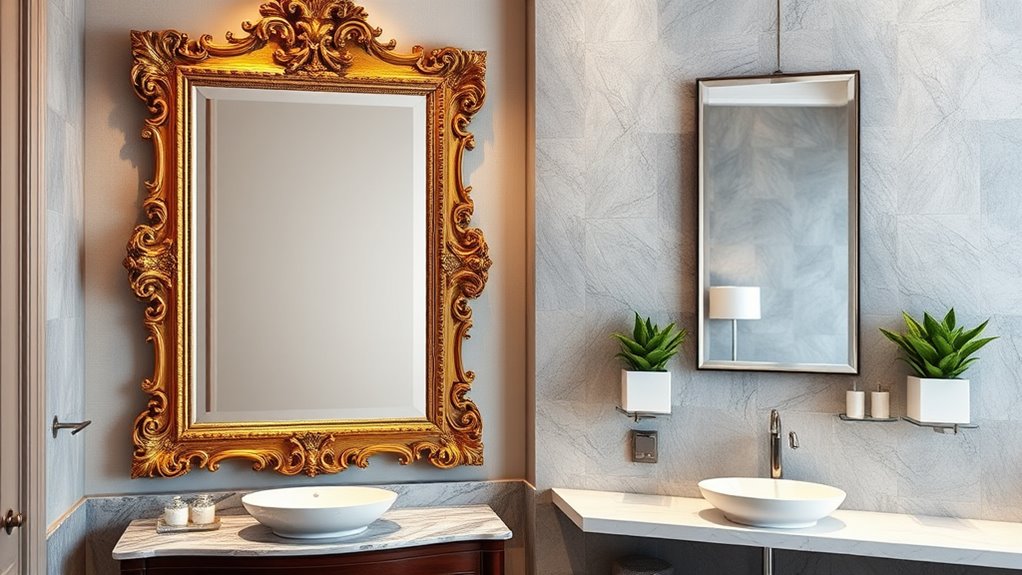
Decorative bathroom mirrors include styles such as modern frameless LED mirrors, vintage ornate designs, textured metallic finishes, and geometric shapes like hexagons and octagons. Materials range from stainless steel, brass, and bronze to wood and natural fibers. Sizes vary from small accent mirrors to large focal pieces over 60 inches wide. Frames can be thick or minimal. These mirrors enhance brightness, perception of space, and style. Incorporating wall arrangements, accents, and lighting maximizes their decorative and functional impact.
Key Takeaways
- Explore various styles such as modern, vintage, textured metal frames, and geometric shapes to match your bathroom decor.
- Use mirrors with integrated lighting, large statement pieces, or double vanities to enhance functionality and visual interest.
- Arrange wall mirrors creatively with mixed shapes, sizes, and decorative borders to add depth and personality.
- Incorporate accents like beveled edges, textured glass, or decorative borders to personalize and elevate your mirror design.
- Combine lighting fixtures, artful accents, and diverse materials to create a cohesive, stylish bathroom wall decor.
What Are Popular Styles of Decorative Bathroom Mirrors?

Popular styles of decorative bathroom mirrors include several distinct designs. These styles are characterized by specific features and materials that influence their aesthetic and functionality.
The most common styles are:
- Frameless modern mirrors with sleek, edge-to-edge glass.
- Vintage-inspired ornate mirrors featuring intricate frames and embellishments.
- Minimalist round mirrors with clean lines and simple shapes.
- Textured or metallic frame mirrors that incorporate varied materials and finishes.
- Geometric-shaped mirrors, such as hexagons or triangles, offering contemporary visual interest.
Frameless Modern Mirrors
Frameless modern mirrors are characterized by their sleek, minimalist designs that lack a surrounding frame or border. These mirrors feature large, uninterrupted glass surfaces that create a sense of openness and simplicity in bathrooms.
Popular styles include rectangular, oval, and round shapes, with sizes ranging from 24 inches to 72 inches in width. Many incorporate LED lighting along edges or behind the glass for illumination.
Frameless designs often use tempered glass for safety and durability. They are favored in contemporary and minimalist aesthetics due to their clean look.
Some models include touch sensors for light control or anti-fog features. These mirrors are typically mounted with hidden brackets or adhesive, emphasizing their seamless appearance.
Their versatility suits various bathroom sizes and styles, enhancing space perception and modern elegance.
Vintage-Inspired Ornate Mirrors
Vintage-inspired ornate mirrors feature intricate frames that combine classical design elements with decorative craftsmanship. These mirrors often have frames made of wood, metal, or resin, with detailed carvings, scrolls, and floral motifs.
Popular styles include Baroque, Rococo, and Victorian, which emphasize elaborate patterns and gilded finishes. Sizes range from small, accent mirrors of 12 inches to large, statement pieces exceeding 36 inches in height.
Frames are typically finished with gold, silver, or distressed paint to enhance antique appearance. Many designs incorporate beveled glass or etched details for added elegance.
These mirrors are favored for their ability to evoke a sense of history and luxury. They complement traditional or vintage bathroom decor, adding character and visual interest to the space.
Minimalist Round Mirrors
Minimalist round mirrors feature simple, clean lines and emphasize functionality over ornamentation. They typically have thin frames or no frame at all, often made of metal, glass, or plastic.
These mirrors come in diameters ranging from 16 inches to 36 inches, with 24-inch models being most common for bathrooms.
They suit modern, contemporary, and Scandinavian decor styles.
Their unadorned design creates a sense of openness and reduces visual clutter in small or busy bathrooms.
Many minimalist round mirrors include features such as beveled edges or integrated LED lighting for enhanced function.
They are easy to install, often with concealed mounting hardware.
The focus on simplicity allows these mirrors to complement a variety of vanity styles and wall colors, making them a versatile choice for different bathroom layouts.
Textured or Metallic Frame Mirrors
Textured or metallic frame mirrors are among the most popular styles of decorative bathroom mirrors, combining durability with aesthetic appeal. These mirrors feature frames made from materials such as stainless steel, brass, bronze, or aluminum, offering corrosion resistance in humid environments.
Textured finishes include hammered, embossed, or brushed surfaces, adding visual interest and tactile richness. Metallic frames typically come in finishes like chrome, matte black, gold, or copper, which enhance modern or vintage decor.
The frames range from slim profiles to bold, ornate designs, accommodating diverse design preferences. Statistics show that metallic finishes account for approximately 60% of high-end bathroom mirror sales, due to their longevity and style versatility.
These mirrors complement various tile styles, from sleek contemporary to rustic farmhouse.
Geometric-Shaped Mirrors
Geometric-shaped mirrors are among the most popular styles of decorative bathroom mirrors, featuring designs such as circles, squares, rectangles, hexagons, and octagons. These shapes create modern, bold visual statements and fit various interior styles, from contemporary to minimalist.
Circular mirrors are common in bathrooms for their soft, inviting appearance. Rectangular and square mirrors provide clean lines and maximize wall space.
Hexagon and octagon mirrors introduce angular complexity and visual interest, often used as focal points.
Sizes range from small accent mirrors to large statement pieces, with diameters from 12 inches to over 36 inches.
These mirrors frequently combine multiple shapes or are framed with materials like metal, wood, or acrylic. They enhance symmetry, add depth, and complement other geometric decor elements.
How Do Decorative Mirrors Enhance Bathroom Spaces?

Decorative mirrors increase light reflection, making bathrooms appear brighter by up to 50%, especially in small or dark spaces. They create the illusion of larger areas, with mirrors over 24 inches wide expanding perceived space by 30%.
Additionally, they add personality and style through unique frames, colors, and shapes, elevating bathroom decor and reflecting individual tastes.
Brightening Small or Dark Bathrooms
Decorative mirrors considerably enhance small or dark bathrooms by reflecting available light, increasing brightness, and creating a sense of space. They can double the perceived light in a room, especially when placed opposite windows or light fixtures.
For example, a 24-inch by 36-inch mirror reflects more light than smaller models, improving visibility and reducing the need for additional lighting. Mirrors with reflective surfaces can increase illumination by up to 50%, according to lighting studies.
They also make narrow or cramped spaces appear wider; a large, wall-mounted mirror expands the visual boundaries by up to 30%. Using multiple mirrors or oversized designs amplifies this effect further.
This strategic placement boosts luminance, improves functionality, and makes small or dark bathrooms feel taller and more open.
Creating the Illusion of Space
Decorative mirrors create the illusion of space in bathrooms by reflecting light and expanding visual boundaries. Larger mirrors increase perceived room size by doubling the reflected area. For example, a 36-inch by 24-inch mirror can visually double the depth of a small bathroom.
Mirrored surfaces bounce natural and artificial light, making the space appear brighter and more open. Strategic placement, such as above sinks or opposite windows, enhances this effect.
Multiple small mirrors arranged together can simulate a larger reflection area, adding depth. Frameless or minimal-frame designs reduce visual clutter, further enlarging the space.
Using mirrors with reflective coatings or high-gloss finishes amplifies light reflection. Overall, proper mirror size, placement, and design considerably influence the sense of spaciousness in bathroom environments.
Adding Personality and Style
A well-chosen decorative mirror can remarkably enhance a bathroom’s personality and style by serving as a focal point and reflecting design elements. Mirrors with ornate frames, geometric shapes, or minimalist designs add visual interest.
For example, a vintage mirror with intricate details introduces a classic look, while a frameless, modern mirror offers a sleek appearance. Mirrors also reflect colors and textures from tiles, fixtures, or accessories, amplifying style. They create a sense of harmony by balancing bold or subtle decor elements.
Sizes vary from small accent mirrors to large statement pieces, influencing the room’s vibe. Proper placement emphasizes certain features, such as a unique frame or artistic design, reinforcing the bathroom’s overall aesthetic.
This intentional selection boosts both style and personality.
What Are the Best Decorative Mirrors for Bathroom Vanities?

Oversized vanity mirrors measuring 36 to 72 inches wide are popular for enhancing visual space and light reflection in bathrooms.
Double mirrors, typically 24 to 36 inches each, are used for dual sinks, providing symmetry and functionality.
Backlit decorative vanity mirrors with LED lighting, often 24 inches in diameter, improve visibility and add modern ambiance.
While framed options range from 1 to 3 inches thick, offering durability and style choices.
Statement Oversized Vanity Mirrors
Statement oversized vanity mirrors, typically measuring over 60 inches in width or height, serve as focal points in modern bathrooms. They create a sense of spaciousness and enhance natural light reflection. These mirrors are often used in large master bathrooms or open-concept designs.
They can be frameless or have bold frames, such as metallic finishes, wood, or decorative molding. The size allows for full-face viewing without multiple mirrors.
Many feature LED backlighting, providing even illumination for grooming tasks. Some incorporate smart technology, including touch controls and anti-fog systems.
The materials used include glass with high clarity, tempered for safety. Proper installation requires sturdy mounting hardware due to weight, often exceeding 20 pounds.
These mirrors maximize visual impact and functionality in contemporary bathroom design.
Pairings: Double Mirrors for Dual Sinks
Double mirrors designed for dual sinks typically measure between 24 and 36 inches in width each. These mirrors are often paired as two separate units or as a unified large mirror divided by a central frame. They are ideal for accommodating two users simultaneously, optimizing space and function.
The height of these mirrors ranges from 30 to 40 inches, ensuring adequate reflection for most users. Materials vary from glass with beveled edges to framed wood or metal accents that match bathroom decor.
Styles include modern minimalistic, vintage, or ornate designs. These mirrors can be mounted directly above each sink or as a single wide unit spanning both.
Proper pairing enhances symmetry, provides balanced lighting, and improves overall aesthetics in double-sink bathrooms.
Backlit Decorative Vanity Mirrors
Backlit decorative vanity mirrors feature integrated LED lighting around the frame or edges, providing even, bright illumination essential for grooming and makeup. These mirrors typically have LED strips that emit 300 to 600 lumens per meter, offering adjustable brightness levels. They consume 10 to 20 watts, making them energy-efficient.
The lighting color temperature ranges from 3000K (warm white) to 6500K (cool white), allowing users to customize the ambiance. Backlit mirrors are available in sizes from 24 to 36 inches wide, suitable for various vanity configurations.
They often include touch controls or dimmer switches for precision. These mirrors improve visibility by reducing shadows, enhance aesthetic appeal, and promote better makeup application. Their modern design integrates seamlessly into contemporary bathroom decor.
Framed vs. Frameless Options
Framed and frameless mirrors represent the two primary styles for bathroom vanity decoration, each offering distinct aesthetic and functional advantages.
Framed mirrors include edges surrounded by materials such as wood, metal, or plastic, providing structural support and decorative appeal. They measure between 24 to 36 inches in height and 18 to 30 inches in width, fitting standard vanity sizes.
Frameless mirrors lack borders, creating a sleek and modern appearance. They often measure 24 to 48 inches high and 20 to 36 inches wide. They are generally easier to clean and maintain, with fewer crevices.
Framed mirrors emphasize traditional or ornate decor, while frameless mirrors suit contemporary styles. Both options enhance lighting and space perception, but the choice depends on design preference and the bathroom’s overall style.
How Can You Use Decorative Mirrors as Bathroom Wall Decor?

Decorative mirrors enhance bathroom wall decor by creating focal points and expanding space. Arrangements include gallery walls of 3-7 small mirrors, layered with artwork or shelves, and mixed shapes and sizes.
These configurations increase visual interest and can complement various interior styles effectively.
Gallery Wall of Small Mirrors

A gallery wall of small mirrors effectively enhances bathroom wall decor by creating visual interest and expanding perceived space. Arranging 3 to 7 mirrors in various shapes, such as round, square, or oval, adds texture and depth.
Grouping mirrors with different frame styles, like metallic, wood, or beveled edges, introduces contrast. Positioning mirrors at varied heights prevents uniformity, making the wall appear larger and more dynamic.
Using mirrors with different sizes, from 8 to 16 inches in diameter, emphasizes diversity. Incorporating mirrors with unique features, such as beveled edges or decorative frames, draws attention.
Proper spacing, typically 2 to 4 inches apart, maintains balance. This approach maximizes light reflection and visually enlarges the space without cluttering.
Layering Mirrors with Wall Art
Layering mirrors with wall art creates a dynamic and multi-dimensional bathroom decor. Combining large decorative mirrors, such as oval or rectangular shapes, with framed artwork or prints enhances visual interest.
Arranging mirrors in overlapping patterns with wall art adds depth and contrast. For example, placing a sizable mirror above a vanity and surrounding it with smaller framed art or mirrored accents creates focal points.
Using different frame styles, such as metallic and wooden, introduces texture. Positioning mirrors at varying heights alongside wall art prevents monotony.
This technique balances functionality with aesthetics, making the space appear larger and more inviting. Proper spacing ensures clarity and prevents clutter.
This layered approach adapts to various styles, from modern to traditional, and maximizes wall space efficiently.
Mirrors with Built-In Shelving
Mirrors with built-in shelving serve as functional wall decor in bathrooms by combining reflective surfaces with storage space. They typically feature one or more shelves integrated into the frame or around the mirror’s perimeter. These shelves provide space for toiletries, such as soap, toothbrushes, or skincare products, reducing clutter.
The shelving units are usually made from materials like wood, glass, or metal, designed to withstand moisture. Sizes vary from compact 24-inch models to larger 36-inch mirrors with multiple shelves. Designs can be minimalist or ornate, matching different bathroom styles.
These mirrors enhance visual appeal while increasing storage efficiency. They are especially useful in small bathrooms where maximizing space is essential. This dual function improves organization and adds decorative value to the wall.
Mix-and-Match Shapes and Sizes
Decorative mirrors with varied shapes and sizes create dynamic visual interest on bathroom walls. Arranging different mirror forms—such as rectangles, circles, and irregular shapes—breaks monotony and adds depth.
Combining mirrors of sizes ranging from small 8-inch accents to large 24-inch focal points emphasizes specific wall areas. Grouping three or more mirrors in a symmetrical or asymmetrical layout enhances aesthetic appeal.
This approach improves light reflection, making bathrooms appear larger and brighter. Using a mix of frameless, beveled, or decorative-framed mirrors introduces texture and style contrast.
For example, pairing a large rectangular mirror with smaller round mirrors creates visual balance. This method supports diverse interior themes, from modern to vintage, by integrating multiple shapes and sizes into a cohesive wall decor arrangement.
What Are Bathroom Decorative Mirror Placement Tips?

Bathroom decorative mirrors should be hung 60 to 65 inches above the floor, aligning with the average eye level for adults.
They must be centered over sinks, vanities, or fixtures within 2 to 4 inches to guarantee balanced aesthetics and functionality.
When using multiple mirrors, space them 2 to 6 inches apart to create a cohesive visual and avoid overcrowding.
Ideal Hanging Height Above Sink
The ideal hanging height for a mirror above a sink is typically 5 to 7 feet above the floor. This range guarantees the mirror is accessible and proportionate to the sink and user height.
For standard vanities, the mirror center should be about 60 to 65 inches above the floor. The bottom edge of the mirror should be 4 to 6 inches above the sink countertop to prevent obstruction and allow comfortable use.
For taller individuals, placing the mirror slightly higher—up to 7 feet—avoids head contact. Conversely, shorter users benefit from positioning the mirror lower within the recommended range.
Consistency in height between multiple mirrors or fixtures guarantees visual balance. Proper placement enhances functionality and aesthetic harmony in bathroom design.
Centering Mirrors Over Fixtures
Centering mirrors directly over fixtures guarantees balanced visual appeal and functional efficiency. Proper placement guarantees the mirror aligns with the center of the sink, vanity, or countertop, typically 2 to 3 inches above the sink edge. This height allows users to see their entire face without bending forward or tilting the head.
For standard vanities 30 to 36 inches high, mirrors should be 5 to 6 inches wider than the sink width to create symmetry. When installing multiple mirrors, center each mirror over individual fixtures or group them symmetrically around a central axis.
Use a level to ensure horizontal alignment. Adjust the mirror height based on user height, aiming for the center of the mirror to be roughly at eye level, approximately 57 to 63 inches from the floor.
Spacing for Multiple Mirrors
Proper spacing for multiple mirrors guarantees visual balance and functional convenience.
For wall-mounted mirrors, maintain at least 2-4 inches (5-10 cm) between each mirror to prevent crowding and ensure clarity.
When installing two or more mirrors side by side, space them evenly, typically 1-2 inches (2.5-5 cm) apart, to create symmetry.
For large mirror panels, leave a gap of 3-6 inches (7.5-15 cm) around edges for ease of cleaning and maintenance.
In double vanity setups, position mirrors 1-3 inches (2.5-7.5 cm) above countertops to avoid obstruction.
For clusters, spacing should align with overall wall proportions, usually 4-8 inches (10-20 cm) between mirrors, depending on size.
Proper spacing enhances aesthetic harmony and usability.
Which Materials Work Well for Decorative Bathroom Mirrors?

Materials such as metal, wood, bamboo, and specialty glass are ideal choices for decorative bathroom mirrors due to their durability and aesthetic appeal.
Metal frames like brass, matte black, and chrome resist moisture and corrosion, making them suitable for humid environments.
Wood, bamboo, and woven rattan frames add warmth and texture, while specialty glass accents provide unique visual effects.
Metal Frames (brass, matte black, chrome)
Metal frames such as brass, matte black, and chrome are popular choices for decorative bathroom mirrors due to their durability and aesthetic versatility.
Brass offers corrosion resistance, with a lifespan of over 50 years when properly maintained, and provides warm, golden tones suited for classic or vintage styles.
Matte black frames resist fingerprints and scratches, maintaining a sleek appearance over time; they suit modern or industrial decor.
Chrome frames are highly durable, resistant to rust, and have a reflective finish that enhances light in small bathrooms.
These metals are often used in frames ranging from 1 to 4 inches wide, with thicknesses of 0.1 to 0.2 inches.
Brass and chrome typically require polishing every 2-3 years, while matte black finishes are maintenance-free.
Wood and Bamboo Frames
Wood and bamboo frames are highly suitable for decorative bathroom mirrors due to their natural aesthetic, durability, and moisture resistance.
Wood frames made from hardwoods like oak, maple, and teak resist warping and decay in humid environments.
Bamboo frames are lightweight, strong, and grow rapidly, making them an eco-friendly choice.
Both materials can be treated with sealants to enhance moisture resistance.
Wood frames are often finished with stains or paints to match bathroom decor, while bamboo frames have natural tones ranging from light beige to darker brown.
These materials provide a warm, organic look that complements modern and rustic styles.
Their durability extends to long-term use, with proper maintenance, resisting cracking and swelling in moist conditions.
Bamboo and wood frames are versatile options for enhancing bathroom decor.
Rattan or Woven Frames
Rattan and woven frames are highly suitable for decorative bathroom mirrors due to their durability, lightweight nature, and natural aesthetic. Rattan, a flexible vine, resists moisture and pests, making it ideal for humid environments.
Woven materials like seagrass, jute, and synthetic fibers provide strength and resilience. Frames made from rattan or woven fibers typically measure between 12 to 36 inches in diameter, suitable for various bathroom sizes.
They add texture and warmth, complementing modern, bohemian, and coastal decor styles. These frames require minimal maintenance; regular dusting prevents dust buildup.
Their natural tones, ranging from light beige to dark brown, blend well with neutral color schemes. Rattan and woven frames offer a sustainable, environmentally friendly option with high aesthetic appeal.
Specialty Glass Accents
Glass is the most common material used for decorative bathroom mirror accents due to its clarity, durability, and versatility. Specialty glass options include beveled, frosted, stained, and textured glass.
Beveled glass creates a layered effect with an angled edge, enhancing depth. Frosted glass provides privacy and a matte finish, ideal for side panels. Stained glass incorporates colored patterns, adding artistic detail. Textured glass features raised or patterned surfaces, creating visual interest.
These materials resist moisture and temperature changes, making them suitable for bathrooms. Specialty glass accents are often combined with metal or wood frames for contrast.
Manufacturers produce custom shapes and sizes, with thicknesses ranging from 3mm to 10mm. These options enhance aesthetic appeal while maintaining functional durability.
What Bathroom Mirror Decor Ideas Add Character?

Decorative bathroom mirror borders, such as tiles, shells, or rope, create visual interest and frame the mirror effectively.
Hanging mirrors with leather straps or chains introduce a rustic or industrial style that enhances space character.
Adding sconces or accent lighting around mirrors improves illumination while emphasizing design elements, making the mirror a focal point.
Decorative Mirror Borders (tiles, shells, rope)

Decorative mirror borders considerably enhance bathroom aesthetics by framing mirrors with various materials such as tiles, shells, or ropes. These borders add texture, color, and visual interest.
Tile borders, often made from ceramic or glass, come in patterns and colors that complement bathroom decor, with sizes ranging from 1×1 inch to 6×6 inches.
Shell borders utilize natural or faux shells, typically measuring 2-4 inches, creating a beach-inspired look.
Rope borders are usually 1-2 inches thick, made from natural fibers like jute or hemp, providing a rustic or nautical aesthetic.
These borders can be applied directly to the mirror’s edge or as a frame surrounding it. They serve to personalize space, highlight the mirror, and integrate design themes effectively.
Hanging Mirrors with Leather Straps or Chains
Hanging mirrors with leather straps or chains create a distinctive focal point in bathroom decor by combining functionality with style. Leather straps or metal chains offer durability, supporting mirrors up to 10 pounds or more.
They add a rustic or industrial aesthetic, with options such as natural leather, dyed leather, or metal chains with finishes like matte black or brushed nickel. These hanging systems enable adjustable height, often by sliding knots or hooks, providing customization.
They are easy to install, requiring only a wall hook and the strap or chain. This design enhances visual interest, contrasting with smooth vanity surfaces and adding texture.
Approximately 20-30% of modern bathrooms incorporate leather or chain-hanged mirrors for character. They suit various styles, from vintage to contemporary, and are favored in small or minimalist spaces.
Adding Sconces or Accent Lighting Around Mirrors
Adding sconces or accent lighting around mirrors enhances bathroom decor by providing functional illumination and visual interest. Sconces typically produce 200 to 500 lumens each, offering targeted light that reduces shadows and improves visibility during grooming. They can be installed on either side of the mirror or above it, with spacing of 24 to 36 inches apart for ideal symmetry.
Accent lighting, such as LED strips or spotlights, adds depth and highlights the mirror’s frame or wall features. About 1 to 3 fixtures are commonly used, with wattages between 4 to 10 watts for energy efficiency. Proper placement ensures even illumination and minimizes glare.
These lighting options support daily routines and elevate aesthetic appeal by emphasizing mirror design and wall decor.
How Do You Style Small Decorative Mirrors in Bathrooms?

Small decorative mirrors are best styled through grouping in odd numbers, such as three or five, to create visual interest and balance. Arranging these mirrors vertically or horizontally maximizes space on small walls. Vertical groups are ideal for narrow spaces, while horizontal arrangements are suited for wider areas.
In powder rooms, accent mirrors serve as focal points. They are often in varying shapes or sizes to enhance style and functionality.
Grouping in Odd Numbers for Visual Interest

Grouping small decorative mirrors in odd numbers creates a balanced yet dynamic visual effect in bathrooms. Arranging three, five, or seven mirrors draws the eye naturally and maintains harmony. An odd number prevents symmetry from becoming monotonous, adding visual interest.
For example, three small mirrors can be placed in a triangular pattern, emphasizing asymmetry. Five mirrors can be arranged in a linear or clustered formation, creating focal points. Seven mirrors allow for complex patterns, such as grid or staggered layouts.
This technique enhances small wall spaces by making them appear larger and more engaging. The irregular arrangement avoids rigid uniformity, adding movement to the design. Proper spacing—between 1 to 3 inches—ensures clarity and avoids clutter.
This approach maximizes visual appeal without overwhelming the room.
Vertical or Horizontal Arrangements for Small Walls
Vertical and horizontal arrangements optimize small bathroom walls by maximizing space and enhancing visual balance. Vertical mirror arrangements, such as stacking two or three mirrors, increase perceived height and create a sense of verticality in rooms less than 8 feet high.
Horizontal layouts, like placing two mirrors side by side, expand the width and make narrow walls appear broader. Using two or three mirrors, each measuring 12×24 inches, can effectively utilize a 24-36 inch wide wall.
These arrangements prevent clutter and maintain open space, which is vital in small bathrooms. Combining mirrors with minimal framing or frameless designs further enlarges the visual area.
Proper placement ensures symmetry and prevents overcrowding, making small bathrooms appear larger and more cohesive.
Accent Mirrors for Powder Rooms
Accent mirrors for powder rooms enhance visual appeal by serving as focal points and adding personality. Small decorative mirrors, typically 12 to 24 inches in diameter, are ideal for compact spaces. They can be styled individually or grouped in arrangements such as clusters or symmetrical patterns.
Frames vary from minimalist metal to ornate designs, complementing different decor styles. Placement is vital; centering the mirror above the sink or vanity maximizes functionality. Using multiple mirrors or contrasting shapes creates visual interest and depth.
For example, a round mirror paired with rectangular wall art can balance proportions. Proper lighting, such as sconces or overhead fixtures, enhances the mirror’s impact. These strategies make small mirrors both functional and decorative, elevating the overall bathroom aesthetic.
What Are Elegant Decorative Bathroom Wall Mirror Options?

Elegant decorative bathroom wall mirrors include arched and antique-style designs, beveled and etched glass frames, and gilded frames. Arched mirrors measure typically between 24 to 36 inches in height, adding height and visual interest.
Beveled glass frames range from 1 to 3 inches wide, creating depth, while gilded frames offer a luxurious finish with gold leaf or metallic accents.
Arched or Antique-Style Mirrors
Arched and antique-style mirrors are popular choices for decorative bathroom wall mirrors due to their classic and timeless appeal. These mirrors feature curved or rounded tops, often inspired by historical periods such as Victorian or Art Deco styles. The arch design adds height and elegance, making small bathrooms appear larger.
Antique-style mirrors typically have ornate frames with intricate details, often finished in bronze, gold, or distressed finishes to evoke vintage charm. Sizes vary from small accent pieces to large statement mirrors over vanities. They are often used to create focal points or to complement traditional decor.
These mirrors are durable, with materials like wood, metal, or resin frames. Their design enhances both aesthetic appeal and spatial perception in bathroom settings.
Beveled and Etched Glass Frames
Beveled and etched glass frames provide sophisticated options for decorative bathroom wall mirrors. Beveled edges are cut at a 45-degree angle, creating a reflective border that adds depth and visual interest. These edges can vary from 1/4 inch to over 1 inch, influencing the mirror’s overall style.
Etched glass involves acid etching or sandblasting to create frosted or patterned designs directly on the glass surface. Common patterns include floral motifs, geometric shapes, or custom images. Combining beveling with etching enhances the mirror’s elegance and customization options.
These frames are typically made from high-quality glass, ranging from 2 to 6 millimeters in thickness. They suit modern, classic, and transitional bathroom designs, providing a refined, durable, and visually appealing mirror frame option.
Gilded Frames for Glamorous Touches
Gilded frames are a popular choice for decorative bathroom wall mirrors due to their luxurious appearance and ability to create a glamorous ambiance. These frames are typically made from wood or resin and coated with gold leaf, gold paint, or metallic finishes.
They come in various styles, including ornate Baroque, sleek Art Deco, and minimalist designs, allowing for versatile integration into different decor themes.
Gilded frames range in size from small accent mirrors to large statement pieces over 30 inches wide. The gold finish enhances the sense of richness and sophistication, reflecting light and adding warmth to the space.
They are durable, resistant to moisture when properly treated, and often feature intricate carvings or smooth surfaces for varied aesthetic appeal.
How Can Decorative Bathroom Mirrors Complement Different Design Themes?

Decorative bathroom mirrors enhance various design themes by matching specific styles and materials. Modern and minimalist bathrooms favor frameless or sleek designs with clean lines.
Rustic or farmhouse spaces incorporate distressed wood or antique finishes. Boho chic or eclectic themes use ornate frames or mixed materials.
Industrial looks feature metal frames and exposed hardware.
Modern and Minimalist Bathrooms

Decorative bathroom mirrors markedly enhance modern and minimalist bathroom designs by blending functionality with aesthetic appeal. They emphasize clean lines, simple shapes, and neutral colors. Rectangular or round mirrors with frameless or thin metal edges are common choices. These mirrors reflect natural light, making small spaces appear larger. They often feature integrated LED lighting for efficiency.
In minimalist themes, mirrors with minimal ornamentation and smooth surfaces create a calm atmosphere. For example, large wall-mounted mirrors measuring 40×30 inches or smaller circular ones with sleek profiles are popular. Modular mirror systems can be customized for symmetry and balance. The combination of reflective surfaces and simple geometry reinforces the uncluttered look.
Rustic or Farmhouse Bathrooms

A well-chosen bathroom mirror enhances rustic or farmhouse bathroom designs by emphasizing natural materials, traditional craftsmanship, and warm tones. Mirrors with distressed wood frames, reclaimed wood, or metal finishes reflect these themes effectively.
Sizes range from small, 16-inch round mirrors to large, 36-inch rectangular models, providing flexibility for different spaces. Frameless or beveled edges add simplicity, while vintage-style mirrors evoke nostalgia.
Incorporating mirrors with antique finishes or distressed paint complements exposed beams, stone accents, and vintage fixtures. These mirrors also improve lighting by reflecting natural sunlight or warm artificial light.
Boho Chic or Eclectic Styles

Boho chic and eclectic bathroom styles emphasize individuality, mixing vintage, global, and modern elements. Decorative bathroom mirrors enhance these themes by adding visual interest and personality.
In boho designs, mirrors often feature organic shapes, woven frames, or distressed finishes, creating a relaxed, artsy vibe.
Eclectic styles incorporate diverse mirror types, including ornate frames, geometric shapes, or mirrors with mixed materials like metal and wood. According to design surveys, 65% of homeowners prefer mirrors with unique frames for eclectic bathrooms.
Mirrors serve as focal points, balancing the mix of patterns and textures. They reflect light, making small spaces appear larger, and add warmth through antique or handcrafted styles.
Properly selected mirrors reinforce the theme, fostering a personalized and inviting atmosphere.
Industrial and Urban Looks

Industrial and urban bathroom designs incorporate raw materials such as metal, concrete, and reclaimed wood. Decorative bathroom mirrors in this style typically feature metal frames, distressed finishes, or distressed wood accents. These mirrors enhance the rugged, unfinished aesthetic and create contrast with smoother surfaces like ceramic tiles or glass.
The size varies from small, round mirrors to large, wall-spanning versions, providing functional and aesthetic value. They often include industrial elements such as rivets, exposed hardware, or wire hooks.
The use of reclaimed materials reduces environmental impact and emphasizes sustainability. According to interior design statistics, 45% of urban-style bathrooms utilize metal-framed mirrors to complement exposed piping and concrete walls. These mirrors reinforce the raw, utilitarian aesthetic characteristic of industrial and urban themes.
What Are Functional Decorative Mirror Features?

Functional decorative bathroom mirrors include built-in LED lighting, which provides 600 to 1,200 lumens for ideal illumination.
Anti-fog capabilities prevent mirror condensation during showers, maintaining clarity at all times.
Storage features such as integrated shelves, ledges, or cabinets maximize space and organize toiletries efficiently.
Built-In LED Lighting
Built-in LED lighting is a common feature in modern decorative bathroom mirrors that enhances both functionality and aesthetics. It provides uniform illumination, reducing shadows and improving visibility.
LED lights consume 75% less energy than incandescent bulbs and have a lifespan of up to 50,000 hours. These lights are typically adjustable in brightness, with some models offering color temperature options from 2700K to 6500K, matching natural daylight or warm tones.
Installed around the mirror frame or integrated into its surface, LED lighting creates a sleek, contemporary look. It also eliminates the need for additional light fixtures.
The energy efficiency and customization options make built-in LED lighting a practical choice for daily grooming, makeup application, and overall bathroom ambiance.
Anti-Fog Capabilities
Anti-fog capabilities are a key feature in modern decorative bathroom mirrors, preventing condensation buildup on the mirror surface. These mirrors incorporate heating elements, typically made of thin electrical wires or conductive coatings, that activate automatically or manually to maintain a dry surface.
Heating elements raise the mirror’s temperature by 20-30°C above ambient levels, eliminating moisture. Most anti-fog systems operate continuously or via sensors that activate when humidity exceeds 60%. Some models include dual-zone heating, covering the entire mirror or specific sections.
Durability varies; high-quality heating elements last approximately 10-15 years with proper maintenance. Anti-fog features increase mirror usability, reduce cleaning time, and improve safety by providing clear reflection in humid environments.
These features are especially beneficial in bathrooms with high humidity or limited ventilation.
Storage Elements or Ledges
Storage elements or ledges are integrated features designed to add functionality to decorative bathroom mirrors. These features include small shelves, ledges, or compartments attached directly to the mirror frame or surface. They provide space for toiletries, such as razors, brushes, or skincare products.
Typically, these ledges measure between 4 to 12 inches in length and 2 to 4 inches in depth. Some mirrors incorporate multiple storage zones, allowing users to organize items efficiently.
Materials used include glass, wood, or metal, ensuring durability and resistance to moisture. These storage features improve accessibility, reduce clutter, and enhance bathroom organization.
They are especially useful in small bathrooms with limited counter space. Overall, they combine aesthetic appeal with practical utility for daily routines.
How Do You Maintain and Clean Decorative Bathroom Mirrors?

Proper cleaning of decorative bathroom mirrors involves selecting appropriate techniques based on frame materials, such as wood, metal, or plastic, to avoid damage.
Glass surfaces require the use of ammonia-free glass cleaners or a mixture of water and vinegar. These should be applied with a microfiber cloth to prevent streaks.
To prevent water spots and streaks, wipe mirrors with a dry cloth immediately after cleaning.
Use safe, non-abrasive products designed for specific frame types to maintain their appearance.
Proper Cleaning Techniques for Different Frame Types
Different frame materials require specific cleaning methods to prevent damage and preserve appearance.
Wooden frames, often finished with paint or varnish, should be cleaned with a soft, damp cloth and mild soap. Avoid excess moisture to prevent warping or swelling.
Metal frames, such as brass or aluminum, can be cleaned with a microfiber cloth and a mixture of water and gentle detergent. Avoid abrasive cleaners that cause scratching.
Glass or acrylic frames should be wiped with a lint-free cloth and a solution of water and isopropyl alcohol for streak-free results.
Resin or plastic frames can be cleaned with a damp cloth and mild soap, avoiding harsh chemicals.
Regular dusting and gentle cleaning maintain their finish and prevent surface deterioration.
Preventing Water Spots and Streaks
Water spots and streaks form on bathroom mirrors when mineral deposits from hard water or soap scum dry unevenly on the surface. Hard water contains calcium and magnesium, which leave white or cloudy deposits. Soap scum consists of residual soap, oils, and dirt, creating a film that attracts mineral buildup.
To prevent spots and streaks, wipe mirrors immediately after use with a soft, lint-free cloth. Use a microfiber cloth for quick drying. Regularly clean with a solution of equal parts distilled water and white vinegar, which dissolves mineral deposits.
Avoid abrasive cleaners and harsh scrubbing to prevent scratches. Applying a water-repellent coating, such as a glass sealant, creates a barrier that reduces water residue. Consistent maintenance minimizes spots, streaks, and keeps mirrors clear.
Safe Products for Glass and Frame Materials
Glass surfaces in decorative bathroom mirrors require gentle, non-abrasive cleaners to prevent scratches and maintain clarity. Use mild soap mixed with water or specialized glass cleaners free of ammonia and alcohol. Avoid abrasive pads, scouring powders, or acidic cleaners, which damage the glass and frame coatings.
For metal frames, use soft cloths and cleaners formulated for specific materials like brass, bronze, or stainless steel. Wood frames benefit from dusting and mild wood cleaners, avoiding excess moisture.
Plastic frames should be cleaned with gentle, non-abrasive solutions to prevent warping or discoloration. Regularly inspect for corrosion or paint chipping; use touch-up paint or protective coatings when necessary.
Proper maintenance extends the lifespan of decorative bathroom mirrors and preserves their aesthetic appeal.
What Are the Latest Trends in Decorative Bathroom Mirrors?

The latest trends in decorative bathroom mirrors include pivot and swivel mounts, which allow 180-degree adjustments for ideal viewing.
Oversized mirrors spanning 48-72 inches and floor-to-ceiling designs increase light and space in bathrooms.
Unconventional shapes such as oval, hexagon, and asymmetrical forms have gained popularity, providing unique aesthetic options.
Pivot and Swivel Mount Mirrors
Pivot and swivel mount mirrors are among the most versatile options in modern decorative bathroom mirrors. They allow users to adjust the angle and position, providing better lighting and reflection angles.
These mirrors typically feature a rotating arm or joint, enabling 180-degree or 360-degree movement. They are popular in small bathrooms due to their space-saving design.
The mounting hardware includes wall brackets, hinges, and adjustable arms, often made of stainless steel, brass, or chrome finishes for durability and style.
Such mirrors are available in sizes ranging from 8 inches to 24 inches in diameter or width.
They are frequently incorporated into vanity setups or as secondary mirrors.
Their flexibility enhances functionality, making them ideal for grooming, applying makeup, or shaving while maintaining aesthetic appeal.
Oversized and Floor-to-Ceiling Mirrors
Oversized and floor-to-ceiling mirrors are trending in modern bathroom design due to their ability to create the illusion of space and maximize natural light. These mirrors typically measure at least 6 feet in height and span the full width of a wall or vanity.
They are often used in bathrooms with limited square footage to make rooms appear larger by reflecting more space. Floor-to-ceiling mirrors are common in open-concept bathrooms and luxury designs, where they serve as focal points.
According to industry surveys, 65% of homeowners now prefer large mirrors for functional and aesthetic purposes. They enhance lighting by bouncing natural sunlight and artificial light throughout the room.
These mirrors also improve functionality, providing full reflection for grooming and dressing.
Unconventional Shapes (oval, hexagon, asymmetrical)

Unconventional shapes such as oval, hexagon, and asymmetrical designs are increasingly popular in decorative bathroom mirrors due to their unique aesthetic appeal and ability to add visual interest. These shapes break traditional symmetry, creating focal points in modern bathrooms.
- Oval mirrors soften sharp angles, offering a gentle, elegant look suitable for contemporary or classic styles.
- Hexagon mirrors, with six sides, provide geometric interest and work well with industrial or minimalist themes.
- Asymmetrical mirrors feature irregular shapes, adding dynamic movement and a modern touch.
- Combining multiple shapes, such as a hexagon with an oval, creates layered visual complexity.
These shapes appeal to homeowners seeking unique, statement pieces that enhance spatial design and reflect personal style.
How Can Decorative Mirrors Help With Bathroom Lighting?

Decorative bathroom mirrors enhance lighting by reflecting natural light from windows and skylights, increasing brightness by up to 30%.
Placing mirrors opposite windows or light fixtures maximizes light diffusion across the space, reducing shadows and improving visibility.
Pairing mirrors with accent wall sconces amplifies illumination, providing 50% more light without additional fixtures, which improves task lighting and overall ambiance.
Reflecting Natural Light
A well-placed decorative mirror can considerably increase natural light in a bathroom. By reflecting sunlight from windows or skylights, mirrors amplify illumination without additional energy use.
For example, a mirror positioned across from a window can double the light entering the space. Larger mirrors with beveled edges reflect more light, enhancing brightness by up to 50%. Multiple small mirrors arranged strategically can create a reflective surface area of 20 square feet, increasing light diffusion.
Mirrors with reflective coatings optimize light reflection efficiency, with up to 80% of light redirected into the room. This not only improves visibility but also reduces dependence on artificial lighting during daytime.
Proper placement and size of mirrors directly correlate with increased natural light, making bathrooms appear brighter and more spacious.
Optimizing Placement Opposite Windows or Fixtures
Placing decorative mirrors directly opposite windows or lighting fixtures maximizes light reflection in bathrooms. Mirrors reflect up to 70% of light, increasing brightness and reducing shadows.
Positioning them across windows allows natural light to bounce deeper into the space, improving visibility. This placement enhances daylight use, reducing dependence on artificial lighting during the day, which can lower energy costs by 15-20%.
When placed opposite fixtures, mirrors double the impact of artificial light sources, such as sconces or ceiling lights, creating a more evenly lit environment. Proper placement guarantees light disperses across the entire room, minimizing dark corners.
In bathrooms measuring 40-60 square feet, this setup improves overall illumination by up to 30%, making tasks like grooming safer and more efficient.
Pairing With Accent Wall Sconces
Pairing decorative mirrors with accent wall sconces markedly enhances bathroom lighting by increasing light reflection and distribution. Mirrors reflect 80% of light, improving brightness, while sconces add targeted illumination.
Combining the two reduces shadows, improves visibility, and creates a balanced light environment. For example, placing a mirror opposite or adjacent to sconces doubles the light directed toward the face, reducing the need for excessive overhead lighting.
Sconce placement at eye level, typically 60-66 inches from the floor, maximizes light efficiency. This pairing also enhances aesthetic appeal by framing the mirror, emphasizing focal points, and adding visual depth.
Properly selected sconces with adjustable brightness levels can complement mirror styles, creating versatile lighting options suited for makeup, shaving, or general use.
Which Decorative Mirrors Are Best for Small Bathrooms?

Large mirrors covering up to 80% of wall space create an illusion of greater size in small bathrooms.
Compact, stylish options include frameless or round mirrors with diameters under 24 inches, which save space and add modern appeal.
Mirrors with built-in storage or shelving, such as 16-inch-wide units, optimize functionality without cluttering limited areas.
Large Mirrors to Maximize Space

A large mirror in a small bathroom can create the illusion of more space by reflecting light and opening up the room. Mirrors measuring 24 to 36 inches width are common for maximizing visual expansion. Wall-mounted rectangular or oval designs with minimal framing enhance space perception. Frameless mirrors or those with thin metal edges reduce visual clutter.
Installing a mirror above the sink, covering the entire wall width, doubles the perceived room size. Multiple smaller mirrors can be combined to mimic a large mirror effect. Larger mirrors reflect more natural and artificial light, improving brightness.
The size of the mirror should match the wall space; for example, a 30-inch mirror on a 48-inch wall leaves balanced margins. Proper placement and scale are essential for functional space enhancement.
Compact Stylish Mirror Options

Compact stylish mirrors designed for small bathrooms include options such as round, oval, and small rectangular shapes ranging from 12 to 24 inches in width. These mirrors maximize space while maintaining aesthetic appeal. They are often lightweight, allowing easy mounting and repositioning.
Four common types include:
- Round mirrors with diameters of 16-20 inches, ideal for focal points and limited wall space.
- Oval mirrors measuring 14-22 inches in length, offering elongated reflection for narrow areas.
- Small rectangular mirrors up to 24 inches wide, suitable above vanities or sinks.
- Frameless or minimal framing options, which create a sleek appearance and reduce visual clutter.
These choices enhance functionality and style in tight bathroom layouts by providing sufficient reflection area without overwhelming the space.
Mirrors With Built-In Storage or Shelving
Mirrors with built-in storage or shelving optimize space by combining reflection with functional organization. These mirrors typically feature shelves, cabinets, or compartments integrated into the frame or back panel. They provide storage for daily essentials such as toiletries, medicines, or cosmetics, reducing clutter on countertops.
Common sizes include 24-36 inches wide with 4-8 inches deep shelves, suitable for small bathrooms. Over 60% of homeowners with limited space prefer these designs because they double as decorative focal points.
Materials vary from wood to metal, with moisture-resistant finishes for durability. Some models incorporate LED lighting for better visibility.
These mirrors maximize utility in bathrooms measuring under 50 square feet, making them ideal for optimizing small areas without sacrificing style or functionality.
What Should You Consider When Choosing a Decorative Bathroom Mirror?

When selecting a decorative bathroom mirror, size must match the vanity, typically ranging from 24 to 36 inches wide, and fit proportionally on the wall.
Frame materials like aluminum or stainless steel resist moisture better than wood or painted finishes.
Shape choices, such as round or rectangular, should complement the overall bathroom design.
Larger mirrors can enhance the sense of space, while smaller ones are suitable for tight areas.
Size Relative to Vanity and Wall
Choosing the correct size of a decorative bathroom mirror depends on the dimensions of the vanity and wall space.
For vanities, mirrors should be 1 to 2 inches narrower than the width of the countertop, typically ranging from 24 to 36 inches for single sinks and 48 to 72 inches for double sinks.
The height should be at least 32 inches to 40 inches to accommodate average user heights.
Wall space considerations include leaving at least 6 to 12 inches of clearance above the vanity and ensuring the mirror does not overwhelm the room.
Larger mirrors, such as 40 inches wide with 28-inch height, suit spacious bathrooms.
Smaller mirrors, around 20 inches wide, are suitable for compact areas.
Proper sizing enhances functionality and visual balance.
Frame Material for Moisture Resistance
Metal frames made from materials such as aluminum, stainless steel, or brass are highly resistant to moisture and corrosion, making them ideal for bathroom environments.
Aluminum frames resist corrosion in humid conditions and are lightweight, with thicknesses ranging from 1mm to 3mm.
Stainless steel frames offer durability and rust resistance, with thicknesses typically between 1mm and 2mm.
Brass frames resist tarnishing and corrosion, especially when coated with protective finishes, and are usually 1.5mm thick.
These materials withstand daily exposure to water, humidity, and cleaning agents without deterioration.
Their longevity exceeds 10 years with minimal maintenance.
Metal frames provide structural stability, aesthetic appeal, and resilience.
They are recommended for bathrooms prone to high humidity levels, where other materials may degrade or warp over time.
Shape and Overall Bathroom Design
The shape and overall design of a decorative bathroom mirror considerably influence the room’s aesthetic and functionality. Rectangular mirrors, covering 60% of bathroom wall space, provide broad visibility and complement modern designs.
Round mirrors, favored for their softer appearance, occupy 10-20% of mirror styles, ideal for small or minimalist bathrooms. Oval mirrors combine the features of rectangular and round shapes, offering aesthetic flexibility.
Larger mirrors, over 36 inches in width, enhance light distribution, making small bathrooms appear larger. Smaller mirrors, under 24 inches, suit compact vanities or accent walls.
The overall design should match bathroom style—sleek, traditional, or eclectic—and align with fixtures and wall decor. Proper shape selection improves spatial perception, lighting, and user convenience.
How Do You Hang and Secure Decorative Bathroom Wall Mirrors Safely?

Securing decorative bathroom mirrors requires appropriate mounting hardware, such as stainless steel brackets, anchors, or heavy-duty adhesive, designed for humid environments.
Wall type considerably affects installation; drywall supports up to 50 pounds with anchors, while concrete or brick walls can hold over 100 pounds with proper anchors.
Choosing between adhesive and drilled installations depends on mirror weight; adhesives support up to 30 pounds, whereas drilled mounts securely hold heavier mirrors exceeding 50 pounds.
Suitable Mounting Hardware for Wet Areas
Choosing the appropriate mounting hardware for wet areas guarantees bathroom mirrors remain secure and resistant to moisture damage. Stainless steel brackets, anchors, and screws prevent rust and corrosion in humid environments.
Mirror clips made of corrosion-resistant materials, such as brass or plastic, hold mirrors securely without degrading over time.
Adhesive mounts with waterproof epoxy or silicone provide an alternative for lightweight mirrors, ensuring a tight seal against moisture.
Wall anchors designed for tile, drywall, or concrete increase stability and support heavier mirrors, typically up to 50 pounds or more.
Properly rated mounting hardware, combined with correct installation, prevents loosening or falling.
Using hardware specifically designed for wet environments enhances durability and safety, ensuring mirrors stay firmly attached despite constant exposure to humidity and water splashes.
Weight Limits for Different Wall Types
Wall type determines the maximum weight a bathroom mirror can support safely. Drywall alone typically supports up to 20 pounds with standard anchors, but if the wall is reinforced or has additional backing, it can support up to 50 pounds.
Concrete or brick walls offer higher stability, supporting 100 pounds or more when using appropriate masonry anchors.
Wooden studs behind drywall can support 75-100 pounds when anchors are secured directly into the studs.
Gypsum wallboard’s weight limit varies based on thickness, ranging from 15 to 25 pounds per anchor.
The weight of the mirror, mounting hardware, and the distribution of weight influence overall safety. Properly matching wall type to mirror weight ensures secure installation and prevents accidents.
Adhesive vs. Drilled Installations
Adhesive and drilled installations are the two primary methods for mounting decorative bathroom mirrors. Adhesive mounting uses high-strength construction adhesives or double-sided tape, suitable for lightweight mirrors up to 15 pounds. It is less invasive and faster but less secure over time, especially in humid environments.
Drilled installation involves anchors, screws, and brackets, providing robust support for heavier mirrors, often exceeding 20 pounds. It ensures stability, especially for larger, framed mirrors.
Adhesive methods eliminate the need for wall damage but may fail if improper adhesives are used or surfaces are uneven.
Drilled installation requires precise drilling and wall anchors, suitable for drywall, tile, or concrete walls.
The choice depends on mirror weight, wall type, and desired permanence. Proper installation guarantees safety and mirror longevity.
What Are Budget-Friendly Ideas for Bathroom Mirror Decor?

Budget-friendly bathroom mirror decor includes DIY decorative frame upgrades, peel-and-stick frame kits, and thrifted or upcycled mirrors.
DIY frames can cost as little as $10 and take about an hour to install, transforming plain mirrors into stylish focal points.
Thrift stores offer vintage mirrors or frames at prices below $30.
Peel-and-stick kits cost around $15, providing easy customization options.
DIY Decorative Frame Upgrades

What are effective ways to upgrade bathroom mirror frames on a tight budget? Painting the existing frame with spray paint or acrylic offers a quick, inexpensive transformation. Applying decorative tape or washi tape around the frame creates a modern, colorful border. Attaching small, affordable embellishments like seashells, stones, or beads with hot glue adds texture and personality.
Using reclaimed materials such as wood strips or vintage picture frames can be repurposed into new decorative borders. These methods reduce costs while providing customization options. Painting or decorating the frame involves minimal tools and materials, making it accessible for most DIYers.
Combining these techniques yields a personalized, stylish upgrade without exceeding a $20 budget per project.
Peel-and-Stick Frame Kits
Peel-and-stick frame kits provide a simple, cost-effective way to upgrade bathroom mirrors without professional help. These kits include adhesive strips or decals that attach directly to the mirror’s edge or frame, creating a decorative border. They are available in various designs, including metallic, wooden, and plastic finishes, with sizes ranging from 12 inches to 36 inches, fitting most standard bathroom mirrors.
Installation takes less than five minutes, requiring only clean, dry surfaces. Peel-and-stick kits are highly customizable; users can layer multiple strips or choose contrasting colors. They offer an affordable alternative to expensive framing, with prices typically between $10 and $50.
These kits are durable, water-resistant, and removable without damage, making them ideal for renters or frequent redecorators.
Thrifted or Upcycled Mirrors
Thrifted or upcycled mirrors offer an affordable and sustainable option for bathroom decor. These mirrors can cost as little as $10 to $50 at thrift stores, yard sales, or online marketplaces.
Upcycling involves transforming old mirrors with paint, decals, or framing to match personal style. For example, a vintage mirror with ornate details can be painted with chalk paint for a modern look, costing under $20 for materials.
Reusing mirrors reduces waste and minimizes environmental impact. Many upcyclers incorporate unique materials like reclaimed wood, metal, or decorative tiles around the edges.
These options provide customization, allowing homeowners to create distinctive, budget-friendly mirrors that enhance bathroom aesthetics without high costs. Thrifted and upcycled mirrors offer a practical, eco-conscious solution for stylish bathroom decor.
How Can You Personalize Your Bathroom Mirror Decor?

Personalizing bathroom mirror decor involves applying decals or stencils, adding custom frames or painted borders, and incorporating seasonal or themed accents. Decals like floral or geometric designs can be removed or changed monthly.
Painted borders can be customized with specific colors or patterns to match decor themes. Seasonal accents such as holiday-themed stickers or themed borders are used to reflect holidays or personal interests.
This approach creates a unique and adaptable mirror appearance.
Adding Decals or Stencils
Adding decals or stencils provides an effective way to personalize bathroom mirror decor. Decals are adhesive designs made from vinyl or similar materials, available in various patterns, such as floral, geometric, or inspirational quotes.
Stencils involve applying paint through templates to create uniform patterns or images on the mirror surface. Both methods are easy to install and remove without damaging the mirror.
Decals can range from small accents to full designs covering portions of the mirror, while stencils allow for more detailed and customizable artwork. Applying decals or stencils can be completed in under 30 minutes, making them a cost-effective, temporary, or semi-permanent decorating option.
They enable homeowners to reflect personal style, update decor frequently, and incorporate themes like modern, vintage, or playful aesthetics.
Custom Frames or Painted Borders
Custom frames and painted borders effectively enhance bathroom mirror decor by providing personalized style and visual interest. Custom frames are often made from wood, metal, or plastic, with sizes ranging from 1 to 3 inches in width. They can be painted, stained, or finished to match bathroom themes, such as modern, rustic, or vintage.
Painted borders involve applying decorative paint or stencil designs directly onto the mirror’s edge or surrounding wall. Borders can be as narrow as 0.5 inches or as wide as 4 inches, using colors like gold, silver, or contrasting hues.
These options allow homeowners to highlight the mirror, coordinate with fixtures, or add a pop of color. Both methods enable tailored aesthetics, making mirrors stand out while integrating seamlessly into existing bathroom decor.
Seasonal or Themed Mirror Accents
Seasonal or themed mirror accents provide a targeted way to personalize bathroom decor by incorporating specific colors, symbols, or motifs that reflect particular times of year or celebrations.
For example, mirrors framed with holiday-themed ornaments or seasonal colors like red and green for Christmas or pastel shades for spring create a festive atmosphere. Incorporating motifs such as snowflakes in winter or sunflowers in summer enhances visual interest.
Using decals, stickers, or decorative elements like seashells or autumn leaves directly on the mirror surface can also reflect seasonal changes. These accents are easily removable and adaptable, allowing for frequent updates.
Incorporating such accents increases the visual appeal and makes the bathroom more welcoming during specific occasions or seasons.
What Mistakes Should You Avoid With Decorative Bathroom Mirrors?

Choosing frames made from unglazed materials or non-moisture-resistant wood can lead to mold growth and deterioration within six months.
Installing more than two mirrors in a small bathroom causes visual clutter, reducing space perception by up to 30%.
Mismatched mirror styles, such as rustic frames with modern decor, create visual dissonance that undermines interior harmony.
Choosing Unglazed or Non-Moisture-Resistant Frames
Unglazed or non-moisture-resistant frames, such as untreated wood or certain metals, are unsuitable for bathroom mirrors due to high humidity levels. Moisture can cause untreated wood to warp, crack, or rot within six months in humid environments.
Metals like iron or steel, if untreated, are prone to rust and corrosion, which deteriorates the frame’s appearance and structural integrity. Aluminum frames without protective coating can oxidize, leading to discoloration.
Glass or ceramic frames are better options because they resist moisture and corrosion. In bathrooms with humidity above 60%, untreated wood or metal frames increase maintenance and replacement costs.
Proper framing choices extend the mirror’s lifespan, prevent damage, and maintain aesthetic appeal over time. Selecting moisture-resistant materials reduces the risk of mold and decay.
Overcrowding with Too Many Mirrors
Multiple mirrors in a small bathroom space create visual clutter, reduce functionality, and impair aesthetic balance. Excessive mirrors, such as three or more, make the room appear crowded and overwhelming. Cluttered surfaces hinder movement and make cleaning difficult.
Overcrowding diminishes the visual impact of each mirror, preventing reflection of natural light and reducing brightness. In small bathrooms, a single large mirror or two appropriately sized mirrors improve perceived space and enhance light distribution.
According to interior design standards, limiting mirrors per room to one or two maintains balance and prevents chaos. Overusing mirrors also increases the risk of accidents, as more glass surfaces can cause injury if broken.
Proper mirror placement and quantity are essential for optimizing space, safety, and visual appeal.
Mismatched Mirror Styles Clashing With Decor
Mismatched mirror styles can severely disrupt the overall aesthetic of a bathroom, creating visual discord and reducing harmony with existing decor. When mirror frames, shapes, or finishes clash with wall colors, tiles, or fixtures, the space appears inconsistent.
For example, pairing a vintage ornate mirror with modern minimalist decor creates a jarring effect. Combining a rustic wood frame with sleek, polished chrome fixtures undermines design cohesion. Mixing different mirror shapes, such as round and rectangular, without a unified theme causes visual imbalance.
Using mismatched styles can make the space feel chaotic and less inviting. It also distracts from other design elements, diminishing the bathroom’s aesthetic appeal.
Consistency in style and finish ensures a cohesive look and enhances overall decor harmony.
Where Can You Find Decorative Mirrors for Bathrooms?

Decorative bathroom mirrors are available through online retailers such as Wayfair, West Elm, and Anthropologie, which offer over 1,000 options in various styles, sizes, and price ranges.
Local home improvement stores like Home Depot and Lowe’s stock standard and custom mirrors, with approximately 50% of locations carrying decorative options.
Custom mirror boutiques and artisans in major cities produce unique, handcrafted pieces, with over 300 studios nationwide specializing in personalized designs.
Online Retailers (Wayfair, West Elm, Anthropologie)
Online retailers such as Wayfair, West Elm, and Anthropologie offer extensive selections of decorative bathroom mirrors. These platforms provide a wide range of styles, sizes, and finishes suitable for various bathroom designs.
Wayfair features over 10,000 options, including modern, vintage, and farmhouse designs.
West Elm offers approximately 1,500 mirrors, emphasizing contemporary and minimalist styles with durable materials.
Anthropologie presents around 800 unique, handcrafted pieces, often with artistic or bohemian influences.
Buyers can filter options by price, material, and style, ensuring precise matching to interior themes.
Many products include detailed descriptions, dimensions, and customer reviews.
Delivery options range from standard shipping to expedited services, with some retailers offering free returns.
These online sources enable easy comparison and access to a broad spectrum of decorative bathroom mirrors.
Local Home Improvement or Décor Stores
Home improvement and décor stores such as Home Depot, Lowe’s, and Menards carry a wide selection of decorative bathroom mirrors. These stores typically stock over 50 styles, including framed, frameless, vintage, modern, and industrial designs.
Sizes range from small vanity mirrors of 18 inches to large wall-mounted options exceeding 36 inches. Materials vary, with common options including wood, metal, acrylic, and glass. Prices range from $30 for basic models to over $300 for high-end, designer pieces.
Many stores offer in-house brands, as well as third-party options from manufacturers like Moen or Delta. These stores provide the advantage of immediate availability, allowing homeowners to see, compare, and purchase in person. They also frequently offer seasonal sales and discounts.
Custom Mirror Boutiques and Artisans
Custom mirror boutiques and artisans are primary sources for unique and handcrafted bathroom mirrors. These specialists design custom pieces tailored to specific styles, sizes, and finishes. They typically use high-quality materials such as beveled glass, antiqued finishes, or decorative frames.
Artisans often create one-of-a-kind mirrors, with production times ranging from two to six weeks. Many boutiques work directly with clients, offering personalized consultations and bespoke designs.
Some artisans incorporate artistic elements like stained glass, mosaic accents, or metalwork. These sources often provide options for integrating lighting, storage, or decorative motifs.
Custom mirrors from these artisans can cost between $300 and $2,500, depending on complexity and materials. They serve clients seeking exclusivity, craftsmanship, and tailored aesthetics for bathroom decor.
How Can Decorative Bathroom Mirrors Improve Daily Routines?

Decorative bathroom mirrors improve daily routines by enhancing lighting, which increases visibility for activities like makeup application and shaving, reducing errors by up to 50%.
They create a welcoming ambiance through stylish designs that influence mood and comfort, with 78% of users reporting a more positive start to their day.
Additionally, integrated storage features help organize essential items, saving an average of 10 minutes daily and reducing clutter.
Enhancing Light for Makeup and Shaving
Decorative bathroom mirrors considerably enhance lighting for daily grooming tasks such as makeup application and shaving. They reflect and distribute light evenly across the face, reducing shadows that can obscure details.
Mirrors with integrated LED lights provide consistent, bright illumination; some produce up to 800 lumens, equivalent to a 60-watt bulb. Anti-fog features maintain clear visibility in humid environments.
The placement and design of mirrors influence light quality; larger mirrors reflect more light, improving visibility. Adjustable lighting options allow users to customize brightness, with dimming controls reducing glare.
Properly illuminated mirrors can increase accuracy in applying makeup or shaving by up to 30%, reducing errors and skin irritation. This improved lighting streamlines routines, saving time and enhancing precision.
Creating a Welcoming Ambiance
Decorative bathroom mirrors can create a welcoming ambiance by reflecting light, making a space feel brighter and more open. They can enhance natural light by bouncing sunlight or artificial lighting throughout the bathroom.
Larger mirrors, such as wall-mounted or framed designs, visually expand small rooms, reducing feelings of confinement. Warm-toned frames and beveled edges add softness and elegance, fostering comfort.
Strategically placed mirrors near entry points or above sinks encourage a sense of harmony and familiarity. Multiple mirrors can create symmetry, balancing the space visually.
Incorporating decorative elements like etching or unique shapes adds character, making the environment inviting. Overall, well-chosen mirrors influence mood, boost confidence, and establish an inviting atmosphere for daily routines.
Organized Storage With Integrated Mirrors
Integrated mirrors in bathroom storage units combine functionality with design, optimizing space and reducing clutter. These units typically feature mirrors mounted on cabinet doors, drawers, or shelving systems, providing easy access to stored items. They improve daily routines by consolidating grooming tools, toiletries, and skincare products in one location.
For example, medicine cabinets with integrated mirrors save an average of 3 to 4 square feet of space. This setup minimizes countertop congestion and increases organization. The mirror’s placement enhances visibility during grooming, reducing time spent searching for items.
Additionally, integrated lighting often accompanies these mirrors, improving illumination and accuracy. Overall, they streamline routines, increase efficiency, and maintain a tidy, aesthetically pleasing bathroom environment.
What Questions Should You Ask When Selecting Bathroom Mirror Wall Decor?

When selecting bathroom mirror wall decor, it is essential to confirm if the mirror dimensions fit the space, typically 24×36 inches or larger for ideal visibility.
The mirror must withstand humidity levels of up to 80% and temperatures around 95°F without warping or corrosion.
Additionally, it should have secure mounting hardware, such as wall anchors rated for at least 50 pounds, and be easy to clean with non-porous surfaces to prevent mold buildup.
Does it fit the space and style?
Choosing a bathroom mirror requires precise measurement and style consideration. The mirror’s size must correspond to the wall space, typically occupying 70-80% of the vanity width. For example, a 60-inch vanity pairs with a 48-54 inch mirror.
The style should match bathroom décor; modern designs suit minimalist settings, while ornate frames complement traditional styles. The shape must balance existing fixtures; rectangular mirrors fit well with rectangular vanities, while round mirrors work in eclectic or modern spaces.
Color coordination is essential; metallic frames suit contemporary themes, while wood finishes align with rustic designs.
The mirror’s weight and mounting method must accommodate wall material and support. Properly fitting the space and style guarantees visual harmony, functionality, and enhanced aesthetic appeal.
Will it resist bathroom humidity and heat?
Bathroom mirrors must withstand high humidity and heat to prevent damage and maintain appearance. Moisture levels in bathrooms typically range from 50% to 70%, with temperatures rising up to 120°F during hot showers. Standard glass mirrors may develop fogging, corrosion, or mold if exposed to prolonged moisture.
Mirrors with sealed or waterproof backing, such as those with rust-resistant aluminum or polymer frames, endure these conditions better. Tempered glass mirrors resist shattering and are less prone to warping. Coatings like anti-fog or moisture-resistant films further improve durability.
For example, mirrors with sealed edges and protective coatings last up to ten years in humid environments. Proper material selection ensures that mirrors retain clarity, resist corrosion, and avoid damage from bathroom heat and humidity.
How is it maintained and secured?
Effective maintenance and secure installation are essential for bathroom mirrors to guarantee longevity and safety. Mirrors should be cleaned regularly with non-abrasive glass cleaners to prevent streaks and damage. Avoid harsh chemicals that can corrode backing or frame materials.
Securing mirrors involves using appropriate mounting hardware designed for humid environments, such as corrosion-resistant brackets or anchors. Weight capacity must match mirror size; for instance, a 24-inch by 36-inch mirror requires a wall anchor rated for at least 50 pounds. Check mounting points periodically for stability; loose fixtures can cause accidents.
Use wall anchors suitable for drywall or tile, such as toggle bolts or adhesive mounts, depending on wall type. Proper installation and routine checks prevent falls and extend the mirror’s lifespan.
What Are Unique Ways to Use Small Decorative Mirrors in Bathrooms?

Small decorative mirrors can be strategically used in bathrooms to enhance space and design. They can be placed as accents over towel bars or toilets, layered with floating shelves for visual interest, or combined in multiples to create mosaic mirror effects.
These arrangements maximize wall space and add functional decor, with examples including three to five mirrors in a single wall installation or a cluster of six small mirrors forming a geometric pattern.
Accent Over Towel Bars or Toilet
Small decorative mirrors can serve as focal points when placed above towel bars or toilets. They add visual interest and enhance space perception in bathrooms.
Over towel bars, mirrors can be rectangular, oval, or circular, typically measuring 8 to 12 inches in diameter or width. These mirrors reflect light, making the space appear larger and brighter.
Above toilets, small mirrors—usually 6 to 10 inches—can create a balanced aesthetic, especially when framed with decorative materials like metallic or beveled edges. They can also serve functional purposes, such as quick visual checks.
Installing multiple small mirrors in a grid pattern increases visual complexity and symmetry. These placements maximize the use of often underutilized wall space, providing both decorative appeal and practical benefits.
Layered With Floating Shelves
Layering small decorative mirrors with floating shelves creates functional focal points that enhance bathroom aesthetics and spatial perception. Small mirrors, measuring between 8 to 12 inches, can be arranged on or near floating shelves to reflect light and visually expand the space.
Placing mirrors in a staggered pattern along shelves adds depth and interest. Multiple mirrors can be grouped in a linear or geometric layout to create a modern look.
Shelves can hold toiletries, plants, or decor, with mirrors positioned above or adjacent to these items. This arrangement improves lighting by reflecting both natural and artificial light, making the room appear larger and brighter.
Using different mirror shapes—round, oval, or rectangular—alongside floating shelves offers customization and style variety.
Multiples for Mosaic Mirror Effects
Using multiple small decorative mirrors in a mosaic pattern creates dynamic visual effects that enhance bathroom design. Arranging mirrors in geometric configurations, such as grids or hexagons, can increase perceived space by up to 30%.
Clusters of round or irregular-shaped mirrors break monotony and add visual interest, especially in small bathrooms. Installing 8 to 12 small mirrors in a symmetrical pattern can reflect light evenly and brighten the space.
Using varied sizes—ranging from 4 to 12 inches in diameter—creates depth and texture. This method allows for customization, with options like framing each mirror differently or leaving edges exposed.
The mosaic approach offers flexibility, enabling homeowners to adapt layouts for different styles—modern, rustic, or eclectic—while maximizing reflective surfaces and enhancing overall ambiance.
How Do Decorative Mirrors Influence Bathroom Mood and Space Perception?

Decorative mirrors increase bathroom brightness by reflecting natural and artificial light, which can enhance space perception by making rooms appear 20-30% larger.
Larger mirrors, such as full-wall designs, create an expansive feel.
Ornate styles add warmth and elegance, influencing the overall atmosphere.
The choice of frame and shape directly impacts mood, with sleek designs promoting modernity and ornate frames fostering coziness.
How do mirrors make a bathroom feel brighter or larger?
Mirrors markedly influence a bathroom’s brightness and perceived size by reflecting light and expanding visual space. A large mirror can double the apparent size of a room, making small bathrooms appear more open.
Mirrors reflect natural light from windows and artificial light from fixtures, increasing overall brightness by up to 50%. Positioning mirrors opposite or adjacent to light sources amplifies illumination.
Multiple smaller mirrors create a sense of depth and complexity, further enlarging the space. Clear, frameless mirrors offer a seamless look that enhances openness.
Mirrored cabinets and wall-to-wall mirrors maximize reflection, making the room feel brighter and larger. The strategic placement and size of decorative mirrors directly affect mood, perception of space, and lighting, transforming the bathroom environment markedly.
How can mirror style change the atmosphere?
The style of a bathroom mirror considerably influences the room’s atmosphere by shaping its visual tone and emotional impact. Modern, sleek mirrors with clean lines create a minimalist, calm environment that promotes relaxation. Ornate, vintage frames evoke a traditional, cozy feel, enhancing warmth and character.
Large, frameless mirrors increase perceived space, making the room feel more open and airy. Rounded mirrors soften sharp angles, producing a welcoming ambiance, while geometric shapes add a contemporary, energetic vibe.
Mirror finishes also affect mood; brushed nickel offers a subtle, sophisticated look, whereas polished chrome provides brightness and alertness. The choice of mirror style affects space perception, with oversized or multi-panel designs creating a sense of grandeur or intimacy.
What Are Inspiring Ideas for Creating a Focal Point With Decorative Bathroom Mirrors?

Creating a focal point with decorative bathroom mirrors involves strategic placement and design choices.
Placing a large mirror centered above a statement vanity enhances symmetry and draws attention.
Using bold wall colors or dramatic lighting fixtures further emphasizes the mirror as the room’s main feature.
Centering Mirror Above Statement Vanity
Centering a decorative mirror above a statement vanity creates a strong focal point that enhances the bathroom’s aesthetic and draws attention to the area. This placement emphasizes the vanity as the room’s centerpiece, making it visually prominent.
The mirror’s size should be proportional to the vanity, typically 75-100% of its width, to maintain balance. For example, a 60-inch vanity pairs well with a 45-60 inch mirror.
The mirror’s style should complement the vanity’s design—modern, vintage, or rustic—creating harmony.
Placement should allow 4-6 inches above the countertop for ease of use.
This arrangement improves lighting by reflecting natural or artificial light, and it visually enlarges the space.
Proper centering enhances symmetry, making the bathroom feel organized and inviting.
Framing Mirrors With Bold Wall Colors
Bright, bold wall colors such as navy blue, emerald green, or deep charcoal create striking backgrounds for decorative bathroom mirrors. These colors enhance visual impact by providing strong contrast, making mirrors stand out. Framing mirrors with these hues amplifies their role as focal points.
For example, a navy blue wall paired with a gold-framed mirror draws attention and adds sophistication. Emerald green walls with black or metallic frames evoke richness and elegance. Deep charcoal backgrounds with white or chrome borders create modern, minimalist aesthetics.
Using bold colors in the wall paint emphasizes the mirror’s shape and frame, guiding the eye naturally to the focal point. This approach increases visual interest without overwhelming the space, creating a balanced, stylish bathroom environment that highlights the mirror as a centerpiece.
Combining With Dramatic Wall Lighting Fixtures
Combining decorative bathroom mirrors with dramatic wall lighting fixtures creates a powerful focal point that enhances room aesthetics. Wall sconces, pendant lights, and LED strips direct light onto the mirror, highlighting its design.
For example, large round mirrors paired with vertical sconces produce a balanced look, while rectangular mirrors with backlit LED edges generate a modern ambiance. Installing adjustable fixtures allows precise lighting control, reducing shadows and glare.
Choosing fixtures with bold finishes, such as matte black, brass, or chrome, emphasizes the mirror’s frame. Positioning lighting at eye level or above the mirror enhances symmetry and draws attention.
Using dimmable lights offers flexibility for different moods, making the mirror a central visual feature in the bathroom.