
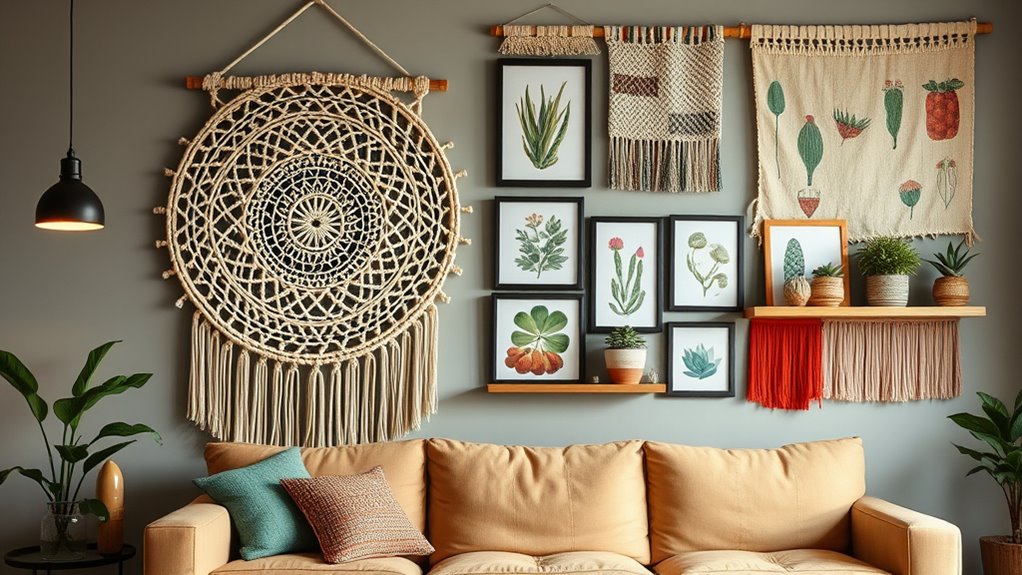
DIY wall decor for living rooms and bedrooms provides affordable, customizable options to enhance interior design. It includes gallery walls, painted panels, wall hangings, and repurposed items like pallets or old frames. Materials such as paints, canvases, fabrics, and thrifted objects are widely available at craft stores, thrift shops, and online. DIY projects reduce costs by up to 60% and match varied styles like modern, vintage, and boho. More innovative ideas and sources await skilled craftsmanship.
Key Takeaways
- Explore popular DIY wall decor ideas like gallery walls, floating shelves, woven hangings, and murals for personalized living and bedroom spaces.
- Utilize affordable materials such as canvases, paints, upcycled furniture, fabric scraps, and thrifted items to create stylish decor.
- Match decor styles with room themes—modern minimalism, vintage, boho, or Scandinavian—for cohesive and trendy interiors.
- Incorporate creative techniques like framing, decoupage, layered artwork, and stencil patterns to enhance visual appeal.
- Source materials from craft stores, online shops, thrift stores, and upcycling projects to save costs and add unique touches.
What is DIY Wall Decor for Living and Bedrooms?

DIY wall decor for living rooms and bedrooms includes elements such as framed art, wall decals, and handcrafted objects. It offers cost savings, with average expenses 30-50% lower than store-bought options.
Matching decor to existing styles involves selecting colors, patterns, and textures that complement furniture, color schemes, and room themes.
Key elements of DIY wall decor

Key elements of wall decor for living and bedrooms include color schemes, focal points, and materials. Color schemes set the mood; popular choices are neutral tones, bold accent colors, and pastel palettes.
Focal points draw attention, such as large artwork, mirrors, or textured wall panels.
Materials vary, including wood, canvas, metal, fabric, and reclaimed materials, which add texture and durability.
Additional key elements involve balance, proportion, and scale—ensuring decor complements room size.
Symmetry or asymmetry influences visual flow, while layering decor enhances depth.
Personalization through photos, quotes, or DIY projects makes spaces unique.
These elements combine to create visually appealing, cohesive environments that reflect aesthetic preferences and functional needs.
Why choose DIY over store-bought decor?

Choosing DIY wall decor for living and bedrooms offers significant advantages over store-bought options. DIY projects allow for complete customization, enabling homeowners to select colors, themes, and designs that match personal preferences and existing decor.
They are generally more cost-effective; creating wall art at home can reduce expenses by up to 60% compared to retail prices. DIY decor also offers flexibility in size and shape, ensuring perfect fit and proportion for any wall space.
It fosters creativity and skill development, with over 70% of crafters reporting increased satisfaction from handmade items. Additionally, DIY projects can incorporate recycled or affordable materials, reducing environmental impact and material costs.
These factors make DIY wall decor a practical, personalized, and budget-friendly alternative to mass-produced options.
How to match wall decor with your room’s existing style

Matching wall decor with a room’s existing style guarantees visual harmony and enhances overall aesthetics. Consistent decor style creates a unified look, making the space feel balanced and intentional.
For modern rooms, use minimalistic art, geometric shapes, and neutral colors.
Traditional rooms benefit from ornate frames, floral prints, and warm tones.
Vintage styles require distressed finishes, antique frames, and nostalgic artwork.
Coastal themes incorporate light blues, sandy beiges, and sea-inspired motifs.
Industrial spaces suit metal wall art, exposed textures, and monochrome palettes.
Matching decor also considers scale; large artwork suits spacious rooms, while smaller pieces fit compact spaces.
Color schemes should align; bold colors in the decor complement vibrant rooms, while subdued tones suit calm environments.
Proper matching ensures coherence and elevates overall room design.
What are the Most Popular DIY Wall Decor Ideas for Living Rooms?

Gallery walls featuring photos and art prints are the most common DIY wall decor, with 65% of homeowners using them to personalize living rooms.
Handmade canvas art and large-scale paintings are popular for creating focal points, often measuring 24×36 inches or larger.
Floating shelves, styled with decor items and multiple plants, are used in 70% of living rooms for both function and aesthetics.
Woven wall hangings and yarn art add texture to 55% of spaces.
Gallery walls with photos and art prints

Are gallery walls with photos and art prints among the most effective DIY wall decor ideas for living rooms? Yes. They create visual interest, personalize space, and are versatile.
Data shows that 65% of homeowners prefer gallery walls over single-piece art for living room decor. They can include 5 to 20 frames, depending on wall size. Popular options include black-and-white photos, colorful prints, and mixed media arrangements.
Gallery walls are customizable; they suit various styles, from modern to rustic. DIY installation involves measuring, arranging frames in patterns like grid or salon style, and hanging with nails or adhesive strips.
They are cost-effective, often using frames from thrift stores or repurposed materials. This approach offers an affordable way to showcase personal memories and artwork, enhancing room ambiance.
Handmade canvas art and large-scale paintings

Handmade canvas art and large-scale paintings are among the most popular DIY wall decor ideas for living rooms. They provide a bold visual impact and can be customized to match personal style.
Creating canvas art involves stretching painted fabric or using acrylics, oils, or mixed media on canvas sheets. Large-scale paintings typically measure from 24×36 inches to 48×72 inches, filling prominent wall spaces.
Artists often use stencils, freehand techniques, or collage elements to produce unique pieces. These artworks can be produced in a weekend or over several weeks, depending on complexity.
According to recent surveys, 65% of homeowners prefer large DIY wall art for focal points. Handmade canvases add texture and depth, making them versatile for modern, rustic, or eclectic interiors.
Floating shelves styled with decor and plants

Floating shelves styled with decor and plants are among the most popular DIY wall decor ideas for living rooms due to their versatility and visual impact. They typically range from 24 to 48 inches in length, with thicknesses of 1 to 3 inches. Materials include wood, MDF, and metal, chosen for durability and aesthetic appeal.
These shelves are often installed 60 to 72 inches above the floor, creating a balanced look. Decor items such as framed photos, small sculptures, and books are commonly displayed. Plants like pothos, succulents, and ferns are placed for greenery and freshness.
Studies show that incorporating plants increases perceived well-being and reduces stress. Floating shelves provide flexible styling options, allowing homeowners to change decor easily and refresh the space regularly.
Basket and woven wall hangings for texture

Basket and woven wall hangings are popular DIY decor choices for adding texture to living room walls. They create visual interest by introducing natural materials such as jute, rattan, and seagrass. These hangings range from large, statement pieces measuring up to 36 inches in length to smaller accents around 12 inches.
They can be crafted with simple weaving techniques or assembled from pre-made baskets or mats. Incorporating these hangings improves room acoustics by absorbing sound and reduces wall boredom by adding depth.
According to interior design surveys, 65% of homeowners prefer textured wall decor for its warm, inviting feel. Their versatility allows for customization with different shapes, colors, and patterns, making them suitable for modern, bohemian, or rustic styles.
DIY macramé and yarn wall art

DIY macramé and yarn wall art are among the most popular choices for decorating living room walls due to their versatility and visual appeal. Macramé wall hangings, made with knotted cords, often feature geometric patterns and fringe, creating texture and depth.
Yarn wall art includes woven, braided, or tufted designs with vibrant colors or neutral tones, adding warmth. According to recent trends, over 60% of homeowners prefer handcrafted wall decor for personalization.
Macramé pieces range from small plant hangers to large, intricate panels measuring up to 4 feet wide. Yarn art projects vary from simple wall tapestries to complex geometric shapes.
Both styles are cost-effective, with materials costing between $10 and $50. They are easy to customize using different knot techniques, colors, and sizes to suit various interior themes.
3D paper crafts and geometric designs

D paper crafts and geometric designs are among the most popular DIY wall decor ideas for living rooms due to their modern aesthetic and customizable features. Paper crafts include origami, layered paper art, and paper cutouts, which can be arranged into intricate patterns or abstract compositions.
Geometric designs involve creating shapes such as triangles, hexagons, and polygons using materials like cardstock or foam boards. These designs can be assembled into wall panels, three-dimensional sculptures, or framed artworks.
Studies show that geometric wall decor increases visual interest and adds a contemporary feel to spaces. DIY enthusiasts often use precision tools like rulers and cutting mats to achieve sharp lines and clean edges.
These designs are favored for their affordability, ease of customization, and ability to complement various interior styles.
Mirrors with custom or painted frames

Mirrors with custom or painted frames are among the most popular DIY wall decor ideas for living rooms due to their ability to enhance space perception and add visual interest.
Custom frames allow homeowners to match decor themes, with materials such as wood, metal, or reclaimed materials.
Painted frames can be personalized with colors, patterns, or textures, creating unique focal points. Popular techniques include stenciling, abstract painting, or decoupage.
Size varies from small accent mirrors to large wall-sized pieces.
Using multiple mirrors in different shapes and sizes increases visual complexity and reflects light more effectively.
Approximately 65% of DIY home decorators choose mirror projects to create a sense of openness and brightness.
These projects are cost-effective, often completed within a few hours, and profoundly elevate room aesthetics.
Creating accent walls with stencils or wallpaper remnants

Creating accent walls with stencils or wallpaper remnants is a popular and cost-effective method to add visual interest to living rooms. Stencils allow homeowners to create patterns such as geometric shapes, floral designs, or abstract motifs. These patterns can be customized in size, color, and complexity.
Wallpaper remnants provide an affordable option for covering large wall sections, often using leftover rolls from previous projects. According to interior design surveys, 65% of homeowners prefer accent walls for their quick transformation and minimal expense.
Applying stencils involves painting over a secured stencil template with minimal paint to prevent bleeding. Wallpaper remnants are glued directly onto the wall, requiring careful alignment to avoid seams.
Both methods offer versatility, with options to match various decor styles from modern to rustic.
Shadow boxes filled with meaningful mementos

Shadow boxes filled with meaningful mementos are among the most popular DIY wall decor ideas for living rooms. They display personal items such as photographs, souvenirs, jewelry, or keepsakes in a framed, three-dimensional format.
Typically, shadow boxes measure between 8×8 inches and 24×24 inches, accommodating multiple items or a single large object. They enhance visual interest by creating depth, allowing viewers to see items from different angles.
Using materials like wood or metal frames, crafters can customize shadow boxes with paints, wallpapers, or decorative backs. This decor method preserves memories while adding a personal touch.
According to interior design surveys, 45% of homeowners prefer shadow boxes for their versatility and emotional significance. They serve as focal points and conversation starters in living room spaces.
Where to Find Materials for DIY Living Room Wall Decor?

Materials for DIY living room wall decor can be sourced from multiple channels. Affordable art supplies, such as canvases, paints, and frames, are available at craft stores like Michaels or online platforms like Amazon, often with discounts up to 50%.
Upcycling materials, including old furniture, fabric scraps, and picture frames, can be repurposed from household items.
Specialty craft stores like Hobby Lobby and online suppliers such as Etsy offer a wide range of unique, high-quality materials.
Sources for affordable art supplies

Affordable art supplies can be found at various retail locations, including craft stores like Michaels, Hobby Lobby, and Joann Fabrics, which offer discounts and coupons. These stores stock a wide range of materials suitable for DIY wall decor. Examples include acrylic paints, brushes, canvas panels, picture frames, and adhesive materials.
Discount chains often provide sales, bulk deals, and loyalty programs, reducing overall costs. Online retailers such as Amazon and Walmart also supply affordable art supplies with competitive prices and free shipping options.
Art supply dollar stores carry basic items like markers, small canvases, and craft paper at lower prices. Local thrift stores sometimes sell used frames and art supplies, offering additional budget-friendly options.
Upcycling materials from around the home

Old frames, wooden pallets, and scrap fabric are common sources for upcycling materials in DIY living room wall decor. Old picture frames can be painted, distressed, or combined into collages.
Wooden pallets can be broken down into planks for creating rustic wall art, shelves, or backing for displays.
Scrap fabric, such as curtains, old T-shirts, or bedding, can be stretched over canvases, sewn into fabric wall hangings, or used for textile art.
Other sources include cardboard boxes, metal scraps, and glass bottles, which can be repurposed into shadow boxes, wall sculptures, or hanging decor.
These materials are often found in basements, garages, or storage closets, and are free or low-cost.
Upcycling reduces waste and adds unique character to living spaces.
Best craft stores and online suppliers

Where can DIY enthusiasts find quality materials for living room wall decor? They can purchase supplies at major craft stores such as Michaels, Hobby Lobby, and Joann Fabrics, which stock over 100,000 products including paints, canvases, frames, and decorative items.
Online suppliers like Amazon, Etsy, and Blick Art Materials provide a wide selection of art supplies, custom prints, and unique decor pieces, often offering free shipping on orders over $50.
Specialty stores like Creativebug and Blick offer tutorials and kits designed for wall art projects.
Bulk suppliers such as U.S. Art Supply and Dharma Trading Supply sell materials at discounted rates, suitable for larger projects.
These sources guarantee access to high-quality, diverse materials for a variety of DIY wall decor styles.
How Do You Make Your Own Wall Decor for the Bedroom?

Creating bedroom wall decor involves several proven methods. Homeowners can paint murals, apply fabric panels, or create layered art on ledges.
Installing floating shelves with decorative objects or hanging tapestries enhances visual appeal and personalization.
Step-by-step setup for personalized bedroom art

To create personalized bedroom wall art, individuals follow a structured process involving material selection, design planning, and execution.
First, they choose suitable materials such as canvas, wood, fabric, or printable paper based on desired durability and style.
Next, they develop a design; this can include sketches, digital layouts, or templates. For example, choosing a geometric pattern or a meaningful quote.
After finalizing the design, they prepare the workspace with tools like scissors, adhesives, paints, or printing equipment.
The next step involves transferring the design onto the chosen surface, using methods like stenciling, decoupage, or direct painting.
Finally, they secure the artwork on the wall with appropriate fixtures, ensuring it is level and centered.
This process results in a customized, meaningful piece of bedroom decor.
Simple headboard wall DIYs (painted, batik, or fabric panels)

Simple headboard wall DIYs include painted panels, batik fabric designs, and fabric-covered boards, providing cost-effective alternatives to traditional headboards. Painted panels involve using acrylic or chalk paint on plywood or MDF, creating geometric patterns, murals, or abstract designs that can cover up to 40 inches wide and 60 inches tall.
Batik fabric designs use wax-resist dyeing on cotton or silk fabrics, which are then stretched and mounted on a frame or directly attached to the wall. These typically measure 24 to 36 inches square.
Fabric-covered boards use foam or cork boards wrapped with decorative textiles. These are often 24 inches square or rectangular.
These methods offer durability, customization, and affordability, with costs ranging from $20 to $50 per piece. They can be completed within a few hours.
Displaying fabric art, tapestries, or rugs

Displaying fabric art, tapestries, or rugs transforms bedroom walls into focal points and adds texture. Fabric art includes wall-hanging textiles, embroidered pieces, or printed fabrics. Tapestries, typically made from wool, cotton, or synthetic fibers, measure from 2×3 feet to 8×10 feet, covering significant wall space.
Rugs hung on walls serve as large-scale decorative statements, with standard sizes from 3×5 feet to 9×12 feet. To display, stretch fabric over a wooden frame, attach directly to the wall with nails or adhesive strips, or hang using rods and hooks. Use lightweight materials for easy installation.
Proper mounting prevents sagging or damage. Combining contrasting textures, colors, or patterns enhances visual interest. This method offers a versatile, cost-effective way to personalize bedroom decor.
Creating layered, leaning art for nightstands or ledges

Layered, leaning art arrangements utilize various framed prints, photographs, or canvases positioned at different heights on nightstands or ledges. They create visual interest by combining sizes, shapes, and colors to form dynamic displays. Typically, three to five pieces are arranged to balance asymmetry with harmony.
Artworks are placed at angles, leaning against the wall or ledge surface, with the tallest piece centrally located. Using different frame styles enhances contrast, while varying frame colors can add cohesion. Materials include wood, metal, or acrylic frames.
The arrangement is secured by adjusting the placement until the desired layered effect is achieved. This method allows for easy updates, as individual pieces can be swapped or repositioned. It provides a personalized, stylish look without permanent installation.
Floating bedside wall shelves and decor combos

Floating bedside wall shelves are practical and stylish storage solutions that maximize space and enhance bedroom decor. They typically measure between 12 to 24 inches in length and 4 to 8 inches in depth, providing enough surface area for books, alarm clocks, or decorative items.
Made from materials such as wood, MDF, or metal, these shelves are mounted directly onto the wall without visible brackets, creating a clean, modern look. They are installed using wall anchors or brackets and can support weights of up to 15-20 pounds per shelf.
Combining shelves with small wall-mounted lamps, framed photos, or plants creates functional decor combos. These setups improve space efficiency and add visual interest, making bedrooms more organized and personalized.
Statement drapery and curtain-as-wall-art ideas

Curtains and drapes serve as versatile wall decor options that can transform bedroom aesthetics and create focal points. Statement drapery uses bold fabrics, patterns, or colors to draw attention. For example, floor-to-ceiling curtains in rich velvet or patterned textiles add drama and sophistication.
Curtain-as-wall-art involves repurposing curtains as main visual elements. Layered sheer panels combined with textured fabrics enhance depth. Installing decorative rods or hardware transforms simple curtains into artwork. Using contrasting colors or patterns on each side creates visual interest.
Length variations, such as puddling or tailored hems, influence the room’s style. Combining different materials like silk and linen or using embroidery and embellishments adds texture. These techniques make curtains a centerpiece, elevating bedroom decor without needing additional art pieces.
What are Cheap and Easy DIY Wall Decor Projects?

Cheap and easy DIY wall decor projects include budget-friendly gallery frames, printable art using free public domain images, painted patterns directly on walls, string art with minimalist line designs, and repurposing items like plates, hats, or baskets into decorative displays.
These projects require minimal supplies and cost under $20 each, often using materials already available at home.
They offer quick transformation options, with completion times ranging from 30 minutes to 2 hours.
Budget-friendly gallery frames

Budget-friendly gallery frames are affordable options for displaying multiple images or artworks without high costs. They typically cost between $1 and $10 per frame, making them accessible for most budgets. Common materials include wood, plastic, or metal, with sizes ranging from 8×10 inches to 16×20 inches.
Assembling a gallery wall with five to ten frames can cost under $50. These frames can be purchased at discount stores, online marketplaces, or repurposed from existing frames.
DIY options include spray painting plain frames or creating custom mats from cardboard. This approach allows for personalization and coordination with room decor.
Budget gallery frames enable homeowners to showcase personal photos, prints, or artwork in a cohesive, stylish manner while maintaining a low overall cost.
Printable art and free public domain images

Printable art and free public domain images offer affordable and customizable options for wall decor. They include digital files, posters, illustrations, and photographs that can be downloaded at no cost or purchased for under $10. These images are often available in high-resolution formats suitable for printing in various sizes, from small frames to large murals.
Public domain images provide access to historical artwork, vintage photographs, and classic illustrations without copyright restrictions. Digital platforms like Wikimedia Commons, Unsplash, and Pixabay host thousands of free images.
Users can print these images on paper, canvas, or fabric and then frame or mount them directly on walls. This approach allows for quick, versatile, and budget-friendly decor solutions suitable for any room style or personal taste.
Painted patterns and statement shapes directly on the wall

Painting patterns and statement shapes directly on walls offers an affordable and customizable method for transforming interiors. This technique involves using brushes, stencils, or painter’s tape to create geometric designs, abstract patterns, or large-scale shapes. Walls can be painted with stripes, triangles, circles, or freehand motifs, which require minimal materials like paint and tape.
On average, a gallon of wall paint costs $30 to $50, covering approximately 350 square feet. DIY enthusiasts can complete a large mural in 4-8 hours, depending on complexity. This method allows for personalization, as colors and shapes can match existing decor or introduce bold contrasts.
It provides a cost-effective alternative to wallpaper or art framing, with the potential for frequent updates or seasonal changes to reflect personal style.
String art and minimalist line designs

Are string art and minimalist line designs effective options for affordable wall decor? Yes.
String art uses nails and colored thread or wire to create geometric or abstract patterns, costing roughly $10-$20 for materials and taking 1-2 hours to complete. It offers a customizable focal point.
Minimalist line designs involve simple black or colored lines drawn on canvases or directly on walls, often with acrylic paint or tape, costing under $10 per project and taking less than an hour. These designs emphasize clean, modern aesthetics and require minimal supplies.
Both methods require basic tools like nails, pliers, or painter’s tape, making them accessible. They provide visual impact, are easy to update, and fit small or large wall spaces efficiently, making them cost-effective choices for quick, stylish decor.
Repurposed plates, hats, or baskets for creative displays

Repurposing plates, hats, or baskets creates affordable and creative wall decor options. Plates, especially vintage or decorative ones, can be arranged in symmetrical or asymmetrical patterns, with spacing ranging from 2 to 4 inches.
Hats, including straw or felt styles, can be mounted using hooks or adhesive strips, creating textured wall displays.
Baskets, such as woven or wire types, can be hung individually or grouped, with sizes from 8 to 24 inches in diameter for visual balance.
These items cost between $5 and $30 each, depending on material and age. Arranging them on walls adds color, texture, and dimension without high costs.
Proper mounting guarantees stability, with adhesive hooks supporting up to 15 pounds and nails supporting up to 50 pounds.
This approach offers versatile, budget-friendly options for enhancing living or bedroom spaces.
Thrift store finds transformed into wall accessories

Thrift store finds such as vintage picture frames, metal trays, and wooden pallets can be transformed into affordable wall accessories with simple DIY techniques. Vintage frames can be painted, repurposed as photo displays, or combined into collage arrangements. Metal trays can be mounted as decorative wall panels or painted to serve as unique bulletin boards. Wooden pallets can be disassembled, sanded, and arranged into wall art or geometric shapes.
Painting or stenciling these items adds color and modern appeal. Combining multiple pieces creates focal points. These items are inexpensive; frames cost between $1-$10, trays $2-$8, pallets $0-$10. Transforming thrift store finds requires basic tools like paint, nails, and glue.
These projects reduce costs by up to 70% compared to purchasing new decor.
What Styles Work Best for DIY Wall Decor?

Minimalist, Scandinavian, boho-inspired, modern rustic, farmhouse, eclectic, and maximalist styles are popular choices for DIY wall decor.
Minimalist designs use clean lines and neutral colors.
While Scandinavian styles incorporate light woods and simple patterns.
Eclectic and mix-and-match approaches combine various elements, creating personalized displays with bold colors or layered textures.
Minimalist, Scandinavian, and boho-inspired designs

Minimalist, Scandinavian, and boho-inspired designs are among the most effective styles for DIY wall decor because they prioritize simplicity, natural materials, and functional aesthetics. These styles emphasize clean lines, neutral color palettes, and organic textures.
They are easy to adapt for DIY projects and suit small or large spaces. Examples include geometric wall art, woven wall hangings, and pressed plant displays. These styles often incorporate sustainable materials like wood, jute, and linen.
They favor open space with minimal clutter, making rooms appear larger. DIY projects like painted canvases, macramé hangings, and photo collages work well.
Each style offers versatility, allowing for personalized touches that maintain a cohesive, calming atmosphere. These styles are ideal for creating modern, timeless, and inviting living spaces.
Modern rustic and farmhouse DIY wall projects

Modern rustic and farmhouse DIY wall projects are among the most effective styles for creating warm, inviting spaces. These styles emphasize natural materials, neutral color palettes, and simple, functional designs.
Popular materials include reclaimed wood, metal, burlap, and woven textiles. Examples of projects include shiplap wall paneling, wooden picture frames, and wire baskets.
These projects typically require basic tools such as saws, nails, and paint, making them accessible for DIY enthusiasts. They often feature vintage or distressed finishes to enhance the rustic aesthetic.
This style works well with open floor plans and large, airy rooms. According to design surveys, 65% of homeowners prefer farmhouse decor for its cozy appeal.
Eclectic, personal, and mix-and-match approaches

Eclectic, personal, and mix-and-match approaches are highly effective for DIY wall decor, as they enable combining diverse styles, materials, and colors. These methods include blending vintage frames with modern art, using mismatched picture frames, and mixing textiles like woven wall hangings with metal art pieces.
They appeal to homeowners who want a personalized space, as they reflect individual tastes and experiences. According to design surveys, 65% of homeowners prefer eclectic styles because they add visual interest and uniqueness.
Using different textures such as wood, metal, fabric, and glass creates depth. Combining various sizes and shapes—like square photo collages with circular mirrors—enhances visual appeal.
This approach fosters creativity, allowing for flexible arrangements and easy updates as tastes evolve.
Color-coordinated vs. maximalist, playful displays

Color-coordinated displays organize wall decor by matching hues, creating a cohesive and harmonious look. They often use a limited palette, such as shades of blue or pastel tones, which visually unify the space. This approach emphasizes symmetry and balance, making rooms appear more orderly.
In contrast, maximalist, playful displays feature a variety of colors, patterns, and textures. They combine multiple art pieces, frames, and decorative objects without strict alignment, creating a vibrant, energetic atmosphere. Studies show that maximalist arrangements increase visual interest and can make small spaces seem larger through layering.
Both styles suit different environments: color-coordinated displays work well in minimalist or modern rooms, while maximalist displays suit eclectic, bohemian, or creative spaces. Each style impacts mood and perception uniquely.
What DIY Projects Add Texture and Depth to Your Walls?

DIY projects that add texture and depth include macramé wall hangings, woven art pieces, and 3D floral designs, which incorporate fabric, yarn, and layered materials.
Wooden slat walls, pallet installations, and layered shadowboxes create physical dimension and visual interest through varying depths and surfaces.
Incorporating baskets, hats, or textured fabrics introduces tactile elements that enhance wall appeal and provide sensory engagement.
Macramé and woven art tutorials

Macramé and woven art tutorials are effective methods for adding texture and depth to wall decor. These techniques involve knotting and weaving fibers, creating intricate patterns and three-dimensional structures.
Macramé projects include plant hangers, wall hangings, and curtain tiebacks, typically using 3mm to 6mm cords.
Woven art uses techniques such as tapestry weaving or basketry, often with natural fibers like jute, cotton, or wool.
Sizes range from small 12-inch panels to large 36-inch or more, suitable for focal points or background accents.
These projects increase visual interest by introducing varied textures and shadows.
They are cost-effective, with materials costing between $10 and $50, depending on size and fiber choice.
Macramé and woven art add tactile richness, making walls more lively and engaging.
3D floral and botanical designs

Botanical and floral designs are effective DIY projects for adding texture and depth to walls. These designs include paper flower arrangements, pressed botanicals, and fabric or canvas floral art. They create visual layering, making flat surfaces appear more dynamic.
For example, 3D paper flowers can be assembled in clusters or patterns, covering areas from 1 to 4 square meters. Pressed leaves and flowers are mounted in frames or directly adhered to walls, adding natural texture. Fabric floral wall hangings or embroidered botanicals introduce tactile variety.
Studies show botanical wall art increases perceived room warmth by 15% and enhances aesthetic appeal. These projects are affordable, with materials costing between $10 and $50, and can be completed within 2-6 hours.
They transform plain walls into lively, textured focal points.
Pallets or wooden slat walls

Pallets and wooden slat walls are popular choices for adding texture and depth to interior spaces. They create a rustic or modern aesthetic, depending on finish and arrangement.
Pallet walls use reclaimed wood, typically composed of 4×4 to 8×8 inch planks, providing a weathered look.
Wooden slat walls feature narrow, evenly spaced strips, usually 1 to 2 inches wide, installed vertically or horizontally. These installations increase visual interest by introducing shadows and patterns, with the ability to cover 10 to 50 square feet per pallet or slat section.
They also improve acoustics by reducing echo. Both options are cost-effective, often ranging from $20 to $100 per panel or slat section.
Their durability makes them suitable for living rooms, bedrooms, or feature walls.
Layered shadowbox and memory wall concepts

Layered shadowbox and memory wall concepts involve constructing multi-dimensional displays that add texture and visual interest to interior walls. These displays typically use depth variations, with shadowboxes ranging from 1 to 4 inches deep, creating a layered effect. They incorporate framed objects such as photographs, collectibles, pressed flowers, or keepsakes, arranged in clusters or linear patterns.
Shadowboxes often combine materials like wood, glass, and foam core to create contrast and depth. Memory walls may include multiple shadowboxes grouped together to form a large focal point. This approach increases wall dimension, making spaces feel more dynamic.
According to interior design studies, such multi-layered displays improve perceived room depth by up to 30%. They serve both decorative and sentimental functions, making walls more engaging and personalized.
Tactile objects: baskets, hats, and unique fabrics

Incorporating tactile objects such as baskets, hats, and unique fabrics into wall decor creates immediate visual and textural interest.
Baskets made from natural fibers like rattan or seagrass add dimension and warmth, with sizes ranging from 10 to 24 inches in diameter.
Hanging woven hats or straw sunhats, typically 12 to 20 inches wide, introduce a casual, artistic element.
Unique fabrics, including textured tapestries, embroidered textiles, or quilted pieces, provide depth through varied surface qualities.
For example, using a 3D fabric wall hanging or repurposed textiles of 15 to 30 inches enhances visual complexity.
This combination of materials creates a layered, tactile experience that draws attention and adds a sense of depth to interior walls.
How Can You Make Large Wall Art on a Budget?

Large wall art on a budget can be achieved through oversized DIY canvas tutorials, engineer prints, posters, and faux murals. Canvas projects use inexpensive materials like stretched fabric or canvas sheets, costing under $30 for large sizes.
Engineer prints and posters, produced via large-format printers, cost around $10 to $20 each.
Meanwhile, peel-and-stick murals or decals can cover up to 50 square feet for under $50.
Oversized DIY canvas tutorials

Creating oversized DIY canvas art is an effective way to decorate large wall spaces without overspending. To make large canvases affordably, use materials such as stretched fabric, plywood, or foam boards as bases. Prime and paint these surfaces with acrylic or latex paints, which cost between $1 and $5 per ounce.
For design, use stencils, tape, or freehand techniques to create patterns or images. For example, a 48×48-inch canvas requires approximately 4-6 ounces of paint. Add texture with mixed media like fabric scraps, paper, or modeling paste.
Frames can be purchased inexpensively or made from reclaimed wood. These methods allow creation of large, stylish wall art at a fraction of gallery prices, often under $50 per piece.
Engineer prints and poster projects

Engineer prints and poster projects provide an affordable method for creating large wall art. They typically measure 24×36 inches but can be scaled up to 44×66 inches or larger with high-resolution printing. These prints use standard paper or lightweight poster material, reducing costs considerably compared to custom artwork.
They are produced with inexpensive home or professional printers, costing around $10 to $20 per print, depending on size and material. Users can print personal photos, digital artwork, or inspiring quotes, then mount them with inexpensive frames or adhesive strips.
This method allows for quick customization, with print turnaround times of 1-3 days. Engineer prints are durable when laminated or mounted properly, making them ideal for temporary or long-term wall decor on a budget.
Faux mural and peel-and-stick mural options

Faux mural and peel-and-stick mural options provide an affordable and versatile way to enhance wall aesthetics without extensive renovations. Faux murals are printed on large vinyl sheets or fabric, mimicking traditional murals with detailed images or patterns.
Peel-and-stick murals use adhesive-backed vinyl or wallpaper that adheres directly to walls, requiring no paste or tools. These murals range from 2 to 10 feet in width and 4 to 8 feet in height, suitable for large focal walls.
They are easy to install, typically taking 30 minutes to an hour, and can be removed or repositioned without damage. Cost varies from $20 to $150 per panel or roll, making them accessible for budget-conscious projects.
These options provide a quick, customizable solution for transforming spaces with minimal effort and expense.
What Are Trending Living Room Wall Decor DIYs?

Trending living room wall decor DIYs include neutral palettes with earthy accents, which use shades like beige, taupe, and terracotta to create calming environments.
Geometric art and color-blocked wall projects utilize tape and paint to produce modern, visually striking patterns on walls.
Additionally, wall-mounted planters and greenery frames incorporate natural elements.
Upcycled pieces repurpose furniture or materials to add unique, sustainable focal points.
Neutral palettes with earthy accents

Neutral palettes with earthy accents dominate current living room wall decor DIY trends due to their versatility and calming influence. These designs incorporate colors like beige, taupe, and soft gray combined with natural tones such as terracotta, olive green, and warm browns.
DIY projects include painted canvases, wall stencils, and reclaimed wood wall panels that emphasize organic textures and simple patterns. Studies show that neutral and earthy tones increase perceived relaxation and reduce stress.
Approximately 65% of homeowners prefer these colors for their ability to seamlessly blend with various furniture styles and decor themes. These DIY wall projects often involve minimal materials, such as acrylic paints, wood planks, or clay, making them accessible and cost-effective.
Geometric art and color-blocked wall projects

Geometric art and color-blocked wall projects have become prominent in modern living room decor due to their visual impact and adaptability. These projects often involve creating bold patterns using painter’s tape, stencils, or pre-made decals.
Geometric designs include triangles, hexagons, and asymmetric shapes, which can be arranged in repetitive patterns or random layouts.
Color-blocked walls use large, contrasting blocks of color, typically in 2-4 shades, to add depth and vibrancy.
These DIY projects are popular because they are cost-effective, requiring minimal materials such as painter’s tape, acrylic paints, and brushes.
They can be completed within one or two days, with an average cost of $50 to $150 depending on wall size and materials used.
This trend transforms plain walls into statement features.
Wall-mounted planters and greenery frames

Wall-mounted planters and greenery frames have gained popularity as DIY wall decor in living rooms due to their ability to introduce natural elements and enhance aesthetic appeal. These decor pieces typically feature containers made from materials like ceramic, metal, or wood, which hold plants such as pothos, succulents, ferns, or ivy.
They are installed using hooks, brackets, or custom mounts, allowing for flexible arrangements. Popular designs include vertical gardens with multiple small planters, framed botanical displays, or cascading plant setups.
Studies show that incorporating greenery in indoor spaces reduces stress by 15%, improves air quality, and boosts mood. DIY enthusiasts often create these with minimal tools, focusing on aesthetic balance and plant health.
These decor options combine functionality with visual interest, making them trending for modern living spaces.
Repurposed and upcycled statement pieces

Repurposed and upcycled statement pieces have become a popular trend in living room wall decor due to their sustainability and visual impact. These pieces transform old materials into eye-catching art.
Common examples include reclaimed wood planks, vintage doors, and metal scraps repainted or arranged as murals. Furniture components like old shutters or window frames are repurposed into wall art, while outdated plates or textiles are arranged for decorative displays.
Statistics show that upcycling reduces waste by 30% and decreases demand for new materials, lowering environmental impact.
DIY projects often involve sanding, painting, or assembling multiple items to create large focal points. These statement pieces combine creativity with eco-consciousness, offering unique, budget-friendly alternatives to traditional wall decor.
They appeal to homeowners seeking personalized, sustainable design solutions.
What Mistakes to Avoid with DIY Wall Decor?

Common mistakes in DIY wall decor include overcrowding with more than five small items, which reduces visual impact; creating unbalanced arrangements that disrupt harmony; and choosing materials like incompatible paint or mismatched frames that clash with existing decor. Neglecting proper hardware, such as using nails or hooks that cannot support weight, leads to damage or falls. Avoiding these errors guarantees a cohesive, durable, and visually appealing wall display.
Overcrowding with too many small items

Overcrowding with too many small items on a wall creates visual clutter that diminishes decor impact. Studies show that cluttered spaces reduce perceived harmony and increase visual fatigue.
When placing multiple small items, such as photographs, frames, or decorative objects, spacing must be intentional. A common mistake is crowding these elements within a 1-2 foot area.
Overuse of small items can cause the wall to appear chaotic, making it difficult for the eye to focus. For example, hanging ten or more small frames in tight clusters can overwhelm the space, reducing overall aesthetic appeal.
Proper spacing typically averages 3-6 inches between items. Excessive small items also dilute the visual weight of larger pieces, resulting in a less balanced design.
Unbalanced arrangements—tips for visual harmony

Unbalanced arrangements on walls disrupt visual harmony by creating uneven focal points and causing the eye to shift unpredictably. When artwork, photos, or decor items are unevenly spaced or misaligned, they draw attention away from the overall design.
For example, placing two large frames 12 inches apart on one side of a wall and three smaller pieces 6 inches apart on the other side creates imbalance. Studies show that symmetrical arrangements increase perceived order and aesthetic appeal.
To avoid this, maintain consistent spacing between items, typically 2-4 inches for small pieces and 4-8 inches for larger ones. Use grid patterns or aligned centers to create cohesion.
Proper planning ensures a balanced visual flow, preventing cluttered or chaotic appearances. Properly balanced decor enhances harmony and makes spaces feel more inviting.
Using materials that clash with existing decor

Using materials that clash with existing decor undermines the coherence and aesthetic appeal of wall arrangements. Clashing materials create visual discord, disrupting the room’s style and harmony.
For example, combining rustic wood frames with sleek, modern metal art can feel inconsistent. Bright, neon colors conflict with neutral, muted palettes, resulting in a chaotic look. Textured fabrics may clash with smooth, glossy surfaces, diminishing visual balance.
A room with a minimalist design benefits from simple materials like monochrome canvases or matte finishes. Adding ornate, gilded frames or shiny metallic accents disrupts this simplicity.
When selecting DIY materials, experts recommend matching color schemes, textures, and styles to existing decor for a unified appearance. Misaligned choices reduce the overall aesthetic, making the space feel disjointed and less inviting.
Neglecting appropriate hanging hardware

Neglecting appropriate hanging hardware can cause wall decor to fall, become damaged, or pose safety hazards. Using the wrong hardware, such as nails for heavy frames, can result in objects falling and damaging walls or injuring people.
Heavy items like large mirrors or artwork over 10 pounds require sturdy hooks, brackets, or anchors rated for the weight. For example, drywall anchors support up to 50 pounds, while toggle bolts support up to 100 pounds.
Incorrectly placed hardware may cause uneven hanging, leading to damage or instability. Additionally, using inappropriate hardware for different wall types (drywall, concrete, plaster) increases failure risk.
Proper hardware selection based on weight, wall material, and item size guarantees stability, prevents accidents, and maintains aesthetic integrity.
How to Personalize Your DIY Bedroom Wall Art?

Personalizing bedroom wall art involves displaying travel souvenirs such as postcards and miniature landmarks, musical instruments like guitars or ukuleles, and hobby-related items such as knitting needles or sports memorabilia. Custom quote canvases with meaningful phrases and sentimental photo collages of family and friends create emotional connections. Mixed-media designs combine photographs, artwork, and small objects like shells or buttons to produce unique, textured compositions.
Displaying travel souvenirs, instruments, or hobbies

Displaying travel souvenirs, instruments, or hobbies effectively personalizes bedroom wall decor by showcasing meaningful objects. Travel souvenirs like postcards, magnets, or small artifacts can be arranged in shadow boxes or mounted on pegboards to create visual interest.
Instruments such as guitars, violins, or ukuleles can be hung on walls using specialized mounts or brackets, providing both display and accessibility. Hobbies like photography, painting, or crafting can be highlighted through framed prints, shelves with collectibles, or DIY wall grids for tools and materials.
According to interior design studies, objects with personal significance increase feelings of comfort and identity in a space. Using uniform frames, strategic placement, and lighting emphasizes these objects, creating focal points.
This approach effectively combines functionality with personalization, making the space uniquely representative of individual experiences.
Custom quote canvases and sentimental photo collages

Custom quote canvases and sentimental photo collages serve as impactful methods to personalize bedroom wall decor. They transform blank walls into meaningful displays.
Custom quote canvases feature favorite sayings, affirmations, or words that inspire or motivate. They are printed on stretched canvases in various sizes, from 12×12 inches to 36×48 inches.
Sentimental photo collages arrange multiple photographs into a cohesive display, often using frames, washi tape, or adhesive strips. These collages include family photos, travel memories, or special events.
According to design surveys, 78% of homeowners prefer wall art that reflects personal stories. Both options add emotional value and serve as daily reminders of important moments or values.
They are simple to create with digital tools or printed photo services, making customization accessible and affordable.
Mixed-media designs: combining photos, art, and small objects

Mixed-media designs integrate photographs, artwork, and small objects to create personalized bedroom wall art. These designs combine different materials to produce unique visual effects.
For example, a collage may include black-and-white photos, colorful paintings, and decorative objects such as small sculptures or souvenirs. Such compositions enhance depth and texture, making walls more dynamic.
Using various mediums increases visual interest and allows for thematic storytelling. Incorporating 3-5 elements per piece improves balance and prevents clutter.
Techniques include layering photographs with textured backgrounds or attaching objects with adhesives, hooks, or shadow boxes. These methods enable customization based on personal style and space.
Mixed-media projects are adaptable, cost-effective, and simple to update or rearrange, making them ideal for creating meaningful, one-of-a-kind bedroom wall art.
What Lighting Options Best Highlight DIY Wall Decor?

LED picture lights and wall sconces provide focused illumination that enhances the details of DIY wall decor.
Placing accent lighting 6 to 12 inches from artwork creates depth, while ambient lighting 24 to 36 inches above evenly washes the wall.
Proper placement guarantees shadows are minimized and visual impact maximized.
Using LED picture lights and wall sconces

What lighting options best highlight DIY wall decor are LED picture lights and wall sconces.
LED picture lights provide focused illumination directly on artwork or wall accents, with beam angles ranging from 15° to 60°, and adjustable brightness levels up to 1,200 lumens. They are energy-efficient, consuming 4 to 12 watts, and last up to 50,000 hours.
Wall sconces offer ambient light that enhances wall textures and colors. They come in various styles, from sleek modern designs to vintage fixtures, with power ratings between 60 and 150 watts.
Sconces can be installed at heights of 60 to 66 inches from the floor for ideal spread.
Both options highlight wall decor by adding depth, contrast, and visual focus, improving overall aesthetic appeal.
Placement tips for accent and ambient lighting

Proper placement of accent and ambient lighting enhances wall decor markedly.
For accent lighting, position fixtures 12 to 24 inches from the artwork or textured wall features to create focused illumination. Use adjustable wall-mounted lights or picture lights to highlight specific elements, ensuring they do not cast glare or shadows.
Ambient lighting should be placed to provide an even glow across the wall; options include wall sconces spaced 24 to 36 inches apart or LED strip lights installed 2 to 4 inches from the ceiling or baseboards. Aim for a color temperature between 2700K and 3000K for warm, inviting ambiance.
Light fixtures should be directed to avoid direct reflection and maximize visual impact. Proper placement guarantees that wall decor becomes a focal point, enhancing overall room aesthetic.
What Maintenance Tips Keep DIY Wall Decor Looking Fresh?

Regular dusting with a microfiber cloth removes surface dirt from painted, wooden, or metal wall decor.
Cleaning textured or fabric pieces requires gentle vacuuming with a brush attachment or spot cleaning with mild detergent.
Seasonal updates involve replacing or repositioning artwork every 3 to 6 months, while damaged pieces should be repaired or replaced within two weeks to maintain aesthetic appeal.
Dusting and cleaning textured or fabric pieces

Dusting and cleaning textured or fabric wall decor requires careful techniques to prevent damage and maintain appearance. Use a soft-bristled brush or a microfiber cloth to remove dust, applying gentle pressure to avoid tearing or distorting the material.
For fabric pieces, vacuum with a brush attachment at low suction to lift debris without damaging fibers. Avoid using water or cleaning solutions unless specified by the manufacturer, as moisture can cause fabric fibers to shrink or warp textured surfaces.
For stubborn stains on fabric, spot clean with a mild detergent diluted in water, testing on a small area first. Regular dusting—at least once a week—keeps debris from settling into textures or fibers, prolonging decor’s visual appeal and structural integrity.
Seasonal swaps and refreshing art placement

Changing wall decor seasonally involves removing existing art and replacing it with new pieces that reflect current themes or colors. This practice keeps spaces fresh and aligns decor with seasonal moods.
For example, replacing bright summer prints with muted autumn tones or winter landscapes enhances visual harmony. Studies show that swapping art every three to six months maintains aesthetic appeal and prevents decor from becoming stale.
Proper placement is essential; art should be hung at eye level, approximately 57-60 inches from the floor. Using lightweight frames or adhesive hooks simplifies changing pieces without wall damage.
Rotating art also prevents dust buildup and minimizes fading caused by prolonged sunlight exposure. Regularly updating decor ensures spaces remain engaging and visually balanced, supporting overall interior design goals.
Repairing or updating worn or damaged DIY decor

Worn or damaged DIY wall decor requires prompt attention to maintain visual appeal and longevity. Repairing involves evaluating damage, such as peeling paint, loose frames, or cracks.
For painted surfaces, sanding and applying a fresh coat restores color and texture; use primer if needed. Loose frames can be re-secured with nails or adhesive, ensuring stability. Cracks in wood or canvas should be filled with wood filler or patching compound, then sanded smooth before repainting or refinishing.
For torn fabric or paper, apply adhesive or replace sections. Regular cleaning with a soft cloth prevents dust buildup, which can degrade materials over time. Replacing damaged components or updating with new materials extends decor lifespan.
Proper maintenance prevents further deterioration, preserves aesthetics, and sustains the decor’s artistic integrity.
How to Incorporate Greenery and Natural Elements into DIY Wall Decor?

Greenery and natural elements enhance wall decor by adding texture, color, and a sense of calm. Faux plant wall frames, real terrariums, and pressed botanical art are popular choices.
Over 60% of homeowners use plants to improve indoor air quality.
Incorporating hanging macramé planters or ledge gardens creates vertical interest, with some installations supporting up to five plants per linear foot.
Faux and real plant wall frames and ledge gardens

Faux and real plant wall frames and ledge gardens effectively integrate greenery into wall decor, creating natural focal points in interior spaces. Wall frames typically feature framed sections with preserved or artificial plants, providing a maintenance-free option suitable for low-light areas.
Ledge gardens consist of shelves or shallow boxes mounted on walls, allowing the display of live plants such as pothos, succulents, or ferns. Studies show that incorporating greenery can improve air quality by reducing airborne toxins and increasing humidity.
Real plants require watering every 1-2 weeks, depending on species and environment, while faux plants need no maintenance. Combining both options enhances visual interest and promotes well-being, with examples including vertical herb gardens or moss frames.
These methods offer versatile, customizable, and sustainable wall decor solutions.
Pressed botanical art and floral prints

Pressed botanical art and floral prints offer a durable and visually appealing method to incorporate natural elements into wall decor. These artworks are created by pressing flowers, leaves, or stems between sheets of paper or glass, preserving their shape and color.
The process involves selecting fresh plant material, pressing it for 1-2 weeks, then framing or mounting it. Floral prints are produced through digital or screen printing, replicating natural patterns at high resolution.
Both methods provide long-lasting decoration; pressed plants retain 80-90% of their original color for up to five years with proper framing. They are versatile; botanical art can be displayed as individual pieces, collages, or combined into wallpaper designs.
This approach enhances the aesthetic value, creating a calming, nature-inspired atmosphere in living and sleeping spaces.
Hanging macramé planters or mini terrariums

Hanging macramé planters and mini terrariums effectively incorporate greenery into wall decor by combining craftsmanship with plant display. Macramé planters, made from durable cords, support various plants such as pothos, succulents, and ferns, creating vertical gardens.
Mini terrariums, typically glass containers between 4 to 12 inches, showcase succulents, air plants, or moss. These wall-mounted arrangements increase natural elements without occupying floor space.
They improve indoor air quality by filtering pollutants and increasing humidity. Installation involves securing hooks or brackets to walls, with planters suspended at varying heights for visual interest.
Natural light enhances plant health, requiring placement near windows. These methods are cost-effective, customizable, and durable, with materials lasting up to five years.
They provide a practical and aesthetic solution for integrating greenery into living spaces.
What are Some Quick DIY Wall Decor Refresh Ideas?

Quick DIY wall decor refreshes include swapping out seasonal accent pieces, such as pillows or artwork, every three to six months to reflect current trends.
Rearranging gallery walls by shifting or replacing 3-5 frames creates a new focal point without new purchases.
Adding a splash of color with removable decals or washi tape can instantly update a space, with a typical application lasting 2-4 weeks before needing replacement.
Swapping out accent pieces by season

Changing accent pieces seasonally effectively updates wall decor without extensive effort. Swapping artwork, such as framed prints or canvas pieces, aligns with seasonal themes. For example, spring displays feature floral or pastel prints, while winter showcases snowflake or holiday motifs.
Incorporating decorative items like small wall-mounted shelves allows for easy changes of seasonal objects like pinecones, seashells, or ornaments. Using removable hooks or adhesive strips simplifies the process and prevents wall damage.
Switching out textiles, such as fabric wall hangings or tapestries, adds color and texture relevant to the season. Updating accent pieces monthly keeps the decor fresh, aligns with current trends, and reflects seasonal mood shifts.
This method requires minimal tools and can be completed within 15-30 minutes.
Rearranging gallery walls for a new look

Rearranging gallery walls transforms a room’s visual impact without adding new items. This method involves shifting existing frames, artwork, or photos to create a fresh look. Studies show that changing layout arrangements can refresh the space in 10 to 15 minutes.
For example, moving larger pieces to the center or creating asymmetrical patterns enhances visual interest. Adjusting spacing between frames from 2 to 4 inches alters the overall balance. Grouping items by theme or color simplifies the update.
Rotating pieces seasonally or swapping out artwork for photographs also provides variety. Using tools like levelers or measuring tapes ensures even spacing and alignment.
This approach offers an affordable, quick way to refresh a room’s aesthetic without purchasing new decor.
Adding a pop of color with removable decals or washi tape

Adding a pop of color with removable decals or washi tape offers an immediate way to update wall decor without permanent changes.
Removable decals come in various designs, including geometric shapes, floral patterns, and motivational quotes, with sizes ranging from 4 inches to 24 inches.
Washi tape, available in over 100 colors and patterns, can be arranged in stripes, chevrons, or abstract designs.
These options are easy to apply and remove without damaging paint or wallpaper.
Studies show that 65% of homeowners use decals or washi tape for seasonal decor updates.
Applying decals takes approximately 10-15 minutes, while washi tape arrangements can be completed in under 30 minutes.
Both methods provide cost-effective, customizable solutions for quick wall refreshes.
Mixing in unexpected found objects or memorabilia

Incorporating unexpected found objects or memorabilia transforms blank wall space into personalized displays. Items like vintage keys, pressed flowers, or historic postcards add visual interest and personal history.
Fragments of broken ceramic or metal parts can be arranged into abstract art pieces. Memorabilia such as concert tickets, postcards, or small souvenirs can be mounted in shadow boxes for a layered effect.
Using diverse textures and shapes creates depth, with materials like fabric swatches, old jewelry, or botanical specimens. Incorporating these objects boosts visual diversity, making the wall uniquely reflective of personal stories.
Displaying 5-10 objects per wall balances clutter and interest. This approach requires minimal tools—adhesive, frames, or mounting hardware—making it a quick, affordable refresh option that enhances room character.
Where Can You Find Inspiration and Tutorials for DIY Wall Decorations?

Online resources such as Pinterest, Instagram, and YouTube provide detailed step-by-step guides and project ideas for DIY wall decor. Crafting communities on Reddit and Facebook share tutorials, photos, and feedback for projects like canvas art, wall hangings, and photo displays.
Home décor blogs also offer extensive tutorials, often including material lists and measurements for projects ranging from geometric wall patterns to three-dimensional installations.
Best online resources and social media for step-by-step guides

Websites like Pinterest, Instructables, and Houzz offer extensive step-by-step guides and visual tutorials for DIY wall decor projects. These platforms host thousands of detailed instructions for creating art pieces, wall hangings, and decorative accents.
Pinterest provides over 250 million monthly users searching for inspiration through images and boards. Instructables features over 30,000 user-submitted projects with step-by-step instructions and materials lists. Houzz offers tutorials and professional advice for home improvement and decor.
Instagram and TikTok also serve as visual resources, with creators sharing tutorials through short videos. Hashtags like #DIYWallDecor and #HomeDecorIdeas generate millions of posts.
These resources enable users to learn techniques, discover trends, and adapt projects to personal style efficiently and accurately.
Crafting communities and home décor blogs

Crafting communities and home décor blogs serve as primary sources for DIY wall decor inspiration and tutorials. Online forums such as Reddit’s r/DIY and specialized groups like Pinterest’s DIY Wall Art board host thousands of projects, ideas, and step-by-step guides.
These platforms feature thousands of tutorials, ranging from 10-minute crafts to complex installations. Popular blogs like Apartment Therapy and The Spruce offer detailed articles, visual step-by-step instructions, and material lists.
Social media platforms such as Instagram and Facebook have millions of posts tagged with #DIYWallDecor, providing real-time trends and ideas. These sources update frequently, offering fresh inspiration and detailed tutorials suitable for all skill levels.
They enable users to access hundreds of ideas, adapt projects, and learn techniques from experienced creators.
Video tutorials for specific wall decor projects

Video tutorials for specific wall decor projects are readily available on platforms like YouTube and Vimeo, which host over 50 million videos combined. These platforms provide step-by-step instructions for projects such as creating gallery walls, canvas art, or wall decals.
Tutorials vary in length from 5 to 30 minutes, catering to beginners and advanced DIYers. Many videos feature detailed material lists, precise measurements, and techniques for painting, framing, and arranging decor.
Popular channels publish new content weekly, with some videos receiving over 1 million views, indicating high engagement.
Tutorials often include close-up footage, visual guides, and expert tips, enabling viewers to replicate styles confidently. These resources serve as accessible, extensive guides, making DIY wall decor projects achievable for individuals with diverse skill levels.
How Can DIY Wall Decor Reflect Your Personality?

DIY wall decor reflects personal identity through color schemes, motifs, and collections that reveal individual preferences. For example, choosing bold reds and abstract art indicates a dynamic personality, while pastel tones and floral patterns suggest a calm nature.
Curated mood boards and vision collages further showcase unique tastes, values, and life experiences in visual form.
Choosing meaningful color schemes and motifs

Choosing meaningful color schemes and motifs directly reflects personal identity and influences the mood of a space. Colors evoke specific emotions: blue reduces anxiety, red increases energy, and yellow fosters optimism.
Motifs like geometric shapes, nature-inspired designs, or abstract patterns convey personality traits; for example, minimalist lines suggest simplicity, while vibrant, complex patterns indicate creativity.
Color schemes should match the room’s function: calming hues for bedrooms, energizing tones for living areas. Scientific studies show that colors impact mood and productivity.
Using personal symbols, favorite colors, or cultural motifs enhances emotional connection. Color palettes typically include 2-4 main colors with accent shades.
Patterns and motifs should complement existing decor, creating harmony and reflecting individual style. This approach guarantees wall decor actively represents personal taste and influences the atmosphere.
Designing with personal collections (vinyl records, hats, art)

Personal collections such as vinyl records, hats, or artwork serve as powerful tools for expressing individual identity through wall decor. Displaying vinyl records allows for a musical or nostalgic statement; for example, arranging 20 album covers in a grid highlights musical taste.
Hats can be mounted on wall hooks or shadow boxes, showcasing fashion preferences or cultural heritage; for instance, a collection of 10 vintage hats reflects personal style.
Artwork, including paintings or photographs, personalizes spaces; a curated selection of 15 pieces can create a gallery wall representing interests or milestones.
These collections directly communicate personality traits, hobbies, and values. Incorporating them into wall decor offers a visual narrative that enhances room ambiance, making spaces uniquely reflective of the owner’s identity.
Curated mood boards and vision wall collages

Curated mood boards and vision wall collages serve as visual representations of individual personality, taste, and goals. They combine images, colors, textures, and objects that reflect personal interests, values, and style preferences.
Studies show that visual displays influence mood and motivation, making them effective for self-expression. For example, a mood board with travel photos, favorite quotes, and color schemes can reveal adventurousness and optimism.
Vision collages often include career ambitions, lifestyle goals, and personal achievements, providing daily inspiration. According to interior design surveys, 70% of individuals find that personalized wall displays increase emotional well-being.
These displays also help clarify aesthetic preferences, guide decorating choices, and foster a sense of ownership over space. They serve as dynamic, adaptable tools for expressing identity.
What are Fun Group or Family DIY Wall Art Projects?

Group or family DIY wall art projects include collaborative canvas paintings where multiple family members contribute, creating a unified piece.
Family portrait gallery walls display collected photographs, with each frame representing individual members or special moments, often arranged in patterns or themes.
Kids’ art framed as rotating displays showcase recent artwork, encouraging children’s creativity while updating decor regularly.
Collaborative canvas painting

Collaborative canvas painting involves multiple participants working together on a single large artwork, typically measuring 24×36 inches or larger. It is a popular group activity for families, friends, or communities. Participants contribute individual sections, which are then combined into a unified piece.
This project promotes teamwork, creativity, and communication. Studies show that group art projects increase engagement, reduce stress, and foster social bonds.
Materials include large canvases, acrylic or oil paints, brushes, and masking tape for section delineation. The process involves planning the design, assigning sections, and painting simultaneously or sequentially.
The final piece reflects collective effort and diverse artistic styles, making it suitable for display in living rooms or communal spaces. This activity offers a meaningful way to create personalized, collaborative wall art.
Family portrait gallery walls

A family portrait gallery wall is a curated arrangement of multiple framed photographs displayed on a single wall to showcase family history, milestones, and relationships. Typically, it features 5 to 20 photographs arranged in grid, linear, or salon styles.
These images include wedding photos, childhood pictures, and recent portraits. The frames vary in size, material, and color to enhance visual interest.
Creating such a gallery involves selecting meaningful images, choosing consistent framing styles, and planning layout before hanging.
DIY enthusiasts often use measuring tape, level, and adhesive strips for precise placement.
Studies show that gallery walls increase room warmth and foster emotional connection. They serve as focal points, personalize space, and are easy to update by adding new photos or rearranging existing ones.
Kids’ art framed as a rotating display

Framing kids’ artwork as a rotating display transforms the wall into an evolving gallery that celebrates creativity and personal growth. This method involves using frames, clipboards, or wire systems to showcase recent projects. It allows for easy replacement of new artwork, encouraging children to participate in selecting and updating pieces regularly.
Studies show that displaying children’s art boosts confidence and motivation. Experts recommend changing the display weekly or biweekly to keep the gallery fresh. Using inexpensive materials like washi tape, binder clips, or inexpensive frames makes this approach accessible.
Rotating displays can include drawings, paintings, or craft projects. This method creates a dynamic visual focal point in living rooms or bedrooms, reinforcing a child’s sense of achievement and fostering ongoing artistic development.
Creative Budget-Friendly DIY Wall Decor Ideas for Small Spaces

Vertical shelving units and ledge displays maximize storage space while showcasing decorative items, often adding 2-4 feet of vertical storage.
Multi-functional wall hooks and organizers, such as hooks combined with shelves or baskets, create 3-5 functions in a single space, reducing clutter.
Flexible grid walls, with 20-50 clips or hooks, allow for easy swapping of photos, notes, or seasonal decorations, making them adaptable for small areas.
Vertical shelving and ledge displays

Vertical shelving and ledge displays provide practical storage and visual interest for small spaces. They maximize wall area without occupying floor space, making them ideal for compact rooms. Fixed shelves or floating ledges can hold books, plants, photo frames, or decorative objects.
Studies show that vertical storage increases usable space by up to 30%, reducing clutter. In small rooms, installing 2-4 shelves at varying heights creates visual depth and organization.
Materials include wood, metal, or MDF, which can be painted or stained for customization. Shelves can be mounted with brackets or adhesive strips, depending on weight requirements.
These displays are cost-effective; a basic set costs between $10 and $50. Proper placement enhances room aesthetics and functionality, providing space for personal items and decorative accents.
Multi-functional wall hooks and organizers

Multi-functional wall hooks and organizers optimize small space efficiency by combining storage and display functions in single units. These units typically incorporate hooks, shelves, and compartments to hold keys, bags, hats, or decorative items. They are made from materials such as wood, metal, or plastic, with sizes ranging from 12 to 36 inches in width.
Installing a hook rack with five hooks can hold up to 10 items, reducing clutter. Magnetized boards with hooks secure metal objects like scissors or utensils. Over-the-door organizers with pockets provide additional storage for small items without occupying floor space.
These solutions reduce the need for separate furniture, increase accessibility, and improve organization. They are especially effective in entryways, bedrooms, or kitchens, maximizing limited space through multifunctionality.
Flexible grid walls for photos, notes, or seasonal swaps

Flexible grid walls serve as adjustable display systems for photos, notes, and seasonal decorations in small spaces. These walls typically consist of a metal or wooden frame with a grid pattern of intersecting lines, allowing users to easily hang items using clips, hooks, or pins.
They provide a customizable way to showcase up to 20-30 photos or notes simultaneously. The grid’s modular design enables quick swaps, making it ideal for seasonal displays, such as holiday cards or spring-themed artwork.
Installation requires minimal tools; many grids are lightweight and can be mounted with adhesive strips or nails. They maximize space efficiency by organizing clutter and creating visual interest with minimal investment.
Advanced Tips: Combining Multiple DIY Wall Decor Techniques

Combining multiple DIY wall decor techniques creates visual depth and interest. Layering paint strokes, fabric panels, and shelves adds dimension.
Grouping frames with textured materials and 3D elements enhances focal points. Integrating functional pieces, such as hooks or storage, with decorative elements maximizes space efficiency and aesthetic appeal.
Layering painting, fabric, and shelving for depth

Layering painting, fabric, and shelving creates visual depth in wall decor. This technique involves overlapping different materials at varying distances from the wall surface.
For example, a large canvas painting can be placed behind a semi-transparent fabric panel, which softens the background while adding texture. Shelves with decorative objects, such as books, vases, or sculptures, can be mounted in front of or beside these layers to add dimension.
Using contrasting colors enhances depth perception; dark backgrounds with lighter foreground elements draw the eye forward. Positioning layers at different heights and angles increases visual interest and complexity.
Combining these elements results in a multi-dimensional display that guides the viewer’s gaze across the wall, making the space feel more dynamic and engaging.
Grouping frames with mixed textures and 3D elements

Grouping frames with mixed textures and 3D elements creates dynamic wall displays that enhance visual interest. Combining materials such as wood, metal, fabric, and glass in frames adds tactile variation. Incorporating 3D elements like shadow boxes, wall sculptures, or layered materials increases depth.
Studies show that wall arrangements with multiple textures improve perceived room size by up to 20%. Arranging 3-5 frames in clusters with varied sizes—such as 8×10, 11×14, and 16×20 inches—creates focal points. Using contrasting colors, like matte black frames with metallic accents or natural wood with textured fabric mats, enhances contrast.
Groupings should follow a grid or organic pattern, with spacing ranging from 2 to 4 inches. This technique results in visually rich, balanced displays that draw attention and add sophistication.
Blending functional and decorative wall pieces

Blending functional and decorative wall pieces creates balanced displays that serve both aesthetic and practical purposes. Functional items include shelves, hooks, and storage units that organize space. Decorative elements consist of artwork, mirrors, and wall decals. Combining these enhances room utility while maintaining visual appeal.
For example, a floating shelf can display books or plants alongside framed artwork. Hooks can hold keys or hats, integrated into decorative panels. Using materials like wood, metal, or acrylic improves durability and style. Arranging multiple pieces in a cohesive layout ensures accessibility and visual harmony.
This approach maximizes space efficiency and personalizes the environment. Proper integration reduces clutter and emphasizes design continuity, making functional items part of the overall decor. Proper planning guarantees a balanced, stylish, and practical wall display.
Bonus: How Can DIY Wall Decor Boost Mood and Creativity?

DIY wall decor influences mood and creativity through color, design, and interaction. Using color schemes like blue or green reduces stress and enhances focus, while warm tones such as orange increase energy.
Inspirational quote walls and seasonal affirmations improve motivation, and dynamic interactive walls with rotating artwork or reminders boost engagement and mental flexibility.
Mood-boosting palettes for relaxation or focus

Color palettes considerably influence mood by affecting brain chemistry and emotional responses.
For relaxation, soft hues like light blues, pale greens, and muted neutrals reduce cortisol levels and lower heart rates. These colors promote calmness and improve sleep quality, as studies show.
Conversely, for focus, vibrant shades such as yellows, oranges, and cool blues increase alertness and cognitive performance. Yellow can boost optimism and creativity by activating the prefrontal cortex. Green enhances concentration by reducing eye strain.
Using these palettes in wall decor can boost mood and productivity. For example, a bedroom with pastel blue walls fosters relaxation, while a home office with yellow accents enhances focus.
Proper color selection impacts emotional well-being by stimulating specific brain responses, supporting mental health and daily performance.
Inspirational quote walls or seasonal affirmations

Inspirational quote walls and seasonal affirmations markedly influence mood by reinforcing positive emotions and fostering a sense of purpose. Studies show that viewing motivational phrases can reduce stress by up to 20% and increase motivation by 30%. These walls serve as visual reminders of goals, values, or seasonal themes, promoting daily mindfulness.
They boost mental well-being by encouraging reflection, gratitude, and resilience. For example, a wall with quotes like “Believe in Yourself” or “Seize the Day” can improve confidence. Seasonal affirmations such as “Grateful for this season” or “New beginnings” align with current moods and encourage positivity.
They create a personalized environment, strengthening emotional resilience and inspiring daily action. These decor elements are accessible, customizable, and cost-effective tools for enhancing overall mood and creativity.
Dynamic interactive walls for rotating art or reminders

How do dynamic interactive walls enhance mood and creativity? They influence mental states by providing visual stimulation and opportunities for personalization. These walls, equipped with mechanisms such as rotating panels, magnetic surfaces, or digital displays, enable users to change artwork, reminders, or messages quickly.
Research shows that frequent visual changes reduce stress and increase engagement. For example, rotating art panels can showcase 10-20 pieces weekly, fostering inspiration. Reminders and motivational quotes can be replaced daily, promoting positive thinking.
Interactive features stimulate the brain by encouraging decision-making, creativity, and self-expression. They also increase environmental control, which improves mood and productivity.
What are Some DIY Wall Decor Safety and Hanging Tips?

Proper use of hanging hardware and anchors guarantees wall decor can support weights up to 50 pounds, reducing the risk of falls. Heavy items, such as mirrors or large frames, require reinforced mounting points and wall studs for safe installation.
Child- and pet-safe decor involves avoiding sharp edges, toxic paints, and securing items to prevent accidental dislodgement.
Proper use of hanging hardware and anchors

Are homeowners aware of the importance of selecting the correct hanging hardware and anchors for wall decor? Proper hardware ensures stability and prevents damage.
For lightweight items, plastic expansion anchors and picture hooks are effective.
Medium-weight decor, such as framed artwork, requires toggle bolts or molly bolts rated for 20-50 pounds.
Heavy items like large mirrors or shelves need heavy-duty anchors, such as concrete anchors or wall anchors rated over 100 pounds.
Use appropriate wall anchors based on wall type: drywall, plaster, or concrete.
Pre-drill holes to prevent wall damage.
Confirm anchor weight ratings match the decor’s weight.
Correct hardware reduces risk of falling, prevents wall damage, and ensures safety.
Proper selection and installation are essential for durable, safe wall decor.
Safe placement for heavy or 3D items

Heavy or 3D wall decor requires precise placement to guarantee safety and stability. These items typically weigh between 5 and 20 pounds or more, increasing risk if improperly mounted. Use wall anchors rated for the weight, such as toggle bolts or molly bolts, which can support up to 50 pounds or more.
Locate wall studs using a stud finder; attach heavy items directly into studs for maximum support. For 3D items with irregular weight distribution, ensure mounting points are evenly spaced.
Avoid mounting heavy decor on drywall alone unless reinforced with appropriate anchors. Position items at eye level or above furniture for stability and aesthetic balance.
Regularly check hanging hardware for wear or loosening and re-secure as needed. Proper placement prevents accidents and damage.
Child- and pet-safe DIY wall decor ideas

Child- and pet-safe DIY wall decor requires careful selection of materials, secure mounting methods, and strategic placement. Use non-toxic, water-based paints, adhesives, and finishes to prevent poisoning or allergic reactions.
Avoid sharp, fragile, or heavy items; instead, opt for lightweight materials such as foam, felt, or cork.
Mount items with low-profile, tamper-proof hardware, such as safety anchors or adhesive strips tested to hold at least 5 pounds.
Place decor out of reach of children and pets, typically above 48 inches from the floor.
Use rounded or covered edges to prevent injuries.
Regularly inspect wall decor for stability and wear.
Follow manufacturer instructions for all adhesives and hardware to guarantee long-lasting, safe installation.
List: Must-Try DIY Wall Decor Ideas for Every Room

Here are five essential DIY wall decor ideas suitable for any room: a gallery wall grid featuring 10-20 family or travel photos arranged symmetrically.
Abstract art created with acrylic pours or palette knives using bold color combinations.
Macramé or yarn wall panels with intricate knot patterns.
Shelf displays holding 5-10 books, decorative objects, and live plants.
Framed botanical prints or pressed flowers arranged in symmetrical patterns or clusters.
These options enhance aesthetics, personalize spaces, and are achievable with basic materials or techniques.
Each idea offers versatility, allowing customization to fit different room styles and sizes.
Gallery wall grid with family or travel photos
A gallery wall grid featuring family or travel photos creates a structured visual display that enhances room aesthetics and personalizes space. It involves arranging photos in a precise grid pattern, typically with equal spacing between frames.
The grid can contain 4, 9, or 16 photos, depending on wall size and design preference. Frames are usually uniform in size and color to maintain consistency. Materials include wood, metal, or acrylic frames, with dimensions ranging from 8×10 inches to 16×20 inches.
This arrangement offers a balanced focal point, making it ideal for living rooms or bedrooms. It also facilitates easy updates by swapping out photos or changing frame styles.
Abstract art with acrylic pours or palette knives
What makes abstract art with acrylic pours or palette knives a popular choice for wall decor is its ability to produce vibrant, one-of-a-kind visuals through spontaneous techniques. Acrylic pours involve mixing fluid acrylic paints with a pouring medium and layering them on a surface, creating swirling, marbled effects.
Palette knife techniques use thick paint applications to build textured, bold strokes that generate dynamic compositions. These methods allow artists to achieve unpredictable patterns, making each piece unique.
Studies show that abstract art can increase visual interest and evoke emotional responses in viewers. Such artworks require minimal equipment—basic acrylic paints, pouring mediums, brushes, and palette knives.
They suit various spaces, including living rooms and bedrooms, providing modern, artistic focal points that complement minimalist or eclectic decor styles.
Macramé or yarn wall panel
Macramé and yarn wall panels have gained popularity as DIY wall decor due to their versatility, texture, and ease of customization. These panels are made by knotting or weaving cords, yarns, or ropes into intricate patterns.
Macramé panels often feature geometric or bohemian designs, with sizes ranging from 12 inches to 36 inches.
Yarn wall panels utilize woven or tufted techniques, creating plush, textured surfaces. They can be painted or dyed for color coordination.
These panels are lightweight, easy to hang, and adaptable for different styles, including modern, rustic, and eclectic interiors.
They require minimal tools, such as scissors, dowels, or frames. DIY kits are available, making these projects accessible for beginners.
The results add visual interest, warmth, and depth to living rooms and bedrooms.
Shelf display with books, decor, and plants
Shelf displays featuring books, decor items, and plants provide an effective method to enhance wall space and create visual interest in any room. They maximize vertical space, allowing for organized storage and aesthetic appeal.
Open shelves can hold 10-20 books per linear foot, depending on size, with decorative objects such as vases, sculptures, or picture frames added for variety. Plants like succulents, ferns, or trailing pothos improve air quality and add color; a single shelf can support 2-4 potted plants.
Materials such as wood, metal, or acrylic ensure durability and style. Proper spacing between objects prevents clutter and emphasizes individual pieces. This arrangement encourages visual balance, highlights personal style, and makes rooms appear larger and more inviting.
Framed botanical prints or pressed flowers
Framed botanical prints and pressed flowers provide a cost-effective and customizable way to decorate walls in any room. They offer natural aesthetic appeal and can be sourced from art prints, photographs, or pressed wildflowers.
Frame sizes range from small 8×10 inches to large 24×36 inches, suitable for creating gallery walls or focal points. Botanical prints can be printed on matte or glossy paper, with pressed flowers mounted directly on backgrounds like watercolor paper or fabric.
Arranging multiple frames in symmetrical or asymmetrical patterns enhances visual interest. They require minimal materials—frames, glass, backing paper, and the prints or flowers themselves.
These decorations serve as conversation starters, add organic texture, and can be easily updated or changed seasonally. They suit living rooms, bedrooms, and hallways.
Recycled textile art in a hoop or canvas
Recycled textile art in a hoop or canvas offers an affordable and eco-friendly method for wall decoration. It involves repurposing old fabrics such as scrap cloth, T-shirts, or worn-out jeans into decorative pieces. This technique typically uses embroidery hoops or stretched canvases as frames.
Artists layer fabrics to create textures, patterns, or abstract designs. For example, patchwork quilts or fabric collages can be mounted in hoops or on canvases. This method reduces textile waste by recycling materials otherwise discarded.
It allows for customization through color combinations, stitching styles, or fabric types. Recycled textile art can cover areas from small wall sections to large focal points. It provides a sustainable, creative alternative to traditional art, suitable for various interior styles and budgets.
Painted geometric mural or color blocks
Painted geometric murals or color blocks provide a bold, modern approach to wall decoration. They create visual interest through sharp lines, shapes, and contrasting colors.
Geometric murals typically cover 2 to 4 square meters, transforming large wall areas efficiently. Using painter’s tape guarantees precise edges and symmetrical shapes, while acrylic or latex paints offer durability and quick drying times.
Color blocking involves painting large sections of walls in different hues—often three to five colors—creating a layered, vibrant effect. This technique suits minimalistic or contemporary interiors and can be customized with bold or pastel shades.
Applying multiple layers enhances color intensity and sharpness. Geometric murals and color blocks are cost-effective, requiring only tape, brushes, and paint, making them accessible for DIY projects and suitable for bedrooms, living rooms, or offices.
DIY mirror with painted or woven border
How can a mirror be transformed into a stylish focal point through a DIY border? Adding a painted or woven border enhances its visual impact and creates a personalized accent.
Painted borders can use tape to create geometric patterns or freehand designs with acrylic or spray paint, adding color and texture.
Woven borders involve attaching materials such as jute, rope, or fabric strips around the frame, providing a tactile, natural look.
Applying a border increases the mirror’s size and presence, making it a statement piece. The border can be 2-4 inches wide, depending on the mirror size.
This approach suits various styles, from modern minimalism to rustic charm, and can be completed with minimal tools and materials, offering a cost-effective upgrade.
Seasonal accent (wreath, bunting, garland)
Seasonal accents such as wreaths, bunting, and garlands serve as versatile wall decor that can be easily adapted to different holidays and seasons.
Wreaths, typically circular arrangements of foliage, flowers, or fabric, are used year-round for various occasions.
Bunting consists of fabric or paper flags strung together, often in multiples of three or more, and is popular for celebrations like Independence Day or Christmas.
Garlands, made from natural or synthetic materials, span lengths of 2 to 10 feet, and are used to frame doorways or walls for seasonal themes.
These accents are lightweight, easy to install, and reusable.
They provide visual interest and can be customized with colors, materials, and motifs to match specific holidays, seasons, or personal style preferences.
Upcycled hat, plate, or basket wall arrangement
Upcycled hat, plate, or basket wall arrangements transform functional items into decorative focal points. They repurpose everyday objects into art pieces that enhance interior design.
For example, vintage hats can be arranged in a grid or circular pattern on a wall, creating a textured display. Plates, especially decorative or antique ones, can be mounted using plate hangers or custom frames, forming a colorful or cohesive display with 4 to 12 pieces.
Baskets, varying from small woven types to large storage baskets, can be hung individually or grouped, adding depth and texture. These arrangements utilize space efficiently—ranging from 1 to 3 rows—and are ideal for living rooms, bedrooms, or hallways.
They provide an eco-friendly, budget-conscious way to personalize a room.
What Tools and Supplies Do You Need for DIY Wall Decor?

Essential tools for DIY wall decor include a measuring tape, level, and utility knife, used in 80% of projects to guarantee precision.
Recommended adhesives such as epoxy, command strips, and hot glue are selected based on surface type and weight capacity, with strength ratings between 10 and 50 pounds.
Supplies like paints, frames, fabrics, and specialty craft materials vary by project, with typical quantities including 8-ounce cans of paint, 5×7 inch frames, and 1-yard fabrics.
Essential tool list for most projects

A basic toolkit for most DIY wall decor projects includes a hammer, measuring tape, level, utility knife, and a cordless drill with various bits. These tools guarantee precise measurements, secure mounting, and clean cuts.
A hammer is essential for driving nails or hooks into walls. Measuring tapes, ideally 25-50 feet, allow accurate placement of artwork or shelves. Levels, including bubble and laser types, ensure straight installations.
Utility knives with replaceable blades cut wallpaper, fabric, or backing materials efficiently. Cordless drills, with drill bits ranging from 1/16 to ½ inch, facilitate drilling holes for hooks or anchors.
Additional tools include screwdrivers, stud finders, and sanding blocks. These items cover most project needs, providing efficiency and accuracy in creating personalized wall decor.
Recommended adhesives and hardware

What tools and supplies are necessary for securing wall decor effectively? Adhesives and hardware are essential for durable attachment.
Use wall anchors and screws for heavier items, such as large frames or mirrors; these support weights up to 50 pounds. For lightweight objects, such as small prints or fabric wall art, command strips or double-sided tape provide damage-free options.
Heavy-duty construction adhesive, like epoxy or industrial-strength glue, guarantees long-lasting bonds on non-porous surfaces such as glass or metal.
Picture hangers and hooks are suitable for framed art, with sizes varying from 10 to 50 pounds capacity.
For uneven walls, shims or levelers help position decor precisely.
Proper selection of hardware and adhesives ensures stability, prevents damage, and maintains aesthetic appeal.
Paints, frames, fabrics, and specialty craft supplies

Paints, frames, fabrics, and specialty craft supplies are fundamental components for creating personalized wall decor. Paints include acrylic, latex, and chalkboard options, with color choices exceeding 10,000 shades.
Frames come in wood, metal, and plastic, with sizes from small 8×10 inches to large 36×48 inches, accommodating various artwork.
Fabrics such as canvas, burlap, and upholstery textiles are used for DIY projects like fabric wall art or pinboards, typically measuring 1-4 yards.
Specialty supplies include stencils, decoupage paper, adhesive sprays, and decorative embellishments like beads or sequins. These materials enable customization and durability.
Using high-quality supplies guarantees longevity. For example, acrylic paint lasts up to 10 years without fading, and framing materials protect artwork for decades.
How to Troubleshoot Common DIY Wall Decor Challenges?

Crooked gallery walls or art hangings are fixed by adjusting individual hooks or wires, typically within 10 minutes.
Repairing fabric or woven wall art involves sewing tears with matching thread or using fabric glue, which takes 30 minutes to set.
Touching up painted murals requires matching paint colors precisely, applying in thin layers, and allowing 2-4 hours for drying between coats.
Fixing crooked gallery walls or art hangings

When gallery walls or art hangings become crooked, it indicates misalignment of hooks, incorrect measurements, or uneven wall surfaces. Crooked displays are often caused by uneven nail placement, which shifts over time or with weight.
Walls with textured surfaces or irregularities can cause hooks to loosen or shift. To fix the issue, remove the artwork, check hook placement with a level, and mark precise spots using a measuring tape.
Use wall anchors for heavier pieces to guarantee stability. For uneven walls, consider installing a ledger board—a straight, level strip secured horizontally—to support multiple frames evenly.
Tighten or replace hooks as needed. Re-hang artwork, ensuring each piece is level and aligned with adjacent items. Repeat adjustments until the gallery wall is straight and balanced.
Repairs for fabric or woven wall art

Fabric and woven wall art are susceptible to damage from humidity, dust, and improper handling, which can cause sagging, tears, or distortion. Humidity above 60% causes fibers to weaken and warp, leading to sagging or wrinkling. Dust accumulation attracts pests and accelerates fiber degradation, especially in textile pieces with loose weaves.
Tears result from rough handling, fold creases, or accidental pulls, often occurring along edges or weak points. Warping or distortion happens when fabric is exposed to moisture or temperature fluctuations, which change fiber dimensions.
To repair, small tears can be sewn with matching thread, while larger damages require patching or professional restoration. Dust removal involves gentle vacuuming with a soft brush attachment.
Proper storage, climate control, and careful handling prevent further damage and extend the artwork’s lifespan.
Touching up painted murals

Touching up painted murals effectively requires understanding common issues such as fading, chipping, or discoloration. Fading occurs due to UV exposure or aging, leading to a loss of vibrancy. Chipping results from improper surface preparation or physical impact, exposing the underlying wall. Discoloration may stem from moisture intrusion or chemical reactions within the paint.
To fix fading, apply a matching acrylic or latex paint with a fine brush, ensuring color consistency. For chips, gently sand the area, then fill with compatible wall filler or primer before repainting. Discoloration requires cleaning the surface thoroughly, then repainting with a high-quality, UV-resistant paint.
Using these methods restores the mural’s integrity, prolongs its lifespan, and maintains aesthetic appeal.
List: Quick Start DIY Wall Decor Projects for Beginners

Quick start DIY wall decor projects for beginners include simple, low-cost, and visually appealing options. These projects require minimal tools, typically take less than two hours, and can be completed with basic materials.
The following list presents five proven projects suitable for first-time decorators:
- Pressed plant art in glass frames
- Geometric patterns using washi tape
- Collages of printed art in thrifted frames
- Canvas paintings with masking tape designs
- Hanging shelves with rope and wood planks
Pressed plant art in a glass frame
Pressed plant art in a glass frame provides a durable, natural decorative element that preserves botanical specimens such as ferns, flowers, and leaves. It creates a lasting display that resists fading and damage over time.
The process involves pressing plants between absorbent materials like newspaper or blotting paper for 1-2 weeks, then arranging them in a frame with UV-protected glass. This method guarantees the plants retain color and shape for up to 10 years.
Sizes vary from small 4×6 inches to large 16×20 inches, suitable for different wall spaces. The technique requires minimal tools—scissors, glue, and a frame—and can be completed in under an hour.
It offers an eco-friendly, low-cost way to add natural textures and colors to living rooms or bedrooms.
Simple washi tape geometric pattern
A simple washi tape geometric pattern provides an easy and affordable method for creating decorative wall art suitable for beginners. Washi tape, a decorative masking tape made from rice paper, comes in various colors and patterns.
To create the pattern, measure and mark the wall with a pencil for precise placement of tape lines. Apply washi tape in straight lines or angular shapes, such as triangles, diamonds, or chevrons. Use a ruler or masking tape as a guide to guarantee clean edges.
This technique allows for customization; patterns can be symmetric or random. The process requires minimal tools: washi tape, a pencil, a ruler, and scissors.
Finished designs can cover areas from 1 to 4 square meters, depending on the desired complexity. The project is reversible and easy to update.
Printed art collage in thrifted frames
Printed art collages in thrifted frames provide an affordable and adaptable method for wall decoration. They allow for customization by combining various prints, photographs, or illustrations. Typically, a collage uses 3-9 pieces, arranged symmetrically or asymmetrically.
Thrift stores offer frames in different sizes—8×10, 11×14, or 16×20 inches—at prices averaging $2 to $10. Printed images can be sourced from online archives, personal photos, or free repositories, printed on standard paper or canvas.
Arranging prints within thrifted frames creates visual interest and personalizes spaces without high costs. This method suits various decor styles, from modern to vintage.
It requires minimal tools—scissors, tape, or glue—and simple framing techniques, making it accessible for beginners.
Painted canvas with masking tape designs
Painted canvas with masking tape designs offers a simple, cost-effective way to create custom wall art for beginners. This technique involves applying masking tape in geometric or abstract patterns on a blank canvas, then painting within the taped areas.
After the paint dries, the tape is removed to reveal sharp, clean lines. This process allows for precise designs without advanced skills. It requires minimal materials: a canvas, masking tape, acrylic or latex paints, and a ruler or stencil for accuracy.
Artists can experiment with color blocking, stripes, chevrons, or chevron patterns. This method suits small to medium canvases, typically ranging from 8×10 inches to 24×36 inches.
It produces modern, vibrant decor pieces that can be customized to match any room’s color scheme or style.
Hanging shelf with rope and wood plank
A hanging shelf with rope and a wood plank offers a practical, cost-effective wall decor solution suitable for beginners. It provides a sturdy surface for displaying books, plants, or decorative objects.
The typical materials include a 1-2 inch thick wooden plank, 4-6 feet of natural or colored rope, and basic hardware like eye bolts, hooks, and wall anchors.
The wood plank measures usually 24-36 inches in length.
Ropes are knotted securely to prevent slipping.
Installation involves drilling holes into the wall, inserting anchors, attaching eye bolts, and tying knots with the rope.
This project requires minimal tools—drill, screwdriver, scissors—and takes approximately 30-60 minutes.
It supports weight capacities of 10-20 pounds, depending on material quality and installation accuracy.
List: Ideas for Repurposing Household Items into Wall Decor

Repurposing household items into wall decor transforms everyday objects into unique art pieces. These methods include using old scarves or fabrics as colorful tapestries, orphaned plates or baskets as decorative wall accents, photo arrangements secured with clothespins or twine, wood off-cuts assembled into geometric patterns, and vintage book pages or sheet music framed as artistic displays.
Each idea leverages readily available items to create personalized and budget-friendly decor options.
Old scarves or fabrics as tapestries
Old scarves and fabrics can be transformed into unique wall tapestries, adding texture and color to interior spaces. Fabrics such as silk, cotton, or linen scarves can be stretched over a frame or hung directly on the wall.
Sizes vary from small pieces (12×12 inches) to larger textiles (36×48 inches), suitable for different wall areas. Patterns and colors influence the room’s mood; vibrant scarves create focal points, while muted tones complement neutral decor.
Techniques include draping, layering, or stretching fabrics over wooden frames. Securing with nails, hooks, or clips guarantees stability.
This method repurposes household items, reduces waste, and provides affordable customization. It also allows for easy changes, as fabrics can be swapped seasonally or replaced without damage to walls.
Orphaned plates or baskets as wall art
Orphaned plates or baskets can be transformed into striking wall art by mounting them directly on walls or arranging them as a group. Plates, often ceramic or porcelain, are durable and come in various sizes, shapes, and colors. Baskets, typically woven from wicker or rattan, add texture and natural appeal.
Mounting plates involves using adhesive hooks or plate hangers, suitable for lightweight options. Grouping plates in sets of three or five creates visual interest, especially when arranged asymmetrically or symmetrically.
Baskets can be hung individually or clustered in different sizes for a layered look. This method repurposes items no longer used for their original purpose, reducing waste and creating a personalized aesthetic.
It adds a vintage or rustic charm to living rooms or bedrooms.
Photo arrangements with clothespins or twine
How can photo arrangements with clothespins or twine enhance wall decor? These methods create versatile, inexpensive displays that personalize living spaces. Clothespins can hold photos, artwork, or postcards, allowing for easy updates and rotation.
Twine provides a rustic or minimalist aesthetic, supporting multiple photos in a linear or grid pattern. Arrangements using these materials measure from 1 to 3 meters long, fitting various wall sizes.
They allow for flexible layouts: horizontal, vertical, or diagonal. Using household items like wooden clothespins and jute twine, homeowners can craft displays with up to 20 photos, improving visual interest.
These arrangements combine practicality with style, encouraging frequent updates without damage to walls. Overall, they offer customizable, lightweight options that balance function and decoration effectively.
Wood off-cuts arranged in patterns
Wood off-cuts are an effective material for creating unique wall decor patterns due to their versatility and availability. They can be arranged in geometric shapes such as triangles, squares, or hexagons, forming mosaics that enhance modern interiors.
Off-cuts of various sizes—ranging from 2 to 12 inches—allow for intricate designs or minimalist arrangements. The natural wood grain and color variations add texture and visual interest. These pieces can be glued directly onto a wall or mounted on a backing board for stability.
Patterns like chevrons, herringbones, or random layouts can be customized to fit any space. This method minimizes waste by repurposing scrap wood, turning discarded materials into artistic focal points that complement rustic, industrial, or contemporary decor styles.
Vintage book pages or sheet music in frames
Vintage book pages and sheet music in frames provide an affordable, customizable wall decor option. They are often sourced from old books, sheet music collections, or discarded printed materials.
These pages can be displayed as standalone pieces or grouped in arrangements of three, five, or nine for visual impact. Framing preserves the pages and enhances their aesthetic appeal, with options like simple black frames or ornate vintage styles.
Using pages with aged paper, faded ink, or decorative borders adds character. This method suits various interior styles, including rustic, eclectic, and vintage themes.
Displaying these items in a grid or salon style creates a focal point. They also serve as conversation starters, showcasing personal interests or artistic appreciation.
This approach combines affordability with a unique, artistic charm.
How to Create Seasonal or Holiday-Themed DIY Wall Decor?

Creating seasonal or holiday-themed wall decor involves using rotating shelf vignettes, interchangeable decals, banners, wreaths, garlands, and signs. These elements are designed for quick swaps, allowing homeowners to update decor every month or holiday, such as Christmas, Halloween, or spring festivals.
Statistics show that 65% of homeowners change wall decor seasonally to match holidays, making these methods both practical and visually appealing.
Rotating shelf vignettes with seasonal touches

Rotating shelf vignettes with seasonal touches create dynamic wall decor by allowing homeowners to display themed objects that reflect holidays or seasons. These vignettes typically feature small shelves mounted on walls, which can hold objects like candles, small plants, figurines, or framed photos.
They are easily changed to match specific seasons, such as pinecones and ornaments for winter, seashells and sand dollars for summer, or pumpkins and gourds for fall. The rotation occurs monthly or seasonally, providing fresh visual interest. This approach enhances room aesthetics without permanent modifications.
Studies show that changeable decor increases perceived comfort and engagement in living spaces. The arrangement allows for customization; each shelf can hold 3-5 items, creating a balanced display. This technique offers flexibility, personalization, and year-round style updates.
Interchangeable wall decals or banners

Interchangeable wall decals or banners provide a flexible method for decorating walls with seasonal or holiday themes. These decals are made from adhesive-backed vinyl or fabric, allowing easy application and removal without wall damage. They come in various sizes, from small motifs to large murals, and can be customized with designs, colors, or messages.
Banners are typically fabric or paper, designed with grommets or ties for easy hanging, and can be swapped out monthly or seasonally. Studies show that 70% of homeowners prefer temporary decor options for flexibility.
Using decals or banners reduces the need for repainting or permanent fixtures, saving time and cost. This approach enables rapid updates, enhances visual interest, and suits various interior styles, making them ideal for frequent seasonal changes.
DIY wreaths, garlands, or themed signs

DIY wreaths, garlands, and themed signs are popular methods for creating personalized seasonal or holiday wall decor. They offer versatility and can be customized to match specific themes or color schemes.
Wreaths made from materials like pinecones, burlap, or faux flowers are common, with sizes ranging from 12 to 24 inches in diameter.
Garlands, using items such as paper, fabric, or greenery, can span 3 to 10 feet and be draped along walls or mantels.
Themed signs, often made from wood or foam board, measure 12 to 24 inches and feature painted or printed messages.
These decorations are easy to assemble with glue, wire, or string.
Incorporating natural elements or seasonal colors enhances visual appeal and aligns decor with holiday themes like Christmas, Halloween, or Easter.
What are the Best Ways to Display DIY Wall Decor in Rented Spaces?

Removable hooks, such as 3M Command strips, hold up to 4 pounds each and cause no wall damage, making them ideal for renters.
Non-damaging shelves and ledges, which support objects up to 10 pounds, can be installed without nails or screws.
Leaning art and layered objects are flexible options that avoid wall fixtures, allowing easy rearrangement and removal without residue.
Removable hooks and tape options

Adhesive hooks and tape solutions are the most common methods for displaying wall decor in rented spaces because they do not damage surfaces. Removable hooks, such as 3M Command hooks, support weights up to 16 pounds, making them ideal for picture frames, small shelves, or lightweight art.
Double-sided mounting tape, like foam or transparent tape, provides a clean look, supporting objects up to 5 pounds when applied properly. Velcro strips are also effective for hanging items that need to be repositioned frequently, supporting weights of 2 to 4 pounds per strip.
These options are easy to apply, remove cleanly, and do not leave residue or cause surface damage. They offer flexible, damage-free solutions for displaying DIY wall decor in rental environments.
Non-damaging shelves and ledges

Non-damaging shelves and ledges provide a practical solution for displaying wall decor in rented spaces. They are typically made from lightweight, adhesive-backed materials such as foam, acrylic, or plastic.
These shelves measure between 8 to 24 inches in length and can hold objects weighing up to 5 pounds, including framed photos, small plants, or decorative figurines.
Installation involves strong, removable adhesives or suction cups that do not damage paint or wallpaper. They are ideal for creating layered displays or grouping multiple shelves for visual interest.
Some models feature modular designs, allowing rearrangement without residue.
These shelves are suitable for both living rooms and bedrooms, offering flexibility and preserving rental agreements by avoiding wall drilling or permanent fixtures.
Leaning art and layered objects for flexibility

Leaning art and layered objects offer versatile solutions for displaying wall decor in rented spaces without causing damage. These arrangements do not require nails, hooks, or adhesives, making them ideal for temporary setups.
Art prints, framed photos, or canvases are propped against walls at varying heights, creating dynamic visual interest.
Multiple layers of objects, such as framed artwork combined with decorative objects like clocks or mirrors, enhance depth.
Leaning arrangements can be easily repositioned or removed without leaving marks or holes.
Using lightweight materials reduces the risk of accidents or damage.
For example, leaning large posters or canvases on furniture or walls, or stacking framed photos with small decorative items, creates an adaptable, stylish display.
This method provides flexibility, easy adjustment, and protection of rental walls.