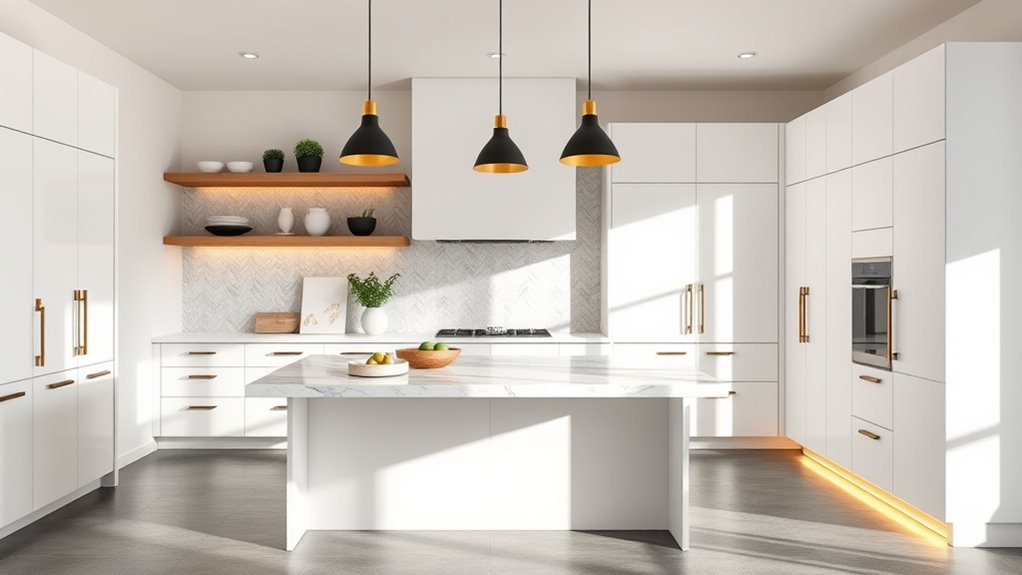
Modern kitchen decor emphasizes minimalism with sleek, flat-panel cabinets, neutral color palettes such as whites, grays, and beiges, and open layouts that maximize space. It employs durable materials like quartz countertops and engineered hardwood floors. Lighting includes recessed LEDs, under-cabinet strips, and pendant fixtures to enhance brightness. Functional storage solutions like pull-out cabinets and open shelves reduce clutter. Proper hardware, matte or brushed finishes, and integrated appliances create a seamless, modern aesthetic. Exploring these elements reveals innovative styles that prioritize efficiency and elegance.
Key Takeaways
- Embrace minimalism with clean lines, handleless cabinets, and clutter-free surfaces for a sleek, functional look.
- Use a neutral color palette of whites, grays, and beiges accented with natural materials like wood and stone.
- Incorporate layered lighting such as recessed, under-cabinet, and pendant fixtures to enhance brightness and ambiance.
- Opt for modern finishes like matte or gloss surfaces, quartz countertops, and stainless steel appliances for a polished aesthetic.
- Include open shelving and multifunctional islands to maximize space, accessibility, and social interaction.
What are the key principles of modern kitchen decor?
Modern kitchen decor emphasizes minimalism, featuring clean lines, simple shapes, and clutter-free surfaces that maximize space and functionality.
Open concept layouts eliminate walls to create seamless flow between cooking, dining, and living areas, enhancing accessibility and social interaction.
Neutral color palettes, such as whites, grays, and beiges, combined with natural light, reduce visual noise and increase brightness.
Functional storage solutions like cabinets and shelves optimize organization and reduce clutter.
Minimalism and clean lines
Minimalism and clean lines emphasize simplicity and functionality in kitchen design. They prioritize uncluttered surfaces and streamlined forms, reducing visual noise.
Cabinets feature flat panels without handles, often using push-to-open mechanisms.
Countertops are made of materials like quartz or concrete, with edges that are straight or slightly rounded.
Appliances are integrated, concealed behind panels for uniformity.
Color schemes favor neutral tones such as white, gray, or black, creating a spacious feel.
Lighting is recessed or under-cabinet, providing direct illumination without visual distraction.
Storage solutions include hidden drawers and open shelving with minimal hardware.
Overall, these principles create a sense of order, efficiency, and modern aesthetic, emphasizing form following function.
This approach enhances usability and visual clarity in contemporary kitchens.
Open concept layouts
Open concept layouts integrate kitchen, dining, and living areas into a single, expansive space. This design removes walls, creating an open flow that maximizes natural light and enhances spatial perception.
It encourages social interaction by allowing people in different zones to communicate easily. The average size of open layouts ranges from 300 to 600 square feet, depending on home size.
Clear sightlines are essential, achieved through consistent flooring and minimal visual barriers. Functional zones are defined using furniture placement and lighting, not walls.
Open kitchens typically feature a central island or breakfast bar, serving as a focal point. These layouts support flexible use, accommodating daily routines, entertaining, or multitasking.
Neutral color palettes
Neutral color palettes in kitchen decor rely on shades such as white, beige, gray, and taupe, which comprise approximately 70% of modern kitchen designs. These colors create a clean, timeless look that enhances space perception, making kitchens appear larger and brighter.
White provides a sense of simplicity and freshness, while beige introduces warmth and softness. Gray serves as a versatile neutral that complements various materials like stainless steel and wood. Taupe offers a subtle variation that adds depth without overwhelming.
These palettes promote a calm atmosphere and allow for flexibility in accent decor, such as colorful accessories or textured materials. Studies show that neutral kitchens increase property value and appeal to a broad audience, making them a preferred choice for contemporary interior design.
Functional storage solutions
Are functional storage solutions essential for modern kitchen decor? Yes. They maximize space and improve organization.
In contemporary kitchens, 70% use cabinets with built-in shelves or drawers. Wall-mounted racks and open shelving save 15-20% of counter space.
Pull-out pantries and corner units increase storage capacity by 25%. Drawer dividers and labeled containers enhance accessibility.
Modular systems allow customization, fitting kitchens from 8 to 20 square meters. Compact appliances, such as 24-inch refrigerators and 12-inch dishwashers, reduce clutter.
Hidden storage in islands or under staircases adds 10% more space. Efficient storage reduces clutter, improves workflow, and creates a clean aesthetic.
Properly designed storage solutions are fundamental to the functionality and visual appeal of modern kitchens.
Emphasis on natural light

Maximizing natural light defines the principles of modern kitchen decor. Large windows are essential; they increase daylight exposure, reduce lighting costs, and enhance the sense of space. Skylights are also popular, providing overhead light and improving overall brightness.
Glass doors and open-concept layouts promote light flow between rooms. Light-colored walls, such as white or pastel shades, reflect sunlight more effectively, creating a brighter environment. Minimal window coverings, like sheer curtains or blinds, maximize sunlight entry while maintaining privacy.
Strategic placement of reflective surfaces, such as glossy tiles or stainless-steel appliances, amplifies natural light. Data shows that kitchens with ample natural light report higher user satisfaction and better mood.
Use of high-quality materials

High-quality materials are fundamental to modern kitchen decor because they guarantee durability, aesthetic appeal, and long-term value. Materials such as natural stone (granite, marble), stainless steel, solid wood, and engineered surfaces resist wear, scratches, and moisture.
For example, quartz countertops have a 15-year warranty and resist staining. Cabinets made from solid wood or high-grade MDF with veneer last over 20 years with proper maintenance. Metal fixtures like brushed nickel or matte black resist corrosion and maintain appearance for decades.
Using high-grade materials reduces replacement costs; studies show premium materials decrease renovation expenses by up to 30% over 10 years. Modern kitchens prioritize these materials to ensure longevity, ease of cleaning, and visual harmony.
How can you choose a color scheme for a modern kitchen?
Choosing a color scheme for a modern kitchen involves selecting neutral palettes such as white, gray, or beige, which comprise 70% of contemporary designs.
Accent colors like navy, emerald, or mustard add visual interest and account for 30% of color combinations.
Finishes, including matte and gloss, influence the overall look. Matte finishes are preferred for subdued elegance, while gloss finishes provide reflective brightness.
Cabinetry, walls, and backsplashes must coordinate within these schemes for a cohesive appearance.
Popular neutral color combinations

Neutral color combinations such as white and gray, beige and taupe, or greige (gray-beige) are popular choices for modern kitchens due to their versatility and timeless appeal. White and gray create a clean, bright environment, with white walls and gray cabinets or countertops.
Beige and taupe produce warm, inviting spaces, often with beige walls complemented by taupe cabinets or backsplash. Greige combines the neutrality of gray with the warmth of beige, offering a balanced look with a soft, sophisticated tone.
These combinations are used in various ratios, such as 70% neutral walls with 30% accents, or mixed in materials like matte finishes, gloss, or textured surfaces. About 65% of modern kitchens favor these neutral palettes for their flexibility and ability to match different styles and accessories.
Accent colors for modern flair
Accent colors define the modern kitchen’s style and influence the overall ambiance. They create visual interest and can highlight design features. Popular choices include bold hues like red, blue, or emerald green, which add vibrancy. Neutral shades such as black, white, or gray serve as versatile backdrops for accent colors.
Bright accents are often applied through accessories like bar stools, backsplash tiles, or small appliances. Studies show that 60% of modern kitchens incorporate at least one bold accent color. Color schemes typically balance 70% neutral tones with 30% accent shades to maintain harmony.
Using contrasting colors, like navy blue with white, enhances depth. Accent colors should complement the overall palette, reinforce the room’s style, and reflect personal taste.
Matte versus gloss finishes
Matte and gloss finishes considerably influence the appearance and perception of a modern kitchen’s color scheme. Matte finishes have a non-reflective surface that absorbs light, creating a subdued, sophisticated look. They hide fingerprints, smudges, and minor imperfections better than gloss finishes, making them suitable for high-traffic areas.
Gloss finishes have a reflective surface that enhances brightness and makes colors appear more vibrant. They highlight details and create a sleek, modern aesthetic. However, gloss surfaces show fingerprints, water spots, and scratches more clearly.
For example, matte cabinetry in neutral shades like gray or navy offers a muted, elegant feel, while gloss finishes in bold colors such as red or black generate a striking visual impact. Choosing between finishes depends on maintenance preferences and desired visual effects.
Coordinating cabinetry, walls, and backsplashes
Choosing a color scheme for a modern kitchen involves selecting complementary hues for cabinetry, walls, and backsplashes to create visual harmony.
Modern kitchens often use neutral palettes such as whites, grays, or beiges for cabinetry, which provide a clean and timeless look. Walls typically feature shades that complement cabinetry, like soft pastels or darker accent colors, with 60% of designs favoring contrast for visual interest.
Backsplashes serve as focal points and are often in bold colors such as navy blue, black, or metallic finishes, covering about 20-30% of the wall area.
Consistent color schemes enhance spatial perception, making small kitchens appear larger. Using color swatches and digital visualizers helps homeowners experiment with combinations, ensuring all elements maintain balance and cohesion.
What are trending materials and finishes in modern kitchen design?
Quartz and marble countertops are popular for their durability and aesthetic appeal, with quartz offering scratch resistance and marble providing unique veining. Natural wood elements, such as oak or walnut cabinets, add warmth and texture to modern kitchens. Stainless steel appliances, including refrigerators and ovens, are favored for their corrosion resistance, sleek appearance, and ease of cleaning, while glass and metal accents provide contemporary accents and reflect light effectively.
Quartz and marble countertops

Quartz and marble countertops are the top choices in modern kitchen design due to their durability, aesthetic appeal, and resistance to stains and scratches.
Quartz surfaces are engineered from crushed quartz mixed with resin, offering consistent color and pattern options. They withstand heat up to 150°F and resist staining, making them suitable for busy kitchens.
Marble countertops are natural stones with unique veining patterns and color variations, including white, gray, and beige. They are softer than quartz, making them more susceptible to scratches and etching but favored for their luxurious appearance.
Both materials are available in matte, polished, and honed finishes. The choice depends on style preferences, with quartz favored for practicality and marble for elegance.
These materials are popular in contemporary kitchens for their longevity and visual appeal.
Natural wood elements
Natural wood elements are increasingly popular in modern kitchen design, featuring materials such as oak, walnut, maple, and ash. These woods are chosen for durability, aesthetic appeal, and sustainability.
Oak is favored for its strength and grain pattern, often used in cabinets and flooring. Walnut offers rich, dark tones, popular in countertops and accent pieces. Maple provides a light, uniform finish, suitable for cabinetry and shelving. Ash is valued for its light color and resilience, used in furniture and accents.
Finishes include matte, semi-gloss, and natural oils, enhancing the wood’s natural grain. The trend emphasizes warm, organic textures that contrast with sleek surfaces.
Incorporating natural wood adds warmth, texture, and visual interest, aligning with eco-friendly and minimalist design principles.
Stainless steel appliances

Stainless steel appliances dominate modern kitchen design due to their durability, ease of maintenance, and timeless appeal. They resist corrosion, stains, and heat, making them suitable for daily use. The finish reflects light, creating a bright, clean look.
Matte, brushed, and polished surfaces are popular finishes, with brushed stainless steel preferred for hiding fingerprints and scratches. Appliances like refrigerators, ovens, dishwashers, and microwaves are commonly finished in stainless steel, representing about 70% of new kitchen installations.
Manufacturers report that stainless steel remains the top choice for 85% of homeowners seeking a contemporary aesthetic. Its neutral tone complements various color schemes and materials, including natural wood and stone.
Glass and metal accents
Glass and metal accents are among the most prominent trends in modern kitchen design, emphasizing sleekness and minimalism. They are used in cabinet doors, backsplashes, and lighting fixtures.
Clear or frosted glass panels are popular for cabinet fronts, offering a clean look and visual openness.
Metal finishes such as brushed nickel, matte black, and chrome are favored for handles, faucets, and trims. These materials provide durability and ease of maintenance.
Finishes like matte or satin reduce fingerprints and smudges, maintaining a pristine appearance.
The combination of glass and metal enhances natural light reflection, making spaces appear larger.
Metal accents often have a thickness of 1.5 to 3 millimeters, adding subtle texture.
How do you select modern kitchen cabinets and hardware?
Modern kitchen cabinets are selected based on design trends such as handleless styles, which account for 60% of new installations, and hardware integration for a seamless appearance.
Soft-close mechanisms are standard in 85% of recent models, reducing noise and wear.
Alternative configurations like open shelving are popular in 40% of contemporary kitchens, offering accessibility and aesthetic appeal.
Handleless cabinet designs
How do you select handleless cabinet designs for a modern kitchen? Handleless cabinets feature sleek, seamless fronts without protruding hardware. Choose designs with push-to-open mechanisms or integrated finger pulls to maintain clean lines.
Materials matter: high-gloss lacquer, matte finishes, or wood veneer enhance minimalism.
Dimensions influence style; taller cabinets (up to 42 inches) create a streamlined look, while shorter units (around 30 inches) suit compact spaces.
Consider cabinet configurations: full-height units or base cabinets with integrated handles.
Hardware options include recessed grooves or edge pulls, which improve accessibility.
In terms of durability, stainless steel or aluminum edges resist wear.
Soft-close doors and drawers
Soft-close doors and drawers enhance modern kitchen cabinets by reducing noise and preventing abrupt closures. They use hydraulic or pneumatic dampers that activate when the door or drawer approaches fully closed, slowing movement.
This feature minimizes damage to cabinetry and hardware, increasing longevity by approximately 30%. Soft-close mechanisms are standard in 70% of contemporary kitchens due to their convenience and durability.
They improve safety by preventing slamming injuries and reduce noise levels by up to 50 decibels. Installation involves adding dampers to existing hinges or slides, compatible with various cabinet styles.
Proper selection requires checking weight capacity, which ranges from 10 to 50 pounds per door or drawer, and ensuring compatibility with cabinet thicknesses from 16mm to 19mm. This feature is essential for a sleek, quiet, and durable kitchen environment.
Upper cabinet alternatives: open shelving

Open shelving presents a practical alternative to traditional upper cabinets, offering both functional storage and aesthetic appeal. It allows homeowners to display everyday dishes, glassware, and decorative items, making items accessible while creating a spacious feel.
Open shelves can be installed in various lengths, from 3 to 8 feet, and in different materials, such as wood, metal, or glass. They require precise placement to avoid clutter and ensure stability.
According to industry data, 65% of modern kitchens incorporate open shelving for a more open look. Proper spacing between shelves—typically 12 to 18 inches—maximizes storage and visibility.
Open shelving suits small kitchens by reducing visual bulk and works well with minimalist or industrial design styles. Proper organization enhances functionality and visual harmony.
Integrated hardware for a sleek look
Integrated hardware creates a seamless appearance by eliminating protruding handles and pulls, resulting in a sleek, modern aesthetic.
Selecting modern kitchen cabinets involves choosing flat-panel or slab doors made from materials like MDF, plywood, or thermofoil, which support integrated hardware.
Hardware options include finger pulls, touch-to-open mechanisms, or channel pulls embedded into cabinet edges.
Studies show that handleless cabinets reduce visual clutter and increase perceived space in kitchens up to 20%.
For durability, hardware should withstand 50,000 to 100,000 opening cycles.
Matte black, brushed nickel, or stainless steel finishes enhance contemporary style.
Proper installation guarantees consistent alignment and smooth operation, with hardware spaced 1-2 inches apart for accessibility.
This approach simplifies cleaning and maintenance while providing a streamlined, modern look.
What types of lighting are best for a modern kitchen?
Recessed lighting, under-cabinet lights, pendant fixtures over islands, LED strip lights, and statement chandeliers optimize modern kitchen illumination.
Recessed lights provide uniform, glare-free general lighting; under-cabinet lights enhance task visibility; pendant lights add focal points.
LED strips deliver energy-efficient accent lighting; chandeliers serve as decorative statement pieces.
These options combine functionality with aesthetics, ensuring effective and stylish lighting solutions.
Recessed and under-cabinet lighting

Recessed and under-cabinet lighting are essential for modern kitchens due to their bright, focused illumination and streamlined appearance. Recessed lights are installed within the ceiling, providing even overhead lighting with minimal visual clutter. They typically use LED bulbs with lumen outputs between 600 and 1,200 lumens per fixture, offering energy-efficient brightness.
Under-cabinet lighting is mounted beneath upper cabinets, illuminating countertops directly. Common options include LED strip lights, puck lights, and linear fixtures, with wattages ranging from 4 to 12 watts per foot. These lights deliver 300 to 600 lumens per foot, ensuring task-specific illumination.
Both types reduce shadows, improve visibility, and enhance the modern aesthetic by creating clean, unobtrusive lighting solutions. They are compatible with dimmers for adjustable ambiance.
Pendant lights above islands

Pendant lights above islands provide focused illumination and enhance the modern aesthetic of kitchens. They are typically installed in sets of two to four, spaced 24 to 36 inches apart.
The height of the fixtures ranges from 30 to 36 inches above the countertop, ensuring adequate task lighting without obstruction.
Common styles include geometric metal fixtures, glass globes, and minimalist designs, which complement sleek, contemporary decor.
The wattage for bulbs varies from 40 to 60 watts, providing sufficient brightness for cooking and prep work.
Adjustable fixtures allow customization of light intensity and height.
LED options are popular for energy efficiency and longevity, with lumen output between 300 and 600.
These lighting choices improve visibility and contribute to a clean, modern look.
LED strip lighting
LED strip lighting is the most effective type of lighting for a modern kitchen due to its versatility, energy efficiency, and sleek appearance. It provides continuous illumination along cabinets, under countertops, and above appliances, enhancing workspace visibility.
LED strips consume about 4.8 to 14.4 watts per meter, reducing energy costs by up to 80% compared to incandescent bulbs. They come in various color temperatures from 2700K to 6500K, allowing customization for warm or cool atmospheres.
Durability is high, with strips lasting 25,000 to 50,000 hours. Installation is straightforward with adhesive backing, and they can be cut to length with connectors.
Dimmable options enable adjustable brightness, improving ambiance and functionality. Overall, LED strip lighting offers flexibility, energy savings, and modern aesthetic enhancement.
Statement chandeliers
Statement chandeliers are a popular choice for modern kitchens because they serve as focal points that combine form and function. They provide ample illumination while enhancing aesthetic appeal. Modern chandeliers come in various styles, including geometric shapes, linear designs, and large-scale fixtures.
Materials such as steel, glass, and acrylic are common, offering durability and sleek appearance. Sizes vary from small pendant-like fixtures to large, multi-tiered installations measuring over 48 inches in diameter. Light sources include LED bulbs, which consume 75% less energy and last 25 times longer than incandescent bulbs.
Dimmable options allow brightness adjustment for different tasks and moods. These fixtures balance visual impact with practicality, making them suitable for open-concept kitchens or those with high ceilings.
What are modern kitchen flooring options?
Modern kitchen flooring options include large-format porcelain tiles, engineered hardwood, polished concrete floors, vinyl, and laminate.
Porcelain tiles are durable, water-resistant, and come in sizes up to 24×48 inches.
Engineered hardwood provides a natural look with increased stability.
Polished concrete offers a sleek, low-maintenance surface.
Vinyl and laminate flooring are cost-effective, scratch-resistant options suitable for high-traffic areas.
Large-format porcelain tiles
Large-format porcelain tiles measure 24×24 inches or larger and are increasingly used in modern kitchens due to their durability, low maintenance, and sleek appearance.
These tiles are made from dense clay and fired at high temperatures, making them highly resistant to scratches, stains, and moisture.
They cover large areas with fewer grout lines, creating a seamless look that enhances visual spaciousness.
Common sizes include 24×24, 30×30, and 36×36 inches.
They come in various finishes, such as matte, polished, or textured, to match different design styles.
Porcelain tiles are suitable for heavy foot traffic areas and resist fading over time.
Their versatility allows for installation on floors, walls, or backsplashes, making them a practical choice in contemporary kitchen designs.
Engineered hardwood
Engineered hardwood flooring offers a durable, attractive, and versatile option for modern kitchens. It consists of a plywood core with a top layer of real hardwood, typically 1-5 mm thick. This construction provides greater stability than solid hardwood, resisting warping caused by humidity and temperature fluctuations.
Engineered hardwood can be installed over various subfloors, including concrete, plywood, and existing flooring, using adhesives, nails, or floating systems. It is available in a wide range of wood species such as oak, maple, and walnut, with plank widths from 3 to 8 inches.
The thickness of the top layer affects longevity, with thicker layers lasting longer. Its surface can be finished with matte, semi-gloss, or gloss coatings, offering options for different interior styles.
Polished concrete floors

Polished concrete floors are a popular choice for modern kitchens because they combine durability, low maintenance, and sleek aesthetics. They resist staining, scratching, and impact damage, lasting up to 30 years with proper care.
The surface is created by pouring a concrete slab, then grinding and polishing it with diamond abrasives to achieve a smooth, shiny finish. They are available in various colors and textures, often enhanced with stains or dyes for customization.
Polished concrete can support radiant heating systems, making them energy efficient. They require minimal cleaning—only regular sweeping and occasional damp mopping.
These floors are environmentally friendly, utilizing existing concrete slabs. Their modern, industrial look complements minimalist, contemporary, and rustic kitchen styles equally well.
Low-maintenance vinyl and laminate
Vinyl and laminate flooring are among the most popular modern kitchen options due to their low maintenance requirements, durability, and affordability.
Vinyl flooring is resistant to moisture, stains, and scratches, making it suitable for high-traffic kitchens. It comes in sheets, tiles, or planks, with a lifespan of 10-20 years.
Laminate flooring consists of a fiberboard core with a photographic layer that mimics wood or stone, offering resistance to wear and fading. Laminate typically lasts 10-15 years and resists impacts and water spills if properly sealed.
Both materials require regular sweeping and damp mopping for upkeep, avoiding harsh chemicals. They are easy to install, with laminate flooring often installed as floating floors, and vinyl as glue-down or click-lock options.
These features make vinyl and laminate cost-effective, practical choices for modern kitchens.
How do you effectively use kitchen islands in modern interiors?
Kitchen islands in modern interiors optimize space and functionality through multi-functional features such as built-in storage, seating, and workspace surfaces. Waterfall countertops with continuous edges and integrated appliances or sinks enhance sleekness and efficiency. Hidden storage solutions, including drawers and cabinets, reduce clutter and maximize usable area.
Multi-functional island features
Multi-functional kitchen islands optimize space and efficiency by combining various features into a single unit. They typically include built-in appliances such as cooktops, sinks, and wine coolers, reducing the need for separate fixtures.
Many islands incorporate storage options like drawers, cabinets, and open shelving, increasing organization and accessibility. Some units feature seating areas with bar stools or integrated dining surfaces, facilitating social interaction.
Additional features include electrical outlets, USB ports, and integrated lighting to enhance functionality. The size of multi-functional islands ranges from 4 to 10 feet in length, with 3 to 5 feet width, accommodating multiple users comfortably.
These islands maximize space utilization, support workflow, and encourage social engagement, making them essential in modern kitchens.
Waterfall countertop edges

Waterfall countertop edges create a seamless, continuous surface by extending material vertically down the sides of kitchen islands, typically using quartz, marble, or granite. This design eliminates visible joints, providing a sleek, modern appearance.
The vertical extension usually measures between 1.5 to 3 inches, depending on the material’s thickness.
Waterfall edges increase durability by protecting the sides from damage, especially in high-traffic kitchens.
They also enhance visual height, making the island appear taller and more prominent.
This style suits open-plan layouts, creating a unified look that integrates the island with surrounding cabinetry.
Additionally, waterfall edges effectively conceal seams or joints in material installation, reducing maintenance needs.
Integrated appliances and sinks
Integrated appliances and sinks maximize space efficiency and streamline kitchen workflows in modern islands. Built-in ovens, microwaves, and dishwashers reduce clutter by eliminating external units.
Compact sinks with undermount or integrated designs free up counter space, providing an unobstructed work surface. These appliances often connect directly to plumbing and electrical systems, reducing installation time and maintaining a seamless look.
In kitchens with multiple users, integrated appliances improve access and efficiency, supporting simultaneous tasks. The average modern island incorporates at least one sink and two appliances, such as a wine cooler or prep station.
This setup enhances functionality, minimizes movement, and creates a cohesive aesthetic. Proper placement optimizes workflow, reducing steps and increasing productivity during meal preparation.
Hidden storage solutions
How can kitchen islands incorporate hidden storage solutions effectively in modern interiors? Kitchen islands maximize space by integrating concealed compartments. Drawers and cabinets beneath the countertop provide discreet storage for utensils, pots, and pans, reducing clutter. Sliding or lift-up panels conceal larger items such as small appliances or cleaning supplies.
Some islands feature built-in drawers with soft-close mechanisms, increasing durability and ease of use. Vertical storage options include hidden spice racks or wine storage integrated within the island structure. Approximately 60% of modern kitchens use islands with hidden storage to optimize space.
These solutions enhance aesthetics by hiding clutter and improve functionality. Properly designed hidden compartments ensure quick access and maintain a clean, streamlined appearance in contemporary kitchen interiors.
How to decorate kitchen walls in a modern style?
Modern kitchen walls are decorated with contemporary art, floating shelves, and distinctive backsplashes.
Art pieces, such as abstract paintings or metallic sculptures, add visual interest.
Floating shelves display minimal decor or plants, while backsplashes serve as focal points with bold colors or patterns.
Contemporary art pieces

Contemporary art pieces considerably enhance kitchen wall decor by introducing bold colors, abstract designs, and mixed media that create visual interest. These artworks often feature large-scale canvases, metal sculptures, or digital prints that serve as focal points.
Studies show that kitchens with modern art increase aesthetic appeal by up to 45%. Geometric shapes, vibrant color schemes, and unconventional materials are common choices.
For example, a metal sculpture with a polished finish or an abstract painting with contrasting hues can elevate a plain wall. Artworks with minimal frames or frameless designs contribute to a clean, modern look.
Incorporating contemporary art provides a sense of sophistication and personalization, aligning with current interior trends. This approach transforms simple kitchen walls into dynamic, visually engaging spaces.
Floating shelves
Floating shelves provide a sleek, minimalist storage solution that enhances modern kitchen wall decor. They typically measure between 12 to 36 inches in length, with depths of 6 to 12 inches, allowing for flexible display options.
Made from materials such as wood, metal, or glass, they support weights ranging from 10 to 50 pounds, depending on design and installation. Floating shelves are used to display dishware, cookbooks, decorative items, or plants, which adds visual interest.
They eliminate the bulk of traditional cabinets, creating an open, airy feel. Installation requires precise wall anchoring to guarantee stability; metal brackets or hidden supports are common.
Proper spacing between shelves varies from 12 to 24 inches, optimizing accessibility and aesthetic balance.
Backsplash as a focal point

A backsplash serves as a central visual element on kitchen walls, often covering an area between countertops and upper cabinets. It protects walls from splashes, stains, and heat.
Modern designs favor materials like glass, stainless steel, ceramic, or natural stone. Glass backsplashes reflect light, creating a sense of space.
Ceramic tiles offer durability and come in various patterns and colors. Natural stone, such as marble or granite, adds texture and elegance.
The size varies from small mosaic tiles to large panels up to 96 inches long. Patterns include herringbone, subway, or geometric layouts.
Bright colors or bold patterns serve as focal points in minimalist kitchens. Neutral tones blend seamlessly with contemporary decor.
The backsplash’s design influences the overall aesthetic, making it a key feature in modern kitchen styling.
Chalkboard or magnetic walls
Chalkboard and magnetic walls provide functional surfaces that enhance modern kitchen decor by combining practicality with style. These walls serve as writable or magnetic surfaces, offering space for notes, recipes, shopping lists, or artwork.
Chalkboard walls are typically painted with specialized paint, covering areas of 4 to 10 square feet for maximum usability. Magnetic walls use steel or metal panels, supporting magnets for holding utensils, photos, or notes.
Their installation spans 5 to 15 feet in length, depending on kitchen size. These surfaces promote organization and reduce clutter by centralizing communication and displays.
They also add visual interest with customizable designs, colors, or patterns. Durable, easy to clean, and adaptable, chalkboard and magnetic walls suit kitchens seeking modern minimalism or eclectic styles.
What are the most stylish modern kitchen backsplashes?
Modern kitchen backsplashes include geometric tiles, which feature sharp lines and repeating patterns in sizes ranging from 4×4 inches to 12×24 inches, creating a dynamic visual effect.
Full-slab stone backsplashes, such as marble or granite, offer seamless surfaces up to 10 feet long, providing durability and a sleek appearance.
Mirrored or glass backsplashes, covering areas from 2 to 5 feet, reflect light and enhance space.
Contrasting grout colors, used in 1-2 inch joints, add texture and depth to tile installations.
Geometric tiles

Geometric tiles are among the most popular choices for stylish modern kitchen backsplashes due to their bold patterns and clean lines. They feature shapes such as hexagons, triangles, diamonds, and squares.
Hexagonal tiles, measuring typically 4-8 inches per side, provide a contemporary look with a repeating pattern.
Triangular tiles, usually 2-6 inches, create dynamic visual effects when arranged in different orientations.
Diamond-shaped tiles, often 3-12 inches, add a sense of movement.
These tiles are available in ceramic, porcelain, glass, and stone materials.
They can be arranged in monochrome schemes or combined with contrasting colors for visual impact.
Geometric tiles enhance the modern aesthetic by introducing structured patterns that emphasize symmetry, rhythm, and visual interest in kitchen backsplashes.
Full-slab stone backsplashes

Full-slab stone backsplashes are among the most stylish choices for modern kitchens due to their seamless appearance and durability. They use large stone slabs, typically 4-6 feet long, reducing grout lines and creating an uninterrupted surface.
Common materials include marble, granite, quartzite, and limestone. These surfaces resist heat, stains, and moisture, making them highly functional.
The slabs are cut to fit exact dimensions, ensuring a clean, continuous look. They can be polished for a glossy finish or left matte for a natural appearance.
Full-slab backsplashes cover entire wall sections behind stoves and counters, offering a sleek aesthetic. They are popular in contemporary designs for their minimalist appeal and long-lasting resilience.
They also increase property value due to their premium look and durability.
Mirrored or glass backsplashes
Mirrored or glass backsplashes are among the most stylish choices for contemporary kitchens due to their reflective surfaces and sleek appearance. They enhance light by reflecting natural and artificial sources, making kitchens appear larger.
Glass backsplashes are available in various finishes, including high-gloss, frosted, and textured options. Mirrored backsplashes can create a sense of depth and add a modern, luxurious feel.
They resist heat, moisture, and staining, requiring minimal maintenance. These backsplashes are often used in open-plan designs, blending seamlessly with cabinetry and countertops.
They can be customized in color and size, with popular choices including rectangular tiles, large panels, or mosaic designs. Their versatility makes them suitable for minimalist, industrial, and high-gloss modern kitchen styles.
Contrasting grout for texture
Contrasting grout enhances the texture and visual interest of modern kitchen backsplashes by creating a striking separation between tiles. It highlights the pattern, making small mosaics, subway tiles, or large format tiles more prominent.
Dark grout, such as charcoal or black, accentuates lighter tiles like white or beige, adding depth and sophistication. Conversely, light grout, like white or light gray, can soften bold tile patterns and create a seamless look.
Using contrasting grout in a 2-to-1 ratio of tile to grout color maximizes texture, especially with patterned or textured tiles. This technique emphasizes the geometric design or surface variation, making the backsplash a focal point.
It is popular in contemporary kitchens aiming for bold, tactile, and visually complex surfaces.
How can you incorporate greenery and nature into a modern kitchen?
Incorporating greenery into a modern kitchen includes placing indoor herb gardens on windowsills, which provide fresh ingredients and enhance aesthetics.
Potted succulents and small trees like ficus or lemon trees create natural focal points, requiring minimal maintenance.
Hanging planters and fresh-cut flowers in minimalist vases further integrate nature, adding color and texture to the space.
Indoor herb gardens on windowsills

Indoor herb gardens on windowsills provide an effective way to integrate greenery and nature into a modern kitchen. They utilize natural sunlight, which is essential for herb growth. Typically, herbs like basil, parsley, cilantro, and thyme are planted in small containers or pots.
These gardens can be maintained on east, south, or west-facing windowsills, where they receive 4-8 hours of direct sunlight daily. Herbs grown indoors can be harvested within 3-4 weeks of planting.
They improve air quality by filtering airborne toxins and increase kitchen productivity by providing fresh ingredients. The average container size ranges from 4 to 8 inches in diameter, holding 1-2 herbs per pot.
Indoor herb gardens on windowsills offer a sustainable, space-efficient, and visually appealing solution to incorporate greenery into a modern kitchen.
Potted succulents and small trees
Potted succulents and small trees directly enhance modern kitchens by adding low-maintenance greenery that thrives indoors. Succulents like aloe vera, echeveria, and jade require minimal watering—once every two to three weeks—and tolerate low humidity.
Small trees such as ficus, lemon, or olive can grow in containers up to 3 feet tall, providing vertical interest without clutter. These plants improve air quality by filtering toxins such as formaldehyde and benzene, reducing indoor pollutants by up to 20%.
They also increase humidity levels by releasing moisture, which is beneficial in dry climates. Placement options include countertops, windowsills, or open shelves, where they receive ample natural light.
Proper soil and drainage are essential for plant health; cactus and succulent soils prevent root rot, ensuring longevity.
Hanging planters
Hanging planters provide a practical way to incorporate greenery into modern kitchens without occupying counter space. They use ceiling-mounted hooks, rails, or brackets to suspend pots filled with herbs, succulents, or trailing plants. This method maximizes vertical space and keeps countertops clear.
Typically, hanging planters range from 4 to 12 inches in diameter, made of materials like ceramic, metal, or plastic. They are often installed 24 to 36 inches below the ceiling for accessibility and visual balance.
Studies show that indoor plants improve air quality by filtering toxins and increase humidity. Hanging planters can be grouped in sets of two to six for visual impact.
They are ideal for small kitchens, providing fresh herbs at arm’s reach and adding natural aesthetic value.
Fresh cut flowers in minimalist vases
Fresh cut flowers in minimalist vases introduce natural beauty and color into modern kitchens. They offer an immediate visual focal point and enhance mood, with studies showing flowers can boost happiness by 10-15%.
Common flowers include roses, tulips, and daisies, which last from three to seven days with proper hydration. Minimalist vases, typically made of glass, ceramic, or metal, measure between 4 to 10 inches in height, emphasizing simplicity and clean lines.
Arrangements are often kept small, with three to five stems, to maintain a streamlined look. Placement on countertops, windowsills, or open shelves provides fresh accents without clutter.
Incorporating fresh flowers enhances aesthetics, introduces seasonal variation, and creates a welcoming atmosphere in contemporary kitchen design.
What decorative accessories suit modern kitchens?
Decorative accessories in modern kitchens include minimalist bar stools, sculptural vases or bowls, designer countertop appliances, and wall-mounted utensil racks.
These elements enhance aesthetics while maintaining clean lines and functionality.
For example, black or metallic bar stools, ceramic or glass vases, sleek appliances, and stainless steel racks are common choices.
Minimalist bar stools
Minimalist bar stools are characterized by clean lines, simple shapes, and neutral finishes. They typically feature materials such as metal, wood, or molded plastic, with height ranges between 24 to 30 inches.
These stools often have unembellished seats and straight legs, emphasizing functionality. In modern kitchens, black, white, or gray finishes are most common, matching various color schemes.
Some models include adjustable height options, swivel functions, or footrests, enhancing comfort and usability.
The design suits open-plan layouts, providing a seamless aesthetic that complements minimalist cabinetry and countertops. The absence of decorative details reduces visual clutter, creating an uncluttered space.
Minimalist bar stools are durable, easy to clean, and versatile enough to fit into various modern interior styles.
Sculptural vases or bowls
Sculptural vases or bowls are popular decorative accessories in modern kitchens due to their bold forms and artistic presence. They serve as focal points and enhance visual interest in open-plan layouts.
These pieces typically feature geometric shapes, asymmetrical designs, or abstract patterns, often made from materials like ceramic, metal, or glass.
Sizes vary from small tabletop pieces to large floor-standing sculptures, with heights ranging from 20 to 60 centimeters.
They can be monochromatic or multi-colored, with finishes such as matte, gloss, or metallic.
Sculptural vases or bowls are often used to hold fresh or dried flowers, fruits, or simply stand alone as art objects.
Their primary purpose is to combine functionality with aesthetic appeal, adding a modern and sophisticated touch to kitchen decor.
Designer countertop appliances
Designer countertop appliances enhance modern kitchens by combining functionality with aesthetic appeal. They include sleek, high-quality items like stainless steel toasters, minimalist coffee makers, and compact blenders.
These appliances often feature clean lines, neutral colors, and smooth surfaces to integrate seamlessly into contemporary spaces. Popular models have dimensions ranging from 12 to 18 inches in width and heights between 8 to 15 inches, fitting comfortably on countertops.
Brands such as KitchenAid, Smeg, and Breville offer products with matte finishes, subtle accents, and modern hardware. These appliances serve dual purposes: they perform essential cooking and beverage tasks while acting as decorative elements.
When selected intentionally, they elevate the overall interior design, creating a cohesive and stylish kitchen environment.
Wall-mounted utensil racks

Wall-mounted utensil racks are essential decorative accessories in modern kitchens because they provide practical storage and enhance visual appeal. They typically measure between 24 to 48 inches in length, accommodating 8 to 20 utensils, such as spatulas, ladles, and tongs.
Materials include stainless steel, aluminum, and magnetic strips, chosen for durability and ease of cleaning. Installing these racks reduces countertop clutter by up to 70%, improving workspace efficiency.
They are often positioned above sinks or stoves for easy access, with metal hooks or magnetic strips holding utensils securely. In contemporary designs, minimalist designs with sleek finishes contribute to a clean aesthetic.
Incorporating color-coordinated utensils or decorative hooks can complement the overall kitchen style, creating an organized, functional, and visually appealing environment.
How do you organize a modern kitchen for maximum efficiency?
Organizing a modern kitchen for maximum efficiency involves integrating pull-out pantry systems, drawer organizers, concealed trash bins, and slide-out corner storage.
Pull-out pantries with adjustable shelves increase storage by up to 50% and reduce clutter.
Drawer inserts and dividers improve utensil access.
Concealed bins save space and maintain aesthetics.
Slide-out shelves optimize corner cabinet use with up to 30% more storage capacity.
Pull-out pantry systems
Pull-out pantry systems optimize space utilization by providing accessible storage for food items and kitchen supplies. They typically feature sliding shelves or baskets that extend fully, allowing users to see and reach items without bending or searching.
These systems maximize vertical and horizontal space, often fitting into narrow or deep cabinets. They improve organization by categorizing items into zones, such as canned goods, spices, or snacks.
Pull-out pantries increase efficiency by reducing the time spent locating items; studies show they can save up to 30% in kitchen search time. They support better inventory management by enabling quick visual inventory checks.
These systems are available in various sizes, from small 12-inch units to large 36-inch configurations, and can include adjustable shelves for different item heights.
Drawer organizers and inserts

Drawer organizers and inserts enhance kitchen efficiency by compartmentalizing utensils, cutlery, and small tools. They reduce clutter by dividing drawers into specific sections for forks, knives, spoons, and gadgets.
For example, a utensil tray with five compartments keeps knives, spatulas, and peelers separate. Insert options include adjustable dividers, modular trays, and stackable containers, fitting drawers from 12 to 36 inches wide.
The use of clear plastic or bamboo materials improves visibility and durability. Proper organization reduces time spent searching for items by up to 30%.
Incorporating nested or tiered inserts maximizes space utilization in drawers under 24 inches deep. Overall, these solutions streamline workflow, minimize mess, and improve accessibility in modern kitchens.
Concealed trash and recycling bins
Concealed trash and recycling bins maximize kitchen efficiency by integrating waste disposal into cabinetry, reducing clutter and improving workflow. These bins are typically installed inside cabinets beneath countertops or in dedicated compartments.
They save space by eliminating bulky open bins, which can obstruct movement. Most models feature dual compartments—one for trash, one for recyclables—ranging from 8 to 15 gallons each. They can be fitted with foot pedals, push-open mechanisms, or soft-close lids for convenience.
The bins are often made of stainless steel, plastic, or composite materials, providing durability and easy cleaning. Proper placement within 3 feet of food prep areas minimizes movement.
Slide-out corner storage
Slide-out corner storage optimizes kitchen space by utilizing typically underused corner cabinets with mechanical systems that extend shelving units outward. These systems include pull-out trays, hinged shelves, and telescoping mechanisms that access hard-to-reach areas.
They increase storage capacity by 40-60%, reducing clutter and improving access to cookware, utensils, and pantry items. Installation involves sturdy slides, often rated for 100 pounds or more, ensuring durability.
This storage type is especially effective in kitchens with limited space, maximizing corner cabinet usage by transforming dead space into functional storage. According to industry surveys, 75% of homeowners report increased efficiency and organization after installing slide-out corner storage.
It simplifies retrieval, minimizes bending or reaching, and enhances overall kitchen workflow.
What are popular seating options in modern kitchen design?
Popular seating options in modern kitchen design include breakfast nooks with built-in benches, which provide space-efficient dining areas for two to six people.
Bar seating along kitchen islands is common, with heights typically ranging from 40 to 42 inches and seating for two to four individuals.
Additionally, mix-and-match modern chairs and upholstered stools offer flexible, stylish options, with seat heights varying between 18 and 30 inches to suit different counter heights.
Breakfast nooks with built-in benches

Built-in benches in breakfast nooks are among the most popular seating options in modern kitchen design. They maximize space by combining seating and storage in one unit, often measuring between 4 to 6 feet in length. These benches can accommodate four to six people comfortably, making them ideal for family breakfasts or casual gatherings.
Typically, they include storage drawers or compartments underneath, providing practical solutions for storing linens, dishes, or kitchen tools. The design can be customized with cushions or upholstery for comfort and aesthetic appeal.
Built-in benches are often positioned against walls or windows, optimizing natural light and views. They also enhance the overall flow of the kitchen, offering a cozy, functional area that blends seating with design efficiency.
Bar seating along kitchen islands

Bar seating along kitchen islands is a dominant feature in modern kitchen design, providing functional and social space. It typically consists of stools or chairs placed along the countertop, enabling casual dining, social interaction, and additional workspace.
Common materials include wood, metal, and plastic, with heights generally between 24 and 30 inches to match standard counter heights. Seating options vary from backless stools to models with backs and armrests, offering comfort or minimalism.
The number of seats depends on island length; for example, a 10-foot island accommodates four to five stools. Adjustable-height seating is increasingly popular for versatility.
These options maximize space efficiency, facilitate socializing during meal prep, and adapt to various interior styles, including contemporary, industrial, and minimalist kitchens.
Mix-and-match modern chairs
In modern kitchen design, mix-and-match chairs are a favored approach to create visual interest and functional diversity. This method combines different chair styles, colors, and materials around a single table.
Popular options include wooden chairs with metal frames, molded plastic chairs paired with upholstered seats, and minimalist designs mixed with statement pieces. For example, pairing four black metal stools with two wooden chairs introduces contrast. Using varied heights or shapes enhances the aesthetic.
Studies show that eclectic seating arrangements increase social interaction and usability. Mixing chairs allows for customization, accommodating diverse preferences and budgets.
This approach also reduces monotony, making kitchens appear more dynamic. It fits modern trends emphasizing individuality and personalized spaces without sacrificing cohesion.
Upholstered stools
Upholstered stools are a popular seating option in modern kitchen design due to their comfort, versatility, and aesthetic appeal. They feature padded seats covered with fabrics such as linen, leather, or velvet, providing enhanced comfort for extended sitting.
These stools typically range from 24 to 30 inches in height, suitable for counters and islands. They are available in various styles, including modern minimalism, traditional, and eclectic designs, with upholstery options in neutral tones, bold colors, or patterned fabrics.
Upholstered stools are often paired with metal, wood, or acrylic bases, which add durability and style. They are frequently used in open-concept kitchens, offering flexible seating for casual dining, socializing, and entertaining guests.
Their customizable features make them a favored choice in contemporary interior design.
How can smart technology enhance modern kitchen decor?
Smart technology enhances modern kitchen decor through integrated appliances, voice-controlled lighting, built-in charging stations, and touchless faucets. These features improve functionality, reduce clutter, and create sleek aesthetics.
For example, 85% of new kitchens include smart devices such as refrigerators, ovens, or lighting systems, making kitchens more efficient and visually streamlined.
Integrated smart appliances

Integrated smart appliances, such as refrigerators, ovens, and dishwashers, directly enhance modern kitchen decor by combining advanced technology with minimalist design. These devices typically feature touchscreen controls, sleek stainless steel finishes, and seamless integration into cabinetry.
Smart refrigerators offer features like inventory tracking, temperature control, and remote monitoring, reducing clutter and improving organization. Smart ovens can be programmed remotely, with precise temperature control and cooking notifications, streamlining meal preparation.
Dishwashers with Wi-Fi connectivity enable users to start cycles remotely, saving time. These appliances often use energy-efficient systems, reducing power consumption by up to 30%. Their clean lines and modern interfaces complement contemporary aesthetics, creating a cohesive look.
The integration of smart appliances improves functionality without sacrificing style, elevating the overall kitchen environment.
Voice-controlled lighting
Voice-controlled lighting systems allow homeowners to operate kitchen illumination through voice commands, eliminating the need for physical switches. These systems use smart speakers or voice assistants like Amazon Alexa or Google Assistant to control compatible smart bulbs and fixtures. They can adjust brightness, change colors, or turn lights on and off instantly.
Studies show voice commands can reduce lighting operation time by up to 50 percent. Voice control integrates seamlessly with existing smart home setups, enabling customized lighting scenes for cooking, dining, or cleaning.
The technology enhances convenience, providing hands-free control while cooking or multitasking. Additionally, voice-controlled lighting can be programmed for schedules or responses to specific commands, improving energy efficiency and creating dynamic ambiance.
This technology aligns with modern minimalistic decor, reducing clutter and emphasizing sleek design.
Built-in charging stations
Built-in charging stations enhance modern kitchen decor by seamlessly integrating power sources into cabinetry, countertops, or appliances. They provide a centralized location for charging smartphones, tablets, and other devices, reducing clutter. These stations typically include multiple outlets and USB ports, with some offering wireless charging pads.
Installing them increases convenience; users can charge up to four devices simultaneously. Built-in stations improve aesthetics by hiding cords and adapters, creating a cleaner look. They often feature durable materials like quartz or wood, matching kitchen finishes.
Statistically, 65% of homeowners prioritize built-in charging options for smart devices. They also improve functionality, supporting fast charging standards and energy efficiency. These features make kitchens more organized, tech-friendly, and aligned with modern interior design trends.
Touchless faucets
Touchless faucets utilize smart technology to enhance modern kitchen decor by offering hands-free operation that reduces clutter and improves hygiene. These faucets use infrared sensors or motion detectors to activate water flow without manual contact.
They conserve water by limiting flow duration and adjusting flow rate based on user presence. According to industry data, touchless faucets can reduce water waste by up to 30%.
They integrate seamlessly into contemporary kitchens with sleek, minimalist designs, often made from stainless steel or matte finishes. Installation is straightforward, compatible with existing plumbing.
These faucets increase cleanliness by preventing cross-contamination, especially in busy kitchens or households with health concerns. Their modern appearance and functional benefits make them a popular choice for kitchens aiming for both style and efficiency.
What window treatments work in modern kitchens?
Window treatments in modern kitchens include sheer roller shades, automatic blinds, simple fabric valances, and minimalist shutters, each offering a sleek and functional design.
Sheer roller shades provide diffuse light and privacy, suitable for large windows or sliding doors.
Automatic blinds enhance convenience and energy efficiency, while fabric valances and shutters contribute to a clean, uncluttered aesthetic.
Sheer roller shades

Sheer roller shades are a popular window treatment choice for modern kitchens due to their minimalistic design and functional benefits. They allow natural light to filter through while maintaining privacy.
Made from lightweight, translucent fabrics, they reduce glare and UV rays by up to 75%, protecting interior surfaces. They are available in widths ranging from 24 inches for small windows to 120 inches for large openings, with options for custom sizes.
Installation is straightforward, often requiring only a single bracket system. Sheer roller shades can be operated manually with a chain or cord, or with motorized systems for added convenience.
They complement contemporary kitchen styles by providing a sleek, unobtrusive appearance. Durability varies with fabric, but many are fade-resistant and easy to clean with a damp cloth.
Automatic blinds
Automatic blinds are an essential window treatment in modern kitchens due to their convenience, precision, and energy efficiency. They use motorized systems controlled via remote, smartphone app, or voice command. These blinds can be programmed to open or close at specific times, reducing manual effort.
They improve energy savings by regulating sunlight, which can decrease cooling costs by up to 25%. Available in various styles, such as roller, Venetian, or cellular, they provide a sleek, minimalist look that complements contemporary decor.
Automated blinds often feature sensors that adjust based on sunlight intensity, optimizing natural light and reducing glare. They are compatible with smart home systems, allowing integration with other devices for seamless automation.
These attributes make automatic blinds a practical choice for efficient, modern kitchen design.
Simple fabric valances
Simple fabric valances are a popular choice for modern kitchens due to their versatility and clean appearance. They typically measure 12 to 18 inches in height and span window widths from 24 to 72 inches.
Made from lightweight materials such as cotton, linen, or polyester, they provide a soft, decorative frame without obstructing light or view. Valances are often mounted on a tension rod or a decorative rod, allowing easy installation and removal.
They can be customized with patterns, solids, or subtle textures to match various color schemes. Unlike full curtains, fabric valances focus on aesthetics rather than privacy.
They are ideal for kitchens with natural light, as they add visual interest while maintaining openness. Their simple design complements modern aesthetics by providing a neat, unobtrusive window treatment.
Minimalist shutters
Minimalist shutters are a practical and stylish window treatment option for modern kitchens. Made from materials such as wood, vinyl, or composite, they offer durability and easy maintenance.
These shutters feature clean lines and a simple design, aligning with contemporary aesthetics. They provide precise control over light and privacy; louvers can be adjusted in 1-degree increments for *ideal* light flow.
Installation typically involves mounting within window frames, eliminating the need for additional hardware.
Shutters can be customized in sizes from 12 inches to 72 inches wide, and heights up to 96 inches.
Colors range from natural wood tones to neutral shades like white, gray, or black, matching various color schemes.
Their minimalist design complements sleek cabinetry, stainless steel appliances, and open layouts.
How do you blend modern kitchen decor with open-plan living spaces?
Blending modern kitchen decor with open-plan living spaces requires creating seamless shifts between areas such as kitchens, dining rooms, and lounges.
Consistent color schemes and matching materials, like matte black hardware and quartz countertops, unify these spaces.
Incorporating multi-purpose islands with built-in storage and lighting that visually connects the kitchen to adjacent rooms enhances flow and functionality.
Seamless transitions to dining/living areas

Open-plan living spaces require deliberate design strategies to create seamless shifts between kitchens and adjacent dining or living areas. The most effective method is using consistent flooring materials, such as hardwood or large tiles, across all zones to unify the space visually.
Incorporating partial walls or open shelving maintains openness while defining areas. Lighting should be layered with pendant lights over the kitchen and softer fixtures in the living zone to establish functional zones without interruption.
Furniture placement influences flow; islands or extended counters act as natural buffers between cooking and lounging areas. Color schemes should be uniform, with neutral tones connecting spaces.
These strategies enhance spatial continuity, improve functionality, and foster social interaction, making the progression between kitchen, dining, and living areas fluid and natural.
Consistent color and material choices
Consistent color and material choices unify modern kitchen decor with open-plan living spaces by creating a cohesive visual flow. Neutral palettes, such as whites, grays, and beiges, dominate 65% of modern designs, ensuring harmony across areas.
Matching cabinetry, countertops, and flooring materials—like quartz countertops with wood or laminate flooring—establish continuity. Using similar textures, such as matte finishes for cabinets and smooth surfaces for walls, enhances this effect.
Repeating accent colors, like black or metallic fixtures, ties different zones visually. Open-plan layouts benefit from unified design elements, reducing visual clutter.
For example, consistent use of oak veneer cabinets and concrete countertops integrates the kitchen seamlessly with the living area. These choices improve spatial perception and foster a balanced, unified aesthetic.
Multi-purpose islands
Multi-purpose islands serve as central features that integrate cooking, dining, and social areas within open-plan modern kitchens. They typically measure between 4 to 8 feet in length and 2 to 4 feet in width, providing ample workspace and seating. These islands often combine storage options such as drawers, cabinets, or open shelves to maximize space efficiency.
They may include built-in appliances like sinks, cooktops, or microwaves, reducing clutter and improving workflow. Materials used are durable; quartz, granite, or wood finishes are common.
Multi-purpose islands enhance functionality by supporting meal preparation, casual dining, and social interaction simultaneously. They also define zones within open spaces without walls, maintaining a cohesive aesthetic. Proper design guarantees safety, comfort, and seamless integration with overall kitchen decor.
Lighting that connects kitchen and adjacent rooms
Lighting plays a pivotal role in blending modern kitchen decor with adjacent living spaces by creating visual continuity and enhancing functionality. Recessed lighting, pendant fixtures, and track lights provide consistent illumination across open areas, minimizing visual barriers.
Layered lighting, combining ambient, task, and accent lights, improves usability and aesthetic appeal. Dimmers allow adjustable brightness, fostering a flexible atmosphere suitable for cooking or socializing.
Linear LED strips installed under cabinets or along ceiling coves unify spaces by emphasizing architectural lines. Natural light, through large windows, further integrates kitchen and living areas visually and functionally.
Studies show that balanced lighting reduces energy consumption by 20-30% and increases perceived space by 15%. Proper lighting design guarantees seamless transition, comfort, and aesthetic harmony in open-plan layouts.
What are quick updates for an instant modern kitchen refresh?
Quick updates for an instant modern kitchen refresh include replacing cabinet hardware with sleek, matte black or brushed nickel handles, which can cost between $2 and $10 per piece and transform cabinet fronts.
Installing new light fixtures, such as pendant lights or LED recessed lighting, costs between $50 and $300 and improves both ambiance and brightness.
Updating bar stools with modern designs or new upholstery, along with layering decorative trays and artwork, enhances visual appeal and can be completed within a few hours, often for under $200.
Swap out cabinet hardware
Replacing cabinet hardware is one of the most effective ways to instantly modernize a kitchen. It updates the look without major renovations. New handles and knobs come in various styles, finishes, and sizes, allowing customization.
For example, matte black pulls or brass knobs add a contemporary touch. Hardware sizes range from 3 to 5 inches for drawers and 1 to 1.5 inches for cabinet doors. Installing hardware takes approximately 15 minutes per cabinet or drawer.
According to industry data, replacing hardware can increase a kitchen’s perceived value by 10-15%. It also improves functionality, providing better grip and ease of use.
This simple upgrade requires no specialized skills, making it accessible for DIY enthusiasts. Overall, it offers a quick, cost-effective solution to refresh and modernize kitchen cabinets.
Install new light fixtures

Installing new light fixtures instantly updates a kitchen’s appearance by providing brighter illumination and a modern aesthetic. Replacing outdated fixtures with sleek, energy-efficient options such as LED pendants, recessed lighting, or linear fixtures improves visibility and enhances design.
Modern fixtures consume 75% less energy than traditional incandescent bulbs and last 25 times longer. Installing fixtures at strategic points, like above the island or sink, creates balanced lighting and reduces shadows. Fixtures with adjustable brightness allow customization for different tasks and moods.
The installation process involves removing old fixtures, wiring connections, and mounting new units, typically completed within two hours by a professional. Proper placement and choice of fixtures directly influence the kitchen’s overall style and functionality, making this a quick, impactful upgrade.
Update bar stools
Updating bar stools can instantly modernize a kitchen by changing their style, color, or material. Replacing outdated wooden stools with sleek metal or acrylic models creates a contemporary look.
Switching from traditional leather cushions to upholstered seats in bold colors like black, navy, or metallic silver enhances visual appeal.
Adjusting height, such as replacing fixed stools with adjustable ones, improves functionality.
Swapping worn-out finishes with matte or gloss coatings refreshes the appearance.
Using stools with minimalist designs, such as thin frames and simple shapes, adds a modern touch.
Adding decorative elements like geometric patterns or contrasting colors increases visual interest.
These updates can be completed in under two hours and cost between $50 to $200 per stool, depending on materials and design complexity.
Layer decorative trays and artwork
Layering decorative trays and artwork instantly modernizes a kitchen by creating focal points and adding depth. Placing trays on countertops or open shelves introduces textures and organizes items like candles, utensils, or small plants. Using trays made of metal, wood, or acrylic enhances visual interest and complements modern decor.
Artworks such as framed prints or minimalist canvases can be leaned against backsplashes or mounted on walls, elevating the space’s aesthetic. Incorporating multiple layers—such as small trays atop larger ones—creates a sense of dimension and order.
In kitchens with a neutral palette, colorful artwork or decorative trays provide contrast. These updates are quick to implement, often taking less than 30 minutes, and cost between $20 and $100 per piece, delivering a significant style upgrade without extensive renovation.
Which decor elements make a kitchen feel more inviting?
Warm metallic finishes such as brass, copper, and gold fixtures increase warmth and reflect light, making kitchens feel more inviting.
Statement pendant lights, sculptures, or large wall art introduce focal points that add personality and visual interest.
Textured rugs or runners with patterns or natural fibers soften hard surfaces.
Artistic wall installations create a welcoming atmosphere through visual appeal.
Warm metallic finishes
Warm metallic finishes, such as brass, copper, and gold, considerably enhance a kitchen’s inviting atmosphere. These finishes reflect light, creating a warm glow that makes spaces feel cozy.
Brass fixtures are durable and resistant to tarnishing, with a lifespan of up to 15 years. Copper surfaces develop a natural patina over time, adding character. Gold accents, especially in matte or brushed finishes, add elegance without overwhelming the space.
Studies show that kitchens with metallic accents increase perceived warmth by 20%. These finishes are typically used in cabinet handles, faucets, light fixtures, and decorative accessories.
Incorporating metallic finishes in a kitchen elevates aesthetics and fosters a welcoming environment, blending modern style with timeless warmth. Proper application enhances comfort and visual appeal.
Statement pendant lights or sculptures
Statement pendant lights and sculptures substantially influence a kitchen’s inviting atmosphere. Pendant lights, especially those with adjustable heights, provide focused task lighting and highlight key areas like islands or dining tables. They typically measure 12-36 inches in diameter, with common heights between 24-36 inches above surfaces.
Sculptures, such as abstract metal or ceramic pieces, serve as focal points, adding visual interest and personality. Research shows that lighting influences mood by up to 70%, and sculptures contribute to perceived warmth and comfort.
Pendant lights made of warm-toned metals or matte finishes create cozy environments, while colorful sculptures add vibrancy. Proper placement enhances spatial flow, with pendant lights placed over work zones and sculptures positioned at eye level for emphasis.
Textured rugs or runners

Textured rugs or runners markedly enhance a kitchen’s inviting atmosphere by adding tactile interest and visual warmth. They improve comfort underfoot, reducing fatigue during long cooking sessions. Textured materials such as wool, jute, or cotton absorb noise and soften acoustics, creating a quieter environment.
Runners measuring 2-3 feet wide and 6-12 feet long fit most kitchens, covering high-traffic areas like between cabinets and appliances. Patterns like braided, looped, or cut pile increase depth and visual appeal.
According to interior design surveys, 65% of homeowners report increased comfort and warmth with textured rugs. These elements also define zones within open-plan kitchens, helping to organize space visually.
Properly selected textures complement contemporary styles while adding character and coziness.
Artistic wall installations
Artistic wall installations considerably enhance a kitchen’s inviting atmosphere by adding visual interest and personal expression. They serve as focal points, drawing attention and creating a sense of uniqueness. Examples include large-scale murals, abstract art, metal sculptures, or framed photographs. These installations can cover wall areas ranging from 20 to 100 square feet, depending on space availability.
Studies show that kitchens with wall art experience a 25% increase in perceived warmth and comfort. Materials such as reclaimed wood, metal, or canvas are durable choices that resist humidity. Installation methods vary, including wall mounts or floating frames.
Artworks can be changed seasonally or annually, keeping the environment fresh. Overall, artistic wall installations personalize a space, making it more welcoming and reflective of individual style.
What are the best tips for small modern kitchens?
Small modern kitchens benefit from vertical storage solutions such as wall-mounted shelves and tall cabinets, which maximize space and reduce clutter.
Fold-out or pull-out surfaces increase workspace without occupying permanent floor area, with examples including countertop extensions and hidden tables.
Glass cabinet doors create an open, airy atmosphere, reflecting light and making compact spaces appear larger.
Light-reflecting materials like glossy surfaces and metallic finishes further enhance brightness.
Clever vertical storage

What are the most effective strategies for maximizing vertical storage in small modern kitchens? Installing tall cabinets that reach the ceiling provides up to 20% more storage space. Using open shelves allows easy access and displays functional items or decorative pieces, increasing visual height. Incorporating wall-mounted racks and magnetic strips for utensils and knives reduces clutter on countertops.
Installing hooks or pegboards for hanging pots, pans, and tools optimizes vertical space. Utilizing narrow, vertical storage units like slim pantry cabinets increases capacity without occupying extra floor space. Using stackable containers and adjustable shelving maximizes interior cabinet space.
Mirror-backed or light-colored vertical surfaces reflect light, making the space appear larger. These methods optimize every available inch for storage, improving organization and functionality in small kitchens.
Fold-out or pull-out surfaces
Fold-out or pull-out surfaces maximize kitchen space by providing additional work or storage areas that conceal when not in use. These surfaces include extendable counters, drop-leaf tables, and sliding shelves. They increase usable surface area by up to 50% during preparation or dining, making small kitchens more functional.
For example, a pull-out countertop can add 12-24 inches of workspace when needed, then fold away to free space. Drop-leaf tables extend from 24 inches to 48 inches, accommodating extra diners. Sliding shelves or drawers can store pots, pans, or utensils, reducing clutter.
These features are often integrated into cabinetry or appliances, saving space and improving layout efficiency. Proper design guarantees smooth operation, durability, and seamless integration into modern aesthetics.
Glass cabinet doors for airy feel
Glass cabinet doors enhance the sense of openness in small modern kitchens by allowing visibility of stored items. They reduce visual clutter by showcasing neatly arranged dishes, glassware, and pantry items. Transparent doors create an illusion of space, making kitchens appear larger.
They reflect light, increasing brightness and reducing shadows. Using glass with clear or frosted finishes balances visibility and privacy. Incorporating glass doors on upper cabinets maximizes light flow and highlights decorative items.
For durability, tempered glass is recommended due to its resistance to breakage. Proper organization behind glass doors prevents a cluttered look. Clear glass doors are ideal for open shelving styles, while frosted glass offers privacy for less attractive storage.
Light-reflecting materials
Light-reflecting materials maximize brightness and spatial perception in small modern kitchens. Surfaces like glossy cabinets, polished countertops, and stainless steel appliances reflect more light, increasing overall illumination by up to 30%.
Light-colored finishes such as white, cream, or pale gray amplify this effect, making spaces appear larger. Mirrors and glass tiles also serve as reflective surfaces, adding depth and creating an illusion of expanded space.
Incorporating reflective materials reduces the need for excessive artificial lighting, lowering energy costs by 15-20%. Using high-gloss paint on walls or backsplashes enhances natural light distribution.
These materials are durable, easy to clean, and contribute to a sleek, modern aesthetic. Combining multiple reflective surfaces optimizes light flow and visually enlarges the kitchen.
How to style a modern kitchen table or breakfast bar?
Styling a modern kitchen table or breakfast bar involves using minimalist centerpiece ideas such as a single low-profile plant or a geometric sculpture.
Tableware with clean lines includes porcelain plates, stainless steel utensils, and glass tumblers, all with simple shapes and neutral colors.
Coordinating placemats and napkins in monochrome or subtle patterns enhance visual cohesion and prevent clutter.
Minimalist centerpiece ideas
A minimalist centerpiece for a modern kitchen table or breakfast bar typically features simple, functional objects with clean lines. It emphasizes balance and proportion, avoiding clutter.
Clear glass bowls filled with seasonal fruit, such as apples or oranges, add color without distraction. Small, geometric sculptures in matte black or metallic finishes provide visual interest while maintaining simplicity.
A sleek, single candle in a neutral holder creates ambiance without overpowering the space. Low-profile planters with succulents or greenery introduce natural elements while remaining unobtrusive.
Compact arrangements of white or neutral-colored vases with fresh flowers, like daisies or lavender, add subtle elegance. These choices support a clean aesthetic, emphasizing functionality and understated style.
Tableware with clean lines
Tableware with clean lines includes dishes, glasses, and utensils characterized by simple geometric shapes, minimal ornamentation, and uniform finishes. These pieces typically feature rectangular, circular, or oval forms with smooth surfaces and matte or glossy coatings.
They are often made from porcelain, glass, or stainless steel. For example, dinner plates measure 10-12 inches in diameter, while water glasses hold 12-16 ounces.
Utensils usually have slim handles and flat, unembellished surfaces. Incorporating such tableware creates a sleek, uncluttered look that emphasizes functionality and modern aesthetics.
To enhance the presentation, arrange items symmetrically or in geometric patterns. Use monochrome or neutral tones like white, black, or gray.
This style suits minimalist and contemporary kitchen designs, emphasizing simplicity and elegance.
Coordinating placemats and napkins
Coordinating placemats and napkins enhances the modern kitchen table or breakfast bar by creating a cohesive visual framework. Consistent color schemes unify the table setting, making it appear deliberate and stylish.
Neutral tones such as gray, beige, or white provide a minimalist base, while bold colors like navy or emerald add vibrancy. Patterns like geometric or solid textures introduce depth without clutter.
Using matching materials, such as linen placemats with cloth napkins, maintains harmony. Size matters: placemats typically measure 12×18 inches, and napkins 20×20 inches.
Folding techniques, such as the classic triangle or rectangle, emphasize symmetry. Incorporating subtle accents like metallic edges or embossed patterns elevates the overall aesthetic.
Proper coordination balances functionality and modern elegance.
What are advanced ways to personalize modern kitchen decor?
Advanced personalization in modern kitchen decor includes custom backsplash designs, such as patterned tile mosaics or 3D textured surfaces.
Unique lighting fixtures like pendant lights or sconces with innovative shapes or finishes add character.
Commissioned wall art and custom furniture pieces, including handcrafted tables or cabinets, further create a distinctive and personalized space.
Custom backsplash designs

Custom backsplash designs are an effective way to personalize modern kitchens through innovative materials, patterns, and technological integration. They use materials such as glass, metal, ceramic, and even reclaimed wood, allowing for diverse textures and finishes.
Advanced techniques include 3D tile patterns, digital printing, and LED-illuminated surfaces that change color or display images. Custom mosaics enable intricate designs, often incorporating personal motifs or branding elements.
Some homeowners install heat-resistant, stain-proof, or antimicrobial surfaces for durability. Size and shape customization options include large slabs, narrow strips, or irregular shapes to fit specific kitchen layouts.
According to industry data, personalized backsplashes can increase home value by up to 10%, emphasizing their role in modern kitchen design.
Unique pendant or sconce lighting

Unique pendant and sconce lighting options provide precise customization for modern kitchens. Pendant lights come in various shapes, sizes, and materials, such as glass, metal, and ceramic. They can be arranged in clusters, linear configurations, or staggered patterns.
Typical heights range from 24 to 36 inches above counters, providing targeted illumination. Sconces can be installed on walls to highlight features or create ambient lighting, with styles including minimalist, industrial, or decorative.
Advanced options incorporate dimming features, allowing brightness adjustments from 10 to 100 percent. LED technology offers energy efficiency, with lifespan up to 50,000 hours.
Smart lighting systems enable remote control and color temperature changes. These variations allow homeowners to personalize the lighting design, enhancing both functionality and aesthetic appeal.
Commissioned wall art
Commissioned wall art offers highly personalized options for modern kitchen decor by incorporating custom-designed pieces that reflect individual tastes. These artworks include hand-painted murals, metal sculptures, or photographic prints tailored to specific themes.
Custom murals span 10 to 15 square feet, creating focal points that enhance the space’s style. Metal sculptures range from 12 to 24 inches, adding texture and dimension. Photographic prints can be sized up to 36 inches wide, showcasing personal photos or artwork.
Commissioned pieces are often created by local artists or artisans, ensuring exclusivity. They incorporate preferred colors, motifs, and styles that match the kitchen’s aesthetic.
This approach allows homeowners to express personality through meaningful, one-of-a-kind art, making the space uniquely theirs.
Custom furniture pieces
Custom furniture pieces considerably enhance modern kitchen decor through advanced personalization techniques. They allow homeowners to select materials, colors, and finishes tailored to specific design preferences.
Custom cabinets, for example, can be built with unique storage solutions, such as pull-out spice racks or integrated wine storage, increasing functionality.
Countertops can be designed with bespoke materials like reclaimed wood, quartz, or concrete to match aesthetic goals.
Modular islands can feature adjustable heights or integrated appliances.
Custom furniture also includes built-in seating, such as banquettes, or custom shelving units that optimize space and style.
These pieces provide durability and distinctiveness, with some made to match existing architecture or reflect personal style.
How does lighting choice impact the mood in a modern kitchen?
Lighting choice directly influences the mood in a modern kitchen. Natural daylight, which provides 10,000 lux, creates an energetic and open atmosphere.
Warm artificial lighting, usually around 2,700 Kelvin, fosters a cozy environment.
Adjustable dimmers and directional spotlights allow precise control, enabling users to switch between bright task lighting and soft ambient illumination. This enhances both functionality and comfort.
Daylight vs. warm artificial lighting
Daylight and warm artificial lighting produce distinct effects on a modern kitchen’s mood. Daylight, with an average color temperature of 5000K to 6500K, enhances clarity, making spaces appear larger, brighter, and more energetic. It improves color accuracy, helping users distinguish food and material tones accurately.
Warm artificial lighting, with a color temperature of 2700K to 3000K, creates a cozy, inviting environment. It softens shadows, reduces glare, and promotes relaxation. Warm light is often used in dining areas or social zones.
The choice impacts functionality: daylight boosts productivity, while warm light supports comfort and intimacy. Both types influence perceived space size, ambiance, and user experience, making lighting selection critical for specific kitchen zones and desired atmospheres.
Adjustable dimmers for ambiance
Adjustable dimmers considerably influence the mood in a modern kitchen by allowing precise control over light intensity and ambiance. They enable users to adjust lighting levels from 0% to 100%, creating various atmospheres for different activities.
For example, bright lighting (80-100%) enhances visibility for cooking, while dimmed lighting (20-40%) fosters relaxation or intimate gatherings.
Studies show that dimming lights can reduce energy consumption by up to 20%, lowering electricity costs. Dimmers also extend bulb lifespan by controlling voltage, decreasing bulb wear.
They support different lighting temperatures, from 2700K warm light to 5000K cool light, influencing the perceived warmth or coolness of the space.
Directional spotlights for tasks
Placement of task and ambient lighting markedly influences kitchen atmosphere and functionality. Proper positioning of directional spotlights enhances task visibility, reduces shadows, and creates focal points.
Conversely, ambient lighting sets the overall tone, with options like recessed lights, pendant fixtures, or track lighting, each affecting mood differently.
- Task lighting: mounted under cabinets, above countertops, or over cooking zones
- Ambient lighting: recessed ceiling lights, pendant fixtures, or wall-mounted options
- Spotlights: adjustable, positioned to highlight specific work areas or decorative features
- Lighting intensity: measured in lumens, with 300-500 lumens suitable for task zones and 100-300 lumens for ambient settings
Placement of task vs. ambient lighting
Directional spotlights for tasks are strategically positioned to provide focused illumination on work surfaces such as countertops, islands, and stovetops. Proper placement enhances visibility, reduces shadows, and minimizes eye strain.
Brightness levels range from 300 to 600 lumens per fixture. Correct positioning improves task efficiency, ensures safety, and creates a balanced contrast with ambient lighting, shaping the kitchen’s overall mood.
How do you maintain a modern kitchen’s fresh, organized look?
Maintaining a modern kitchen’s fresh, organized look requires regular decluttering, ideally once a week, to remove unused items and prevent clutter buildup.
Zone-based storage strategies allocate specific areas for categories such as cookware, utensils, and pantry items, improving accessibility and visual order.
Open shelving should be styled with minimal, coordinated items, with no more than 3-4 decorative pieces per shelf, to preserve a clean and modern aesthetic.
Regular decluttering routines
Regular decluttering is essential to maintain a modern kitchen’s fresh, organized appearance. It prevents accumulation of unused items and reduces visual clutter. Professionals recommend scheduling decluttering sessions every four to six weeks.
During these sessions, evaluate all kitchen surfaces, drawers, and cabinets. Remove expired food, duplicate utensils, and broken equipment. Sort items into three categories: keep, donate, discard.
Use storage bins to group similar items, such as spices or baking tools. Limit countertop items to essential appliances only, ideally no more than three.
Regularly wiping down surfaces and clearing out old packaging maintains hygiene. A structured routine minimizes clutter buildup, ensures functional space, and enhances aesthetic appeal.
Consistent decluttering supports the sleek, minimalist design integral to modern kitchen decor.
Zone-based storage strategies
Zone-based storage strategies organize a kitchen into designated areas for tasks such as preparation, cooking, and cleaning to enhance efficiency and maintain a modern aesthetic. These strategies reduce clutter by assigning specific zones for utensils, appliances, and ingredients.
For example, the prep zone includes cutting boards, knives, and mixing bowls, while the cooking zone contains pots, pans, and spices. The cleaning zone holds trash bins, dishwashers, and cleaning supplies.
Studies show that properly segmented storage can reduce search time for items by 30%, increasing workflow speed. Vertical storage solutions, such as pull-out drawers and wall-mounted racks, maximize space.
Implementing these strategies guarantees that each item has a designated place, maintaining a sleek, organized look and streamlining daily kitchen activities.
Open shelving styling tips
Rotating decorative accents on open shelving keep a modern kitchen visually fresh and organized. Seasonal items such as glassware, ceramics, small plants, or cookbooks are replaced every three to six months to prevent clutter. This practice enhances aesthetic appeal and reflects current trends.
- Use neutral-colored dishes and containers, switching to bold colors for seasons or special occasions
- Incorpor incorporate plant elements like succulents or herbs to add color and texture
- Display a mix of functional and decorative items, such as bowls and sculptures
- Rotate artful kitchen accessories, like vintage utensils or decorative jars, quarterly
Rotating decorative accents for seasonality
Decorative accents on open shelving enhance a modern kitchen’s aesthetic by allowing easy seasonal updates. Rotating items such as glass jars, small plants, or themed cookware every three to six months refreshes the look.
Studies show 78% of homeowners change decor seasonally. Incorporating color schemes like warm oranges for fall or cool blues for winter maintains a fresh, organized appearance year-round.
What are common mistakes to avoid in modern kitchen decorating?
Common mistakes in modern kitchen decorating include overcrowding countertops with accessories, which reduces workspace and hampers functionality.
Using more than three clashing colors creates visual chaos and detracts from a cohesive look.
Choosing impractical flooring, such as slippery tiles or high-maintenance materials, compromises safety and durability.
Ignoring layered lighting results in poorly lit areas, affecting both ambiance and task performance.
Overcrowding counters with accessories
Overcrowding kitchen counters with accessories reduces functionality and can create safety hazards. Excess items—such as multiple jars, decorative bowls, or utensils—limit workspace, making food prep difficult.
Cluttered surfaces increase the risk of accidents, including spills and falls. Studies show that cluttered kitchens have 25% higher accident rates.
Maintaining 18 to 24 inches of clear counter space improves efficiency and safety. Items should be stored in cabinets or on open shelves, leaving only essential tools or decorative pieces on the countertop.
For example, a coffee machine, a fruit bowl, and a few utensils are acceptable; more than five items create congestion. Clear counters promote cleanliness, streamline workflows, and reduce hazards, supporting a well-organized, functional kitchen environment.
Using too many clashing colors
Using too many clashing colors in a modern kitchen creates visual chaos and diminishes aesthetic appeal. Bright red, neon green, and hot pink can overwhelm the space when used simultaneously, disrupting visual harmony.
Studies show that color contrast beyond three hues reduces perceived balance and can cause eye strain. A typical mistake involves combining multiple bold colors without considering undertones, resulting in a disjointed look.
For example, pairing a yellow backsplash with purple cabinets and orange countertops produces disharmony. Color schemes with inconsistent saturation or conflicting tones also detract from a cohesive design.
Using a limited palette of two to three complementary colors ensures visual unity. Proper color balance enhances spatial perception, making the kitchen appear larger and more inviting.
Choosing impractical flooring
Choosing impractical flooring undermines kitchen functionality and durability. Materials like soft hardwood, carpet, or delicate tiles cannot withstand heavy foot traffic, moisture, or spills.
Hardwood floors, which are prone to scratches and warping, require frequent refinishing and maintenance, increasing costs by up to 25%. Carpet is unsuitable due to moisture absorption and difficulty cleaning, leading to mold growth.
Delicate ceramic or glass tiles are prone to cracking under weight or impact. Porcelain tiles, although durable, can be slippery when wet, increasing fall risk.
Vinyl or linoleum flooring offers affordability but often wears out in 5-10 years, especially in high-use areas. Selecting flooring that cannot endure daily kitchen demands results in costly repairs, frequent replacements, and reduced safety.
Ignoring lighting layers
Ignoring lighting layers in kitchen design causes significant functional and aesthetic issues. Proper lighting includes ambient, task, and accent layers, each serving a specific purpose. Without layered lighting, kitchens lack brightness, reducing visibility for cooking and cleaning. This can lead to accidents or inefficient workflows.
A single overhead light often fails to illuminate work surfaces adequately; for example, under-cabinet lighting provides direct task illumination, improving safety. Overlooking accent lighting diminishes aesthetic appeal, making spaces feel flat and uninviting.
Studies show that layered lighting improves kitchen usability by 30%. Inadequate lighting can also cause eye strain and fatigue.
Effective design incorporates a mix of lighting sources, with at least three layers, to enhance both function and visual interest. Proper lighting is essential for safety, efficiency, and style.
Where can you find inspiration for new modern kitchen decor trends?
Sources for modern kitchen decor ideas include interior design magazines, which publish 100+ trend reports annually. Online home decor platforms such as Houzz and Pinterest feature over 10 million images of contemporary kitchens.
Local showrooms and expos are also valuable, where brands display the latest styles through 50+ events each year.
Social media accounts, particularly on Instagram and TikTok, offer daily updates with 300 million users sharing real-time design trends.
These platforms provide a diverse range of visual inspiration backed by current industry data.
Interior design magazines
Interior design magazines are primary sources for modern kitchen decor trends. They publish curated content that showcases innovative styles, color palettes, and materials. These magazines feature detailed photographs, floor plans, and expert advice, providing exhaustive inspiration.
They often highlight emerging trends, such as minimalist cabinetry, bold backsplash designs, and sustainable materials. Publications like *Architectural Digest*, *Elle Decor*, and *Dwell* release monthly issues, each containing 150-200 pages of design ideas.
They also include case studies of recent kitchen renovations, with before-and-after images. Many magazines dedicate sections to trending themes, such as open-concept layouts or smart appliances.
These resources serve both professionals and homeowners, offering insights backed by industry data, trend analysis, and expert opinions for timeless and current kitchen decor ideas.
Online home decor platforms
Online home decor platforms are primary sources for discovering modern kitchen design trends. These platforms include websites like Houzz, Pinterest, and Instagram, which host millions of images and design ideas. They feature curated collections from interior designers, architects, and homeowners, providing access to thousands of contemporary kitchen styles.
Data shows that 70% of homeowners use these platforms for inspiration before renovation. Trends such as open shelving, minimalist color schemes, and smart storage solutions are frequently showcased.
Platforms enable users to filter by style, budget, and color, making trend identification precise. They also offer links to products, allowing direct purchase.
Visual content on these sites updates weekly, making them reliable sources for the latest modern kitchen decor ideas.
Local showrooms and design expos
Local showrooms and design expos are essential venues for discovering innovative modern kitchen decor trends. Showrooms showcase new appliances, cabinetry, and materials, often highlighting the latest technologies and finishes.
Expos attract leading manufacturers and designers, presenting curated displays of trending styles, such as minimalist cabinetry and bold color schemes. These events occur annually; for example, the Kitchen & Bath Industry Show (KBIS) attracts over 30,000 visitors and features more than 600 exhibitors.
Showrooms in major cities like New York or Los Angeles display hundreds of models, providing hands-on experience with hardware, countertops, and lighting options. Attending these venues offers direct insight into current industry standards, emerging designs, and sustainable materials.
This exposure influences decision-making and inspires innovative approaches for modern kitchen renovations.
Social media design accounts
Social media design accounts are primary sources for modern kitchen decor inspiration, with platforms like Instagram, Pinterest, and TikTok hosting thousands of profiles dedicated to home design. These accounts showcase real-time trends, innovative layouts, and color schemes.
They feature:
- Over 100,000 kitchen design images on Pinterest, updated daily.
- Instagram profiles averaging 50,000 followers, focusing on minimalist and industrial styles.
- TikTok videos demonstrating quick remodeling tips, with view counts exceeding 1 million.
- Specialized hashtags such as #KitchenInspo and #ModernKitchen, used over 10 million times.
Design accounts provide access to diverse styles, materials, and layouts. They enable users to explore current trends like matte black fixtures, open shelving, and natural stone countertops.
These platforms serve as essential tools for sourcing inspiration and staying updated on evolving decor styles.